Which DeLonghi espresso machine is best? I’ve had a Magnifica on my counter for about two years now, and I get asked some version of this question constantly. Friends, my mom’s neighbor, people in my replies who see the machine in a photo and assume I’ve tested the whole lineup. I haven’t. But I’ve spent enough time helping people pick that I know where the confusion comes from: DeLonghi makes a lot of machines, the names overlap, the model numbers differ by one digit, and the same handful of features keeps getting shuffled into different boxes at different prices.
So, straight up: there’s no single best DeLonghi. There’s a best one for you specifically, and honestly it usually boils down to just two things. How much milk do you actually drink, and do you enjoy fiddling with coffee or do you just want coffee. That’s most of the decision right there, but let me walk through the lineup properly.
The short answer
- You want the simplest path to decent espresso at home → a Magnifica (Start or Evo). For most people it’s the entry point and the finish line.
- You drink a lot of milk drinks and don’t want to froth by hand → an Eletta, or a Dinamica in its automatic-milk version.
- You switch beans a lot, or want the newest tech on a small counter → the Rivelia.
- You actually want to learn espresso as a craft → skip the automatics entirely and look at La Specialista.
And one thing nobody tells you when you’re standing in the store. As you climb the super-automatic range, you’re paying for milk automation and screens. Not for better espresso. Honestly? The shot from a $500 Magnifica tastes pretty much identical to what comes out of a $1,200 Rivelia — at least to most people drinking it. I’ll repeat this a few times, because it’s where most of the overspending happens.
How the DeLonghi lineup actually breaks down
DeLonghi’s machines split into two worlds, and the dividing line is the portafilter, the little handled basket you fill with ground coffee and lock into the group head.
Manual machines make you do the work: grind, dose, tamp, pull the shot, steam your own milk. That’s the Stilosa, the Dedica, and La Specialista. The Stilosa is the cheapest way in, a basic pump machine with a pressurised basket and no grinder; fine for learning the motions, but you’ll outgrow it. The Dedica is the slim one, about 15 cm wide, built for narrow counters, more polished than the Stilosa but with the same essential limitations. La Specialista (Arte, Maestro, Prestigio variants) is the interesting one: built-in grinder, real control over the shot, much closer to a proper espresso setup. If the words channeling and pre-infusion sound like fun to you rather than chores, that’s your branch of the family, and honestly you can skim the rest of this article.
Super-automatics do everything internally at the push of a button. Grind, dose, tamp, brew. No portafilter at all. That’s the Magnifica, Dinamica, Eletta, and the newer Rivelia, in roughly ascending price order, and it’s where most people land.
The part worth knowing before we go model by model: within the super-automatic range, the brewing guts are essentially the same machine to machine. Same style of brew unit, same extraction. Moving up from a Magnifica to an Eletta buys you milk automation, presets, a nicer screen. Which can be worth it! It’s just not the same thing as better coffee, whatever the marketing implies.
My own machine is a Magnifica, so that’s the one I know from daily use. Everything I say about the Dinamica, Eletta and Rivelia below is researched and cross-checked, not lived, and I’ll flag that as I go.
If you want to compare DeLonghi against other brands, I’ve got a separate piece on super-automatics generally — this one’s just the DeLonghi side of things.
Magnifica: the entry point, and where most people should stop
This is my machine, so bear with me, I have opinions.
The Magnifica grinds whole beans, tamps internally, and pulls a shot at the press of a button. Milk is on you: there’s a manual steam wand, not an automatic carafe. It took me a couple of weeks of genuinely bad foam to get the hang of the wand, and now a cappuccino takes me 30–45 seconds of frothing. Not café microfoam. Good enough for a Saturday morning, absolutely.
Two years in, the things that actually matter day to day: the built-in conical grinder has around a dozen settings, and I run mine near the finer end with a medium roast, no complaints about consistency. There’s a bypass chute for pre-ground coffee, which sounds like a throwaway feature until you want a decaf at 9pm without emptying the hopper. And maintenance is the real long-term story, much more than specs. The brew unit pops out for rinsing, and descaling on schedule is what keeps the machine alive. I wrote up the exact process in how to descale a DeLonghi Magnifica; skip it and no machine in this guide will treat you well. (The general version for any machine is here.)
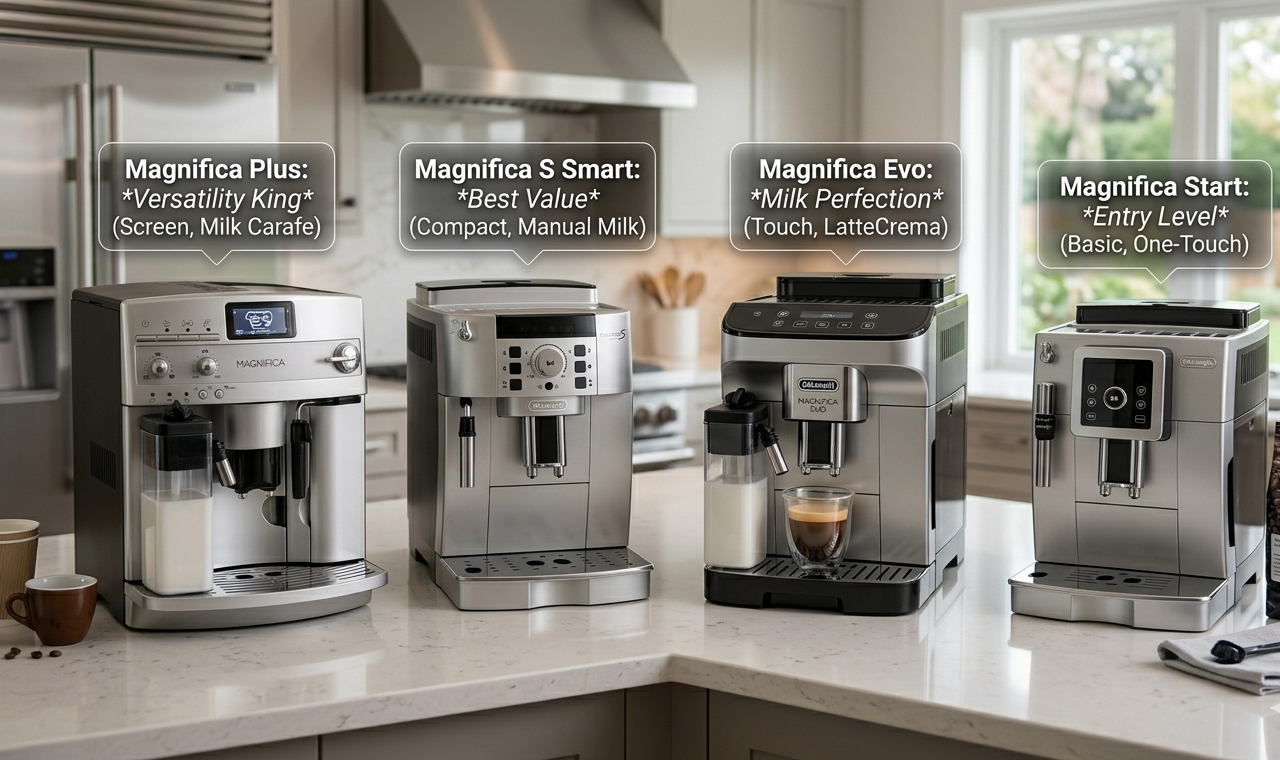
One thing worth flagging here: DeLonghi now sells four different Magnificas — Start, Evo, Evo Plus, and Evo Next — plus the premium Rivelia that most people cross-shop against them. Picking between those is its own rabbit hole, so I broke the whole family down model by model in which DeLonghi Magnifica is right for you. Below I’ll keep it to where the Magnifica sits in the wider DeLonghi range.
Magnifica Start vs Evo
DeLonghi now makes four Magnificas — Start, Evo, Evo Plus, Evo Next — plus the Rivelia people cross-shop against them. Choosing between those is its own decision, and I broke the whole family down model by model in which DeLonghi Magnifica is right for you. Here I’ll keep it to where the Magnifica sits in DeLonghi’s wider range.
Dinamica
Quick disclaimer: I don’t own one. What I can tell you is structural.
The Dinamica sits a tier above the Magnifica and the upgrade is programmability. More drink presets, finer adjustment of strength and length, some models add a cold/over-ice brew function (a “use it twice and forget it” feature for most people, a real draw if you live on iced coffee all summer).
The thing to actually check before buying: the line splits into manual-frother models, where the milk situation is the same as my Magnifica, and the Dinamica Plus versions with the automatic LatteCrema carafe. That milk distinction matters more than the model name, so verify it on the exact SKU.
My read from outside: worth it if you love the idea of saving your exact drink and hitting one button forever. If you don’t care about presets, you’re paying for convenience you won’t use, and the espresso is the same as a Magnifica’s.
Eletta: the milk machine
The Eletta exists for one reason, and it’s milk. It ships with the LatteCrema system, a removable carafe you keep in the fridge that froths and pours steamed milk straight into the cup. Lattes, cappuccinos, flat whites, one touch, hands off.
And here’s where I have to confess my most expensive coffee miscalculation. When I was first shopping, I almost bought into this tier, because I imagined myself making two or three milk drinks a day. The fantasy version of me had a whole latte routine. The real me drinks mostly straight espresso and makes one cappuccino on a slow weekend. I overestimated my milk usage badly, and I suspect a good chunk of the people about to buy an Eletta are doing the same thing right now.
So before you spend on LatteCrema, be honest about the next two weeks of your actual life, not your aspirational one. If you genuinely make multiple milk drinks daily, or several people in your house do, the Eletta earns its keep (current Eletta price on Amazon). My neighbor’s household runs four or five cappuccinos every morning, and for them hand-frothing would be miserable; a carafe that just does it is worth real money there. But if you make a milk drink “sometimes,” a Magnifica’s manual wand will annoy you for a week and then become muscle memory. Also nobody mentions that the carafe needs its own daily cleaning routine. Small tax, but it’s every day.
One more time, because the price gap tempts people into bad logic: the espresso out of an Eletta is not better than the espresso out of a Magnifica. You’re buying the milk robot. Which is a fine thing to buy, as long as you’re buying it for a reason that’s actually true for you.
Rivelia
Same caveat as the Dinamica, I haven’t lived with a Rivelia, so this is researched rather than worn in. But it gets a section because it’s the most genuinely new thing DeLonghi has done to a home machine in a while.
The headline is the Bean Switch system. Instead of one fixed hopper, the Rivelia takes two removable bean containers and you swap the whole canister to change beans. Decaf in the evening, a different roast on the weekend, no purging, no mess. Not a brand-new idea in the wider market, but well executed, and if you keep more than one bean around it solves a real daily annoyance. Around that sits a premium compact package: automatic LatteCrema milk, a color touchscreen, around 18 presets, up to four user profiles, and a Bean Adapt feature that suggests grind and dose for whatever you load. The footprint is genuinely small for a machine doing this much.
Where I’d cool the enthusiasm, based on what owners report: it’s heavy, and it really wants whole beans — the pre-ground bypass is apparently fiddly to the point of not being worth using, which is the opposite of how my Magnifica’s chute behaves. The cold-foam carafe is a separate paid add-on, so the “it does iced drinks too” pitch costs extra to fully unlock. And it runs roughly $1,200, which is a lot of money for bean-switching convenience and a touchscreen.
It’s genuinely great if you rotate between beans and want everything in a small footprint. But if a Magnifica would already do the job for you — and for most people it would — the Rivelia probably isn’t worth the jump.
So which DeLonghi is best for you?
Best DeLonghi for beginners
A Magnifica, the Start especially. It removes the parts of espresso that frustrate beginners (grinding, dosing, tamping) and gives you a real shot from day one. The manual wand is the only learning curve and it’s a gentle one. I’ve started several friends on this machine; most never felt the need for anything more. Full walkthrough in the Start review.
Best DeLonghi for milk drinks
An Eletta, or a Dinamica Plus with LatteCrema. But re-read my confession above first, and buy for the milk volume you actually have. If you want better milk handling without committing to a full carafe, the Evo sits in between; worth seeing how the Evo handles milk before jumping a tier.
Best DeLonghi for value
The Magnifica, no real hesitation here. It delivers the core thing, espresso from whole beans, automated, at the lowest point in the bean-to-cup range, and the shot quality isn’t a compromise versus pricier machines. Everything above it is features, not coffee.
Best DeLonghi for a small kitchen
Depends whether you need a grinder built in. If not, the slim Dedica (about 15 cm wide) is purpose-built for narrow counters, but remember it’s a manual portafilter machine and it still needs pre-ground coffee or a separate grinder, so the machine is narrow but the full setup may not be. Among the bean-to-cup machines the Magnifica is the most compact-leaning, the Eletta grows as the milk system grows, and the Rivelia is the interesting middle case: premium features packed into a deliberately small footprint.
Decision criteria at a glance
| Magnifica | Dinamica | Eletta | Rivelia | |
|---|---|---|---|---|
| Price tier | Entry | Mid | Upper-mid | Premium |
| Milk | Manual wand (most) | Manual or auto (Plus) | Auto LatteCrema | Auto LatteCrema (cold foam costs extra) |
| Built-in grinder | Yes | Yes | Yes | Yes, 2 swappable hoppers + Bean Adapt |
| Drink presets | Few | More | Many | ~18 + saved profiles |
| App control | No | Some models | Some models | Touchscreen + profiles |
| Counter footprint | Smallest in range | Medium | Larger | Compact for its class |
| Best for | Value, beginners, espresso-first | Presets + programmability | Frequent milk drinks | Bean-switchers, premium-compact |
When you strip everything else away, the milk situation is really what you’re deciding. Manual wand versus LatteCrema carafe is what you’re genuinely choosing between across the whole range; everything else varies within a single line, so confirm specifics on the exact model you’re about to buy.
What I’d actually buy
After two years, my unhedged answer: a Magnifica, with the saved money going into better beans, proper descaling, maybe a water filter. For the way I drink coffee, a pricier machine wouldn’t put better espresso in my cup. The differences up the range are milk automation and screens, and I’ve learned I don’t need either. My cappuccino takes under a minute with the manual wand, and honestly the small ritual is part of why I like the machine.
The one situation where I’d spend more without blinking: a household making several milk drinks a day, every day. There I’d go straight to the Eletta for the LatteCrema carafe, because hand-frothing at volume stops being charming very fast.
And if you read pre-infusion and channeling earlier and felt curious rather than tired, don’t buy any of the automatics. Get La Specialista and learn espresso properly. Different relationship with coffee, and a happier one for that particular type of person.
Mostly, though, what I find myself doing is talking people out of buying up the range. If you’re a solo drinker or a couple who mostly want good espresso, paying for milk automation and a stack of presets is a quiet way to overspend on coffee you won’t taste.
FAQ
Which DeLonghi espresso machine is the best?
There isn’t a single best one; it depends on how you drink coffee. For most people the Magnifica is the best balance of price and espresso quality, since the brewing is essentially the same across the super-automatic range. You climb to the Dinamica, Eletta, or Rivelia for milk automation, presets, and conveniences like swappable beans, not for better espresso. After two years with a Magnifica, it’s still the one I recommend first.
What is the difference between DeLonghi coffee machines?
The biggest split is manual versus super-automatic. Manual machines (Stilosa, Dedica, La Specialista) use a portafilter, and you grind, tamp, and froth yourself. Super-automatics (Magnifica, Dinamica, Eletta, Rivelia) do all of that internally at one touch. Within the super-automatic range, the differences are the milk system (manual wand vs automatic LatteCrema carafe), the number of presets, and app control. Espresso quality is not one of the differences.
What are the different types of DeLonghi espresso machines?
Two main types. Manual / portafilter machines: Stilosa (basic), Dedica (slim), La Specialista (with grinder and real shot control). Super-automatic / bean-to-cup machines: Magnifica (entry), Dinamica (more presets), Eletta (milk-focused), Rivelia (newer premium-compact with swappable bean containers). The portafilter is the dividing line: manual machines have one, super-automatics don’t.
Which DeLonghi is best for beginners?
The Magnifica Start. No grinding, no dosing, no tamping, a real shot from day one, and the only thing to actually learn is the manual milk wand. Give it a week. Every friend I’ve started on this machine is still on it.
Is DeLonghi a good espresso machine brand?
For home bean-to-cup machines, yes, one of the most established choices, with consistent espresso across the range. The honest caveat: these are convenience-first machines, not enthusiast setups. If you want to dial in shots like a craft, you’ll be happier with a manual machine. If you want reliable, hands-off coffee with minimal fuss, DeLonghi is a sensible brand to trust, provided you keep up with descaling and basic maintenance.