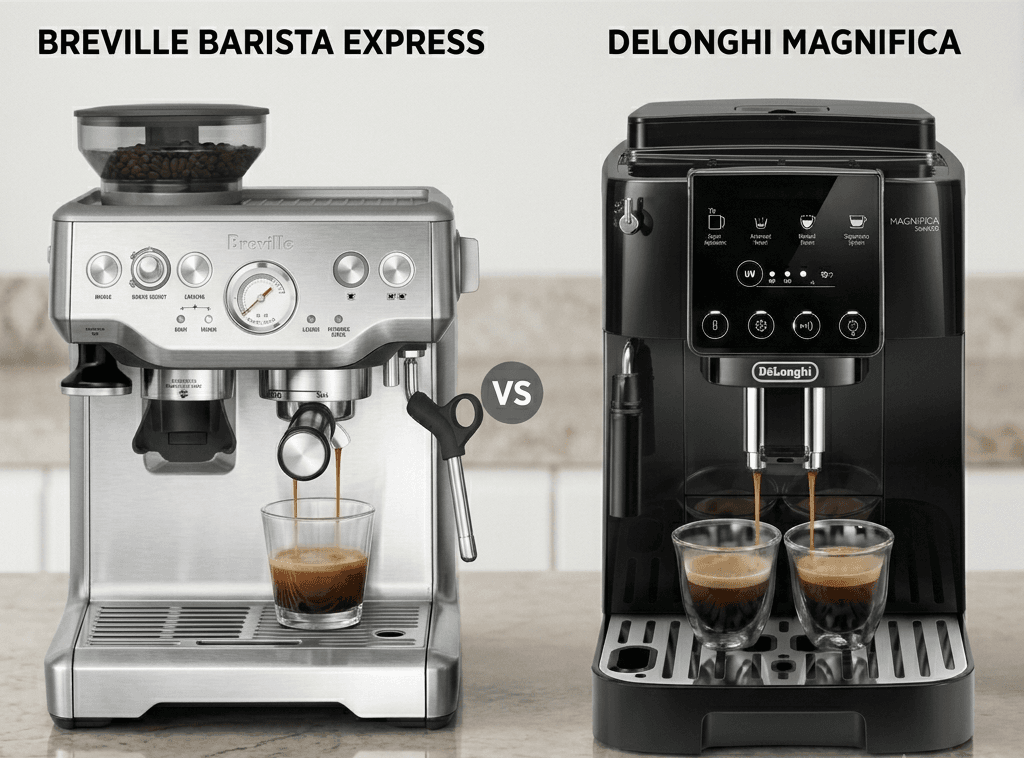
I’ve made espresso both ways. For years my kitchen had a Gaggia Classic on the counter — a semi-automatic, the kind where you grind, dose, tamp, and pull every shot yourself. These days I live with a DeLonghi Magnifica, a super-automatic that does all of that behind a panel while I stand there doing nothing but holding a cup. So when people ask me whether they should buy the Breville Barista Express or a Magnifica, I’m not comparing spec sheets from the outside. I’ve lived on both sides of this exact decision.
One honest note before we start: I haven’t owned the Barista Express specifically. What I know cold is the semi-automatic life as a category — that was my Gaggia for years — plus two years of daily Magnifica. So when I talk about how the Barista Express handles as a machine, the model-specific details come from its specs and from owner reports, and I’ll flag that as I go. The part I can speak to from my own kitchen is the thing this whole choice actually turns on: do you want to make espresso, or do you want to get espresso?
That’s the real question here. Not which machine is “better.” Which kind of morning person you are.
The Short Answer: Which Type of Person Are You
| If you’re someone who… | …you probably want |
|---|---|
| Wants to learn the craft, doesn’t mind 5–10 minutes and a little mess | Breville Barista Express (semi-automatic) |
| Wants a good cup in 90 seconds with no fuss, every single day | DeLonghi Magnifica (super-automatic) |
| Cares about hitting the best possible shot and enjoys the process | Barista Express |
| Has a chaotic morning, multiple drinkers, no patience for variables | Magnifica |
| Wants latte-art-level microfoam and is willing to practice | Barista Express |
| Wants foam that’s fine and quick, not perfect | Magnifica |
If you already see yourself in one column, you can stop reading and go with your gut — it’s usually right. If you’re torn, the rest of this is what each choice actually costs you.
I’ve Owned Both Kinds — Here’s What That Choice Actually Feels Like
I want to tell you about the morning I decided to switch, because it explains this whole comparison better than any feature list.
It wasn’t one bad shot. It was one Monday. I woke up late, weighed my beans, ground them, tamped, locked in the portafilter, pulled a shot — and it channeled. So I adjusted the grind, pulled again, got something decent, and by the time I had a single coffee in my hand I’d burned almost fifteen minutes. I looked at the sink, full of spent grounds, and thought: I just want coffee before work. I don’t want another hobby.
That sentence is the entire decision. The Gaggia was a cooking project. The Magnifica is an appliance. Going from one to the other, I gained back time and predictability, and I lost control and a little bit of ritual. Both of those things are real, and neither machine lets you have both.
Here’s the trade-off in numbers, because it’s the most useful way I’ve found to describe it. My Magnifica gives me an 8-out-of-10 shot almost every single day. Reliable, good, boring in the best way. My Gaggia, when everything lined up — grind dialed in, dose right, tamp even — could pull a 10. Noticeably better than anything my super-automatic makes. But on an off morning, when one variable drifted, that same machine handed me a frustrating 5. The semi-automatic gives you a higher ceiling and a lower floor. The super-automatic flattens both into “consistently fine.”
So the question isn’t “which makes better espresso.” It’s: do you want the occasional 10 with the risk of a 5, or a guaranteed 8 forever? That’s the Barista Express vs the Magnifica, in one line.
Breville Barista Express — What You’re Signing Up For
(I know semi-automatics as a class from my Gaggia years. The specifics of this exact machine below come from its specs and owner reports, not my own counter — I’ll keep that honest.)
The Barista Express is a semi-automatic with a grinder bolted on. That combination is the whole appeal: beans go in the top, you grind straight into the portafilter, and from there it’s all you.
What you’re operating:
- An integrated conical burr grinder with 16 grind settings and dose control. This is the heart of the machine. Espresso lives and dies by grind — my Gaggia didn’t have a built-in one, so I spent two years with a separate grinder eating counter space, and I’d have killed for this layout.
- A 54mm portafilter you fill, tamp, and lock in by hand. (Worth knowing: enthusiast-grade machines usually run 58mm. 54mm is perfectly capable — my Gaggia was 58mm and honestly I never once tasted the difference, so don’t let anyone tell you 54 is the “pro” cutoff.)
- A manual steam wand for milk. You texture it yourself. This is where microfoam and latte art become possible — and where the learning curve bites. One upkeep note specific to the Breville: a semi-auto needs daily portafilter and wand cleaning, plus periodic descaling — and descaling a Breville has its own quirks worth knowing before you buy.
- PID temperature control and low-pressure pre-infusion. The PID keeps brew temperature stable shot to shot; pre-infusion gently wets the puck before full pressure, which helps even out extraction. These are genuinely useful and not a given at this price.
- A single ThermoCoil heating system, which means you can’t pull a shot and steam milk at the exact same moment — there’s a short switch-over. For one or two drinks at a time, you won’t notice. For a dinner party, you will.
It heats up fast — ready in well under a minute — though from experience with semi-autos I’d still give it a few minutes to come fully up to temperature before the first real shot, or you’ll get a sour, under-extracted cup.
“Dialing in” is the phrase you’ll live with. It means adjusting grind, dose, and tamp until the shot runs in roughly the right time, and then re-adjusting when your beans age or the weather shifts. When it clicks, it’s the best coffee you’ll make at home. When it doesn’t, it’s a Monday morning like mine.
This machine is for you if you want to learn, you find the process satisfying rather than annoying, and a little mess and time are a fair price for control.
If you’ve decided you want a hands-on machine, the Breville isn’t the only starter worth weighing — I put it head-to-head with the other classic first machine in Breville Barista Express vs Gaggia Classic.
And if you’re still weighing whether the Barista Express deserves your money at all — before even comparing it to anything — I wrote a separate honest look at whether the Barista Express is worth it, including the alternative setups people recommend instead.
DeLonghi Magnifica — What Hands-Off Actually Buys You
This one I can talk about from my own kitchen.
The Magnifica is a super-automatic — bean-to-cup. You fill the hopper, press a button, and it grinds, doses, tamps internally, and extracts, all behind the panel. I don’t touch a portafilter. I don’t tamp. I don’t dial anything in. On a normal morning I’m holding coffee about ninety seconds after I walked into the kitchen.
What that hands-off design actually gives you:
- Predictability. It’s the 8/10 every day I mentioned. The machine removes the variables that used to ruin my Mondays, because I’m no longer the one controlling them.
- A built-in conical burr grinder with around 13 settings. You adjust strength and cup size, but the precision-chasing of a semi-auto isn’t on the table — and that’s the point. I set mine to grind 3 two years ago and have touched it maybe twice since.
- A manual panarello milk frother. This is the part people misunderstand. “Super-automatic” doesn’t mean automatic milk on the entry Magnifica — you still froth by hand, but a panarello injects air for you, so it’s far more forgiving than a bare steam wand. Easy, fast, a little bubbly. More on that below.
- A bypass chute for pre-ground coffee, so you can run decaf for one guest without emptying the hopper. I use mine for my mother-in-law’s decaf when she visits — drop in a scoop, press the button, nobody has to relearn anything.
- A removable brew unit you rinse under the tap, plus auto-rinse cycles and descale prompts. Maintenance is simpler than people expect.
What you give up is straightforward: control over the cup. I can’t make my Magnifica pull a 10. The machine optimizes for repeatable, not exceptional, and there’s no setting that changes that. Some mornings I miss the ceiling. Most mornings I’m grateful I don’t have to think.
Get the Magnifica if you’ve already decided coffee doesn’t get to be a project. You want it good, you want it the same every day, and you’d take a guaranteed 8 over the gamble of a 10 without much hesitation — because the gamble is exactly the thing you’re trying to keep out of your morning. If you’ve landed on a Magnifica but aren’t sure which one, I broke the whole Magnifica lineup down here — Start, Evo, Evo Next and Rivelia.
The Real Differences That Decide It
Here’s the side-by-side, and I’ve tried to be honest about which way each line cuts.
| Breville Barista Express (semi) | DeLonghi Magnifica (super) | |
|---|---|---|
| Time per cup | ~5 min (more while learning) | ~90 seconds |
| Learning curve | Real. Weeks to get consistent | Almost none |
| Taste ceiling | Higher — with skill | Lower, but you’ll never crash |
| Taste floor | Lower — a bad variable ruins it | High and stable |
| Milk | Manual steam wand (microfoam possible) | Manual panarello (easy, airier) |
| Kitchen mess | Grounds, tamping, wiping the wand | Minimal — it’s mostly internal |
| Maintenance | Daily wand + portafilter cleaning | Auto-rinse, removable brew unit, descaling |
| Counter footprint | Larger, heavier, steel | More compact, lighter |
| Simultaneous brew + steam | No (single boiler) | N/A — you press a button |
What the table really says: the Barista Express asks more of you at every single line, and pays you back in potential. The Magnifica asks almost nothing and pays you back in reliability. There’s no line where one machine is simply “better” — there’s only which trade you’d rather make.
If you’re cross-shopping these two, you’re really deciding how much of your attention espresso gets to have.
Milk, Grinding, and the Daily Ritual
I spent four years pulling shots on a commercial La Marzocco before I ever owned a home machine, so I have opinions about milk — and this is one of the bigger real-world gaps between these two.
Milk. The Barista Express gives you a proper steam wand. That means you control the stretch and the texture, and with practice you can get the glossy microfoam that pours latte art and actually integrates into the espresso. It also means your first few weeks of milk will be loud, bubbly, and a little disappointing. The Magnifica’s panarello is the opposite bargain: it pulls air in for you, so it’s quick and hard to fully mess up, but the foam comes out airier and stiffer. Fine for a flat white you drink, not for a pour you photograph. I gave up on latte art the week I switched and haven’t missed it at 7am.
Grinding. On a semi-auto, the grinder is the machine — it’s where 80% of your shot quality is decided, and the Barista Express having a good dedicated grinder built in is genuinely the reason people recommend it. The flip side: you’re the one turning the dial when the shot runs wrong. The Magnifica grinds for you, every time, the same way. You trade the precision for never having to think about it. I felt that trade most on the Gaggia, where a setting that was perfect on Sunday could run too fast by Wednesday because the beans had aged — none of it the machine’s fault, just the nature of doing it yourself.
The ritual. This is the soft part that people underestimate until they live with it. A semi-auto expects you to show up. Some people find that grounding and pleasant — five quiet minutes of making something with their hands before the day starts. Others find it’s just one more task. I went from loving the ritual to resenting it, and only you know which way you’ll land. A super-auto removes the ritual entirely. Whether that’s a relief or a loss is the most personal thing in this whole comparison — and if you want the full breakdown of how semi-automatic and super-automatic machines differ beyond just these two models, that’s a deeper rabbit hole worth its own read.
Price and What You Actually Get
The Barista Express is the more expensive machine here — usually meaningfully so. As a rule, expect to pay something like 30–50% more for the Breville than for a Magnifica.
But more expensive isn’t the same as better, and it’s worth being clear about what the premium actually buys:
- With the Barista Express, you’re paying for a quality dedicated grinder, PID and pre-infusion, a heavier steel build, and a real steam wand. You’re paying for control and ceiling.
- With the Magnifica, you’re paying for the machine to handle everything so you don’t. You’re paying for not thinking about it.
So the Breville is worth the extra money for control, not for guaranteed better coffee in your specific hands. If you’re not going to use the control — if you’ll press the same button forever — you’d be spending more to get a machine that asks more of you. That’s the one mismatch I’d actively steer people away from.
So Which Should You Buy?
Let me break it down by who you actually are, because that’s the only honest way to answer this.
Buy the Barista Express if you’re curious about the craft and you mean it. You like the idea of dialing in a shot, you want milk you can pour designs into eventually, and you genuinely don’t mind that some mornings will be slower or imperfect. This is the machine that gets better the more you put into it.
Buy the Magnifica if your mornings are non-negotiable. You want a good, consistent cup with no ceremony, possibly for more than one person, possibly while doing three other things. You’d rather have a guaranteed 8 than chase a 10. This was my switch, and I’ve never regretted it for the kind of life I actually have.
Who I’d talk out of each: I’d talk a busy, impatient person out of the Barista Express, even if they like the idea of being a coffee person — the gap between the fantasy and a real Monday is where machines end up in the cupboard. And I’d talk a true tinkerer out of the Magnifica — they’ll hit its ceiling in a month and spend the next year wishing they could adjust something the machine won’t let them touch.
If you want to know where I landed: my first machine was a semi-auto, it taught me everything I’d been doing wrong with grind and tamp, and I’m grateful for it. But the machine that’s on my counter today is the super-automatic. Make of that what you will — it says more about my mornings than about which machine is “best.”
FAQ
Are DeLonghi and Breville the same company?
No — they’re separate companies. DeLonghi is Italian; Breville is Australian (and sells under the name Sage in the UK and parts of Europe). They compete directly in home espresso but aren’t related.
Is the Breville Barista Express hard to use for beginners?
It has a real learning curve, but it’s a forgiving place to learn. From my own semi-automatic years, the hard part isn’t any single step — it’s getting consistent, because grind, dose, and tamp all interact. Expect a few weeks before your shots are reliable. If you find that prospect fun, you’ll love it. If it sounds like a chore, that’s your answer.
Which makes better espresso, the Barista Express or the Magnifica?
Straight answer: the semi-automatic has the higher ceiling, the super-automatic has the higher floor. My Magnifica gives me a solid 8/10 shot almost every day. A well-dialed semi-auto can pull a 10 — but it can also hand you a 5 on an off morning. “Better” depends on whether you want peak quality or guaranteed consistency.
Do you have to grind and tamp with the Barista Express?
Yes. It has a built-in grinder, but you still dose into the portafilter, tamp by hand, and lock it in yourself — that’s what makes it semi-automatic. The Magnifica does all of that internally. If grinding and tamping sounds like the fun part, get the Breville. If it sounds like work, get the DeLonghi.
Is a super-automatic worth it over a semi-automatic?
It’s worth it if you value time and consistency over control and ceiling — which describes a lot of people, including me, most mornings. It’s not worth it if you want to actively shape the shot. I broke the full semi-vs-super comparison down separately if you want the deeper version.