TL;DR: Choosing between a super automatic vs semi automatic espresso machine comes down to one question: do you want espresso to be a hobby or a piece of household infrastructure? A semi-auto gives you control, a higher quality ceiling, and a daily workflow you have to actually perform. A super-auto gives you consistency, convenience, and a lower ceiling — one button, no skill required. The real question isn’t which makes better coffee. It’s whether you want espresso to be a hobby or a piece of household infrastructure. I spent about a decade on a semi-auto before switching to a super-auto, and the honest answer is that both were right — just for different versions of me.
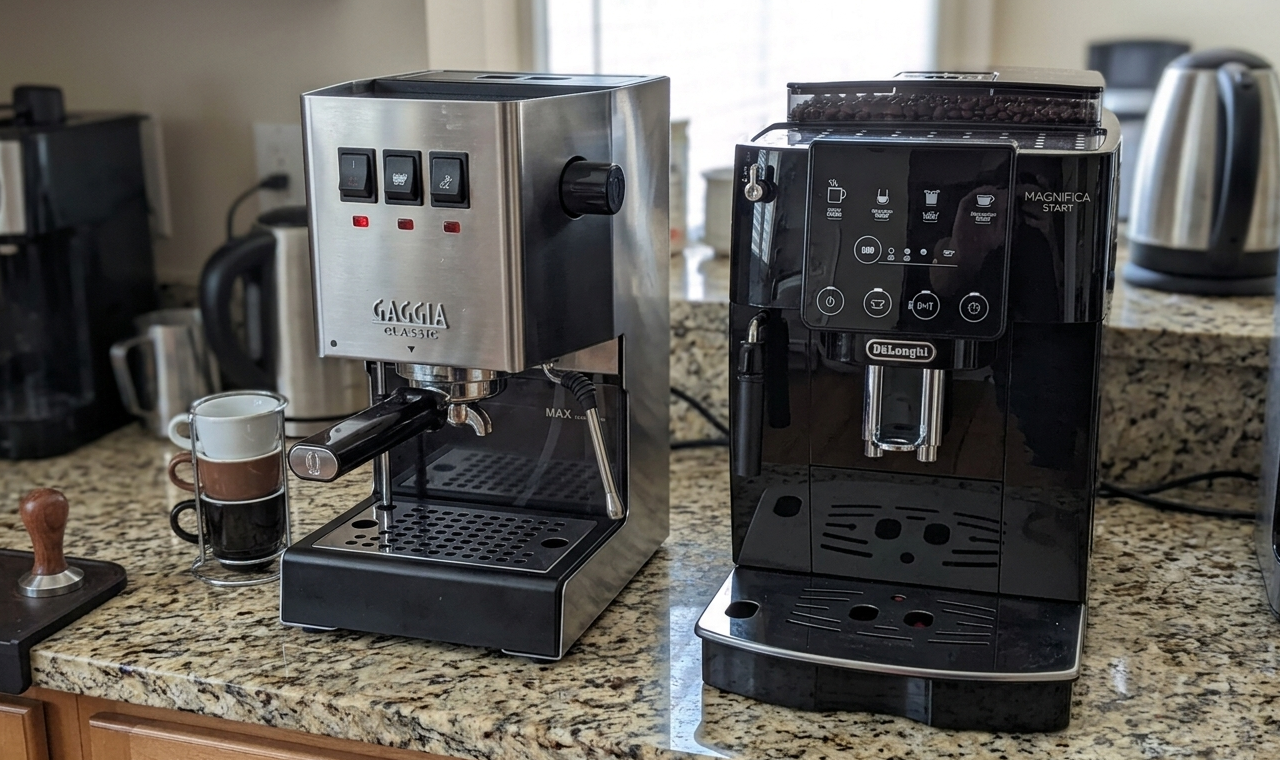
I lived with a semi-automatic espresso machine — an old Gaggia Classic, the heavy little stainless steel one from before the Pro line — for about nine or ten years. Then I switched to a DeLonghi Magnifica Start, a super-automatic, and I’ve been on that for the last two.
So this isn’t a spec-sheet comparison written from the outside. It’s two different lives with coffee, both of which I actually lived. I know what it feels like to pull a beautiful shot by hand on a Tuesday and feel like I made something. I also know what it feels like, years later, to not want to negotiate with an espresso machine before work.
This guide is about that difference. Not “which one is better” — that question has no answer — but which one fits the person you actually are in the morning.
The Core Difference, In One Sentence
The line between the two categories is the portafilter. (I go deeper on the whole category in the super automatic espresso machine guide, if you want the full breakdown.)
With a semi-automatic, you grind beans, dose them into a portafilter, tamp, lock it into the group head, and start the shot. You’re the barista. The machine handles pressure and temperature; you handle everything else.
With a super-automatic, all of that happens inside a sealed brew unit you never touch. You press a button. The machine grinds, doses, tamps, brews, and ejects the puck on its own.
Everything else — the cost math, the morning routine, the quality of the cup, the amount of mental energy involved — flows from that one structural fact.
What Living With a Semi-Automatic Is Actually Like
Here’s the thing nobody tells you when you buy your first semi-auto: the machine is only half the equation. The grinder is the other half, and arguably the more important one.
I learned this the hard way. I started my Gaggia with a cheap burr grinder, and the shots were a lottery — what a friend of mine once called brown anxiety water. One would pour like water, the next would choke the machine completely, and I had no idea why. It wasn’t until I switched to a Baratza Sette 30 that the Gaggia started behaving predictably. Same machine, same beans, completely different result — because the grinder finally produced a consistent grind. If you’re pricing a semi-auto and not budgeting for a real grinder, you’re not pricing a working setup.
Once you’ve settled on semi-automatic, the next question is which one to start on — the two I’d actually compare are in Breville Barista Express vs Gaggia Classic.
The morning workflow
On the Gaggia, from flipping the switch to the first sip was usually 12 to 15 minutes. If I was making a cappuccino, closer to 18 or 20. That time breaks down into a sequence you perform every single morning: warm up the machine, warm up the portafilter, grind, distribute the grounds evenly, tamp, wipe the basket rim, flush the group head, pull the shot, then switch to steam, wait for the boiler, purge the wand, steam the milk, wipe the wand down. And backflush later.
The first few years, this felt like a ritual. There’s a real satisfaction in it — when a shot comes out right, with the grind dialed in and the distribution even, there’s a genuine “yes, I made this” feeling. A super-auto never gives you that. That feeling is the whole reason semi-autos exist.
But here’s what happens over nine years: you stop romanticizing the workflow. The exact same sequence that felt like craft on a Saturday morning feels like friction at 7:10 on a Tuesday. The romance has a half-life.
Bad shots are part of the deal
On a semi-auto, bad shots aren’t rare. Not every day, but often enough to be annoying. The usual culprits, in my experience: the grind drifted slightly, the beans were getting old, the humidity changed, the tamp was uneven, or the machine wasn’t quite warmed up. Any one of these throws the shot off, and on a machine without temperature stabilization, you get temperature drift on top of everything else.
New beans are always a small project. Sometimes I’d dial them in within 2 or 3 shots. Sometimes it took 100 to 150 grams of coffee before things settled — what I came to think of as the espresso tuition fee. Every bag charges it. Light roast charged the most, because it’s the least forgiving and my machine had no PID to hold temperature steady.
On tamping, by the way: I went from eyeballing it, to a proper heavy tamper, to a calibrated tamper. The calibrated one helped with consistency, but it wasn’t the magic fix people online make it out to be. What actually mattered more was distributing the grounds evenly before tamping. Pressure was never really the variable. Distribution was.
What I never modded, and why it eventually wore on me
I never did the OPV mod to bring pressure down to 9 bars. Lived with stock pressure the whole time, despite years of people online insisting espresso is “technically illegal” without it. I also never installed a PID. And honestly, that’s one of the reasons I eventually got tired of the machine — temperature surfing, timing your shot to the boiler’s heating cycle, gets old. It’s a skill, and I had it, and one day I just didn’t want to use it before work anymore.
Maintenance is a relationship
Steaming milk on the Gaggia was genuinely good — much better than the panarello on my Magnifica. You could pull real microfoam, the glossy paint-like texture, but it took attention and practice. Early on I made a lot of bubbly cappuccino-foam before I got the hang of it. And steaming takes longer than people expect: switch to steam mode, wait for the boiler, purge the water out of the wand, then texture the milk. Three to five minutes for one drink, counting prep and cleanup.
Then there’s the upkeep. I backflushed roughly every week or two — the smell of Cafiza still instantly takes me back to those years. I replaced the group gasket several times; it’s almost a consumable on a Gaggia. Near the end, the steam wand started weeping a little. The solenoid valve got temperamental once — the machine would dump pressure strangely after a shot, and the puck would come out wetter than usual.
By the time I switched, the Gaggia was still alive. It hadn’t died. It just felt like a machine that still worked but had started asking for a relationship — and I was ready to stop being in one.
What Living With a Super-Automatic Is Actually Like
The switch was not what I expected.
I assumed I’d miss the control so much that I’d resent the super-auto. What actually happened was stranger: the coffee got a little worse, and my mornings got a lot better, and it took me a while to admit the second thing mattered more than the first.
The daily experience is exactly what the marketing promises, for once. Press a button. Sixty seconds. Coffee. No warmup ritual, no dialing in, no temperature surfing, no wiping down a wand. The machine does its auto-rinse, grinds, brews, drops the puck into the internal container, and you walk away with a cup. On a weekday morning, this is a different category of experience from the Gaggia. It’s not better coffee. It’s a better Tuesday.
The trade-off is real, though, and I won’t pretend otherwise. Straight espresso from a super-auto is softer — less density, lower temperature in the cup, less of the bite that a well-pulled Gaggia shot had. If you drink a lot of straight espresso and you care about that intensity, this is the thing you’ll notice and possibly mourn. I covered why this happens, and which beans work best, in the category guide.
What I didn’t anticipate was how much the super-auto would reduce the mess. With the Gaggia, my counter usually looked like a small coffee station after a shift — grounds, a damp towel, the knock box, milk splatter. With the Magnifica, it’s a cup and a puck container. That sounds trivial. It is not trivial when you do it every day.
Maintenance doesn’t disappear — it just changes shape. Instead of backflushing and replacing gaskets, you rinse the brew unit every week or two and descale on schedule. It’s not less maintenance, exactly. It’s more routine and less skill-based. Different relationship, lower emotional cost.
The honest one-line summary of the switch: the super-auto turned out to be much less magical than I expected, but much more useful.
Head to Head: Where Each One Wins
Stripping it down to the axes that actually matter:
Coffee quality ceiling — semi-auto wins. A well-dialed semi-auto with a good grinder in practiced hands beats any super-auto on peak shot quality. Density, temperature, crema, the whole thing. For straight espresso, this is the clearest win for the semi-auto.
Consistency — super-auto wins. The semi-auto’s ceiling is higher but its floor is much lower. A super-auto gives you the same decent cup every single time. The semi gives you a great cup, or a sour one, depending on the day and your attention.
Morning speed — super-auto wins, decisively. Sixty seconds versus twelve to twenty minutes. On a workday this is the whole ballgame for a lot of people.
Light roast — semi-auto wins. Light roast needs grind precision, temperature stability, and pre-infusion control that most super-autos simply don’t have. If you’re a light-roast drinker, this matters a lot.
Milk texture — split. For quality of foam, a semi-auto steam wand in skilled hands wins — you can pull true microfoam. For convenience, a super-auto’s automated milk system wins by a mile. Depends whether you want latte art or a latte before the bus. (If you’re weighing a manual frother against an automated one within the super-auto world, the Magnifica Start vs Evo comparison covers exactly that trade-off.)
Learning curve — super-auto wins if you value flatness. Semi-auto has a steep curve and a real tuition fee in wasted coffee. Super-auto works on day one. Whether that’s a pro or a con depends entirely on whether you want to learn.
Maintenance — neither wins, they differ. Semi: backflushing, gasket replacement, wand cleaning, descaling. Super: brew unit rinsing, descaling, milk system cleaning. Roughly comparable total effort, different character — the semi’s is more hands-on and skill-adjacent, the super’s is more routine.
Kitchen mess — super-auto wins. Sealed system, internal puck container, no loose grounds. The counter stays clean.
Mental energy — super-auto wins. This is the one that doesn’t show up on spec sheets and ends up mattering most. A super-auto asks nothing of you before you’ve had coffee. A semi-auto asks for decisions and skill at the exact moment you have the least of both.
The Cost Comparison Nobody Makes Correctly
This is where most comparisons mislead people, because they compare machine price to machine price and stop there.
A semi-auto’s sticker price is not its real price, because a semi-auto without a capable grinder is not really a working espresso setup. So the honest math is machine plus grinder.
A Gaggia Classic Pro typically sits around $450, and a Breville Bambino Plus lands in a similar range. A grinder good enough to make either worth owning — a Baratza or equivalent — usually adds at least $150 to $300. So a real entry-level semi-auto setup tends to start around $600 to $750, and that’s the floor, not the comfortable middle.
A super-auto bundles the grinder inside. A DeLonghi Magnifica Start, frequently in the $400 to $500 range, is a complete, working setup out of the box — grinder, brew unit, milk frother, all of it. There’s no second purchase, no separate counter space for a grinder, no decision about which burr set to buy.
So the super-auto is often cheaper as a complete entry into espresso, not more expensive, which surprises people. Where semi-autos pull ahead on value is at the top: a high-end semi-auto plus a high-end grinder can produce coffee a super-auto at the same total price can’t touch. The value crossover is real, it just happens further up the price curve than people assume.
Who Should Buy a Semi-Automatic
Stay with — or move to — a semi-auto if you’re someone who genuinely enjoys the process, not just the result. Specifically:
- You like dialing in. Weighing beans, adjusting grind, chasing a better shot — if that sounds like fun rather than work, semi-auto.
- You drink light roast. This is close to a dealbreaker for super-autos. Light-roast drinkers want a semi with PID.
- You’re a tinkerer. OPV mods, PID installs, pressure profiling — semi-autos are a platform for that. Super-autos are a sealed appliance.
- You enjoy making coffee, not just drinking it. This is the real test. If the eight minutes is the point, not the obstacle, you want a semi-auto.
And specifically: if you’re already happy with a Gaggia, a Breville Bambino, or a Rancilio Silvia and a good grinder — don’t “upgrade” to a super-auto. You’ll feel the loss of control more than you’ll appreciate the convenience.
Who Should Buy a Super-Automatic
Move to — or start with — a super-auto if coffee is something you want to be reliably good without becoming a project:
- You’re a busy parent or working person. Mornings have no slack in them. A super-auto fits into a morning that’s already full.
- You drink milk drinks daily. Cappuccino or latte every morning, without hand-steaming and wiping a wand each time — this is exactly the super-auto’s sweet spot.
- You’re coming from Nespresso or pods. A super-auto is a clean upgrade in quality without giving up the press-a-button format you’re used to.
- Your coffee routine falls apart under friction. If the effort of a semi-auto means you’d just stop bothering some mornings, a super-auto is the machine you’ll actually use.
The clearest signal of all: if you find yourself thinking “I like good coffee, but I don’t want coffee to become a second job” — that’s a super-auto sentence.
What I’d Tell Someone Choosing Today
If you asked me directly, here’s the honest version.
For the person I am now — working mornings, a kid, limited patience for friction before I’ve had caffeine — the Magnifica Start is the right machine. No question. It made espresso a piece of infrastructure instead of a morning negotiation, and that trade was worth far more to me than the small drop in shot quality.
But for the version of me from years ago — the one who wanted to learn espresso, who found the dialing-in genuinely fun, who’d happily spend a Saturday morning chasing a better shot — a Gaggia Classic Pro or a Breville Bambino Plus plus a good grinder would still be the right call. That person wasn’t wrong. They just wanted a different thing.
That’s the actual decision here, and it has nothing to do with which machine is “better.” Semi-auto makes espresso part of a hobby. Super-auto makes espresso part of the household — infrastructure, like the kettle or the toaster, except it makes a genuinely good cup. Figure out which of those you want coffee to be in your life, and the machine chooses itself.
Frequently Asked Questions
Is a super automatic or semi automatic espresso machine better?
Neither is better in the abstract — they optimize for opposite things. Semi-automatics have a higher quality ceiling and give you full control, but require skill, time, and a separate grinder. Super-automatics give you consistent coffee at the press of a button with a lower ceiling. After living with both for years, my honest take is that the “better” machine is whichever matches how much effort you actually want to put in every morning, not which produces the theoretically best shot.
Do super automatics make worse espresso than semi automatics?
A well-dialed semi-auto in skilled hands does produce a better shot — denser, hotter in the cup, with more intensity. But a super-auto produces a more consistent shot with zero effort. The gap is most noticeable on straight espresso and least noticeable in milk drinks, where the milk masks the difference. For most home drinkers, the super-auto’s coffee is genuinely good; it’s just not peak.
Is a semi automatic worth it if I have to buy a grinder too?
Only if you value the process. A semi-auto without a quality grinder doesn’t work — the grind inconsistency makes good espresso nearly impossible, so the grinder isn’t optional. That pushes the real entry cost of a semi-auto setup to roughly $600–$750, often more than a complete super-auto. If you want the craft, it’s worth it. If you just want good coffee, a super-auto gets you there for less.
Can you steam milk on a super automatic as well as a semi automatic?
Not quite, but it depends on what you mean. A semi-auto steam wand in practiced hands produces better microfoam — the kind you can do latte art with. A super-auto’s automated milk system is far more convenient and produces perfectly good foam for everyday drinks, just with less control over texture. For daily lattes, the super-auto wins on convenience. For café-quality foam, the semi-auto wins on quality.
Which is easier to maintain?
They require comparable total effort but different kinds. Semi-autos need backflushing, periodic gasket replacement, wand cleaning, and descaling. Super-autos need brew unit rinsing, milk system cleaning, and descaling. The semi’s maintenance is more hands-on and skill-adjacent; the super’s is more routine. Neither is meaningfully lower-maintenance overall — they just ask for different things.
Should I switch from a semi automatic to a super automatic?
Only if your relationship with the morning has changed. I switched after about a decade on a Gaggia Classic, and the trigger wasn’t a breakdown — it was fatigue. I no longer wanted to manage espresso before work. If you still enjoy the process, don’t switch; you’ll feel the loss of control. If the process has started feeling like friction rather than ritual, a super-auto might give you back something more valuable than shot quality: your mornings.