TL;DR: A super automatic espresso machine grinds beans, doses, tamps, brews, and (on most models) steams milk — all from a single button. It optimizes consistency and convenience, not peak coffee quality. If you want a reliable cup before work without thinking, it’s the right category. If you love the espresso-making ritual, it’s the wrong one. Prices run roughly $400–$3,000 depending on milk system, build quality, and grinder.
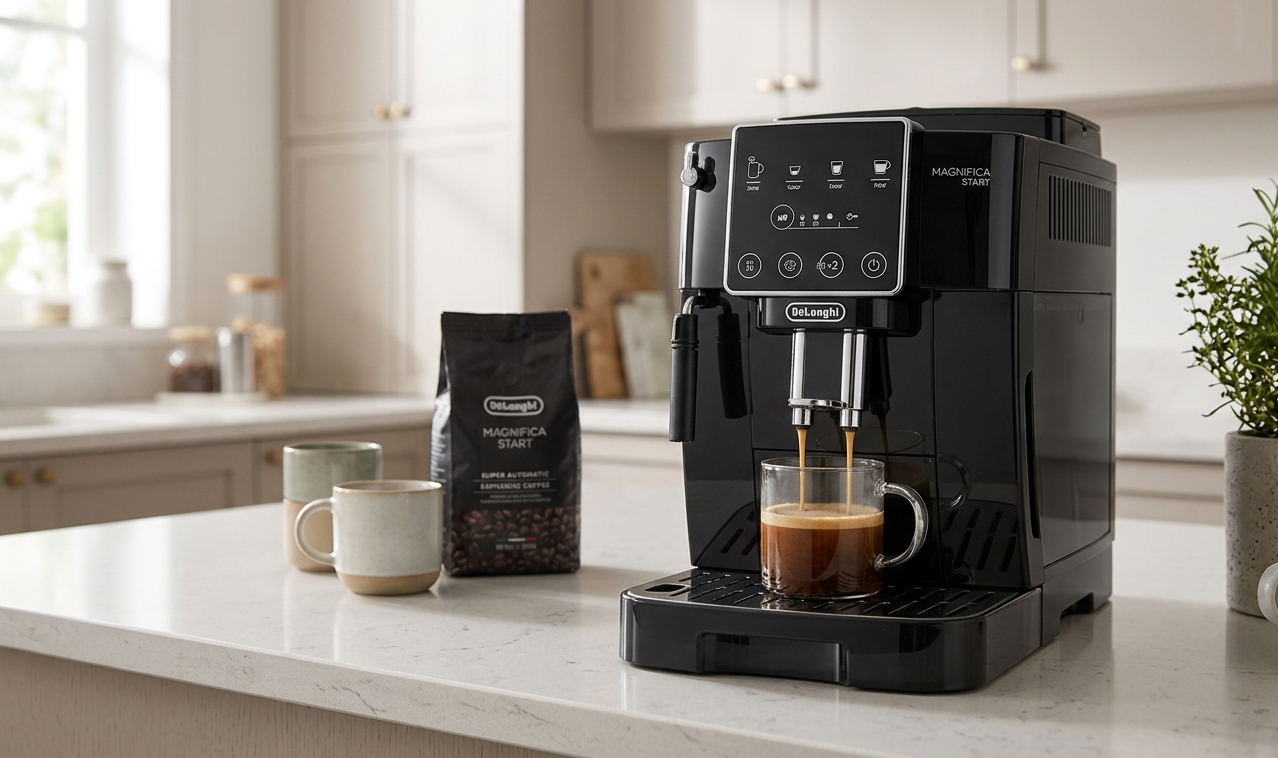
I bought my first super automatic — a DeLonghi Magnifica Start — about two years ago, and I’ve spent that whole time using it as my daily driver. I came into the category from the semi-auto side, having spent about a decade on a used Gaggia Classic before that. So I had opinions about espresso, and I expected to be disappointed by a button-press machine.
I was, a little. And then I wasn’t. And then I figured out what these machines are actually good for.
This guide is the version of that conversation I wish I’d had before buying. What a super automatic actually is. What’s inside one. Who they’re for, who they’re not for, what to look for when shopping, and what you get at each price tier. It tries to be honest about a category I genuinely like but also genuinely have opinions about.
What “Super Automatic” Actually Means
The espresso machine world has three main categories, and “super automatic” sits at one end of the convenience spectrum.
Manual lever machines are the spiritual ancestor — you control pressure yourself by pulling a lever. Niche, fascinating, not what we’re talking about today.
Semi-automatic machines are what most people mean when they say “espresso machine.” You grind beans separately, dose them into a portafilter, tamp, lock the portafilter into the group head, and press a button to start the pump. The machine controls pressure and (usually) temperature. You control everything else. The full super-auto vs semi-auto breakdown covers what that switch actually feels like after living with both.
Super automatic machines do all of that for you in one sealed sequence. You add beans to the hopper, water to the tank, and press a button. The machine grinds, doses, tamps, brews, and ejects the spent puck into an internal container. On models with an automated milk system, it also steams and dispenses milk into the same cup.
The dividing line isn’t really “automation” in the abstract — even semi-autos are heavily automated compared to a lever. The line is whether you ever touch a portafilter. With a super-auto, you don’t. The portafilter is internal, sealed inside what’s called a brew unit, and you only see it when you take it out to rinse.
That single fact — no portafilter access — is what defines the category and creates basically every trade-off in it.
What’s Inside a Super Automatic
Lifting the hood (mentally), here’s what’s actually doing the work in any super-auto, from the cheapest DeLonghi Magnifica up to a $3,000 Jura.
The grinder. Almost always a conical burr grinder, integrated into the body. Adjustable in steps — usually somewhere between 7 and 13 — accessed through a knob inside the bean hopper. The grinder is one of the biggest quality differentiators between price tiers. Cheap super-autos use small, fast-wearing burrs. Expensive ones use larger ceramic or steel burrs that hold their setting longer and grind more consistently.
The brew unit. This is the heart of the machine and the part most people don’t realize exists when they buy. It’s a small mechanical assembly — typically removable through a side door — that receives the dose of ground coffee, compresses it into a puck, infuses it with hot water under pressure, and then ejects the spent puck into the grounds container. On DeLonghi and most Philips/Saeco models, you can pull it out and rinse it under tap water. On Jura, it’s sealed inside the machine and cleaned only through tablet cycles.
The boiler (or thermoblock). Heats water to brewing temperature, typically 88–96 °C at the group head. Cheaper machines use a single thermoblock — fast to heat, slightly less temperature-stable. Higher-end machines use dual boilers (one for coffee, one for steam), which lets you steam milk and brew at the same time.
The pump. Rated at 15 or 19 bars of static pressure, which sounds impressive but is mostly marketing — actual brewing pressure at the puck is 9 bars on any properly running machine. Higher static pressure numbers don’t make better espresso.
The milk system (on models that have one). Two flavors here. The simpler one is a panarello, which is a manual steam wand with a plastic frother sleeve — you hold a pitcher under it and the machine steams your milk. The fancier one is an automated milk system — the LatteCrema on DeLonghi, the LatteGo on Philips, the milk frother carafe on Jura — where you plug in a milk container and the machine dispenses already-frothed milk directly into your cup. The convenience gap between these two is enormous. So is the price gap. The Magnifica Start vs Evo comparison walks through exactly what that gap looks like in daily use.
The thing nobody tells you about automated milk systems: they add another whole maintenance routine. Daily rinsing, weekly cleaning cycles, parts to disassemble. Worth knowing before you buy a milk-system model thinking it’s a one-button machine.
Why Scale and Cleaning Matter More Than You Think
Two years of ownership taught me that the inside of a super-auto is a small, contained ecosystem, and how you treat it shows up in the cup within weeks.
Scale buildup is a constant. Every time the machine heats water, calcium deposits on the heating element. Over months, this insulates the element, drops the brewing temperature, and eventually kills the machine outright. Descaling cycles dissolve the buildup. On a super-auto, this happens every 2–8 weeks depending on water hardness. I’ve covered the whole descaling logic in a separate guide, and the specific DeLonghi Magnifica procedure here, because the topic is bigger than a side note.
The brew unit is the other recurring task. If you don’t pull it out and rinse it every week or two, oils from the coffee build up inside and start affecting the taste. After my first six months of “I’ll get to it eventually,” my espresso started tasting a little muddy. Pulled the brew unit out, found a faint old-coffee smell, rinsed it under warm water — no soap — and the next shot was back to baseline. Now I do it every week or week-and-a-half. Takes two minutes.
Daily, the machine wants you to empty the drip tray, empty the grounds container, and rinse the panarello if you used it. The grounds container fills every 3–4 days on my usage (about three drinks a day). The drip tray fills faster than the grounds container, which surprised me — it took me a while to realize that’s because the machine runs an auto-rinse cycle every time you turn it on and every time you turn it off, and that water has to go somewhere. If I make one espresso and shut the machine down, it feels like half the water I added to the tank went to rinses.
This is the part of super-auto ownership that doesn’t show up in product photos. They’re not maintenance-free machines — they’re maintenance-routinized, which is different.
Who Super-Automatics Are For
The clearest way to think about super-autos is in terms of what you’re optimizing for.
You want consistency over peak quality. This is the big one. A super-auto, dialed in correctly, gives you a consistently decent shot every morning without you doing anything different. A semi-auto in skilled hands can produce something noticeably better — but it can also produce something noticeably worse if you grind wrong, tamp uneven, or didn’t dial in this bag of beans yet. If your floor matters more to you than your ceiling, super-auto is the right category.
You’re making drinks before work. Mornings are when super-autos earn their cost. The grinder runs, the brew cycle runs, the milk frother runs, and 60 seconds later you have a cappuccino without thinking. Time-stressed mornings are where this format genuinely shines.
You drink milk-based drinks more than straight espresso. Lattes, cappuccinos, flat whites — these are forgiving drinks. The milk masks small imperfections in a super-auto shot.
You like the result more than the process. This is the test question. Are you the kind of person who’d happily push a button and walk away, or do you actually enjoy the eight-minute ritual of dosing, tamping, pulling? If it’s the first, super-auto. If it’s the second, you’ll be bored within a month.
You’re moving up from pods. Coming from a Nespresso or Keurig setup, a super-auto is a clean upgrade. Better coffee, fresher grind, no pod waste, lower per-cup cost. The format is recognizable — you still press a button and get coffee — but the quality jump is real.
Who Super-Automatics Are Not For
This is the section most coffee sites skip, which is why people end up with the wrong machine. I’d rather talk you out of one if it’s not the right call.
You love the espresso-making ritual. If part of why you want a home espresso machine is to slow down in the morning, weigh beans, pull a shot, watch the crema form — super-auto kills all of that. The brewing happens inside a sealed unit. You see the cup fill, and that’s it. If that sounds disappointing rather than convenient, you don’t want this category.
You’re already on a semi-auto setup. I’ve never met a person who went from a Gaggia Classic or a Breville Bambino back to a super-auto and was happy about it. The skill you’ve built doesn’t transfer. The control you’re used to isn’t there. The shot is different — softer, less aggressive, lower temperature at the cup — and not in a way most semi-auto users like.
Maintenance friction bothers you. Super-autos want regular attention to small things. Empty the tray. Empty the grounds. Refill the water. Descale. Rinse. Pull the brew unit. It’s not a lot of work, but it’s constant low-grade work. If you’re the kind of person who’d rather have one big task on Saturday than a daily small task, super-autos will wear on you.
You drink mostly light roast. I tried this with my Magnifica and it’s honestly pointless. Light-roast beans need precise grinding, longer pre-infusion, and higher temperature stability than most super-autos can provide. The shot comes out sour and thin no matter what you do with the grind setting. If you’re a light-roast drinker who specifically wants espresso from those beans, you want a semi-auto with PID control, not a super-auto.
You drink very few cups per day. If you’re making one espresso a week, the math doesn’t work. A $700 machine across 50 cups a year is $14 per cup before you account for descaling, beans, and electricity. Pour-over or a moka pot will make you happier for under $30.
What to Look For When Shopping
If you’ve decided super-auto is the right category, the next question is which one. Five things actually matter; the rest is marketing.
Brew unit type. Removable or sealed. Removable (DeLonghi, Philips, Saeco) means you can rinse it yourself, which extends machine life and keeps taste cleaner over years. Sealed (Jura) means cleaning happens through tablet cycles only — more expensive long-term, but less hands-on. There’s no objectively right answer; it’s a preference about how you want to maintain the machine.
Milk system. Three options, in increasing convenience and price. Manual panarello (cheapest, requires you to hold the pitcher and steam). Single-line auto frother (some Philips and DeLonghi mid-tier models — milk goes through a tube into your cup). Full milk carafe (DeLonghi LatteCrema, Jura, Philips LatteGo — separate container, fully automated, multi-drink programs). The honest question is how often you actually make milk drinks. I overestimated my own usage at purchase, then discovered I drink mostly espresso and americanos.
Grinder quality. This shows up in price tier. Entry-level super-autos have small steel burrs that lose sharpness within 1–2 years of heavy use. Mid-tier machines use larger steel or ceramic burrs with longer life. High-end machines (Jura, top DeLonghi) use professional-grade ceramic burrs. If you’re keeping a machine 5+ years, grinder quality matters more than almost anything else.
Programmability. Number of programmable drinks, ability to save user profiles, control over volume / coffee strength / temperature / pre-infusion. Cheaper machines: limited. Mid-tier: enough for most households. High-end: more than most people will ever use.
Boiler setup. Single thermoblock at the low end, dual boiler or thermoblock + steam boiler at the mid and high end. Dual boiler means you can brew and steam at the same time, which mostly matters in a multi-drink household.
What doesn’t matter much: maximum pressure ratings (anything 15+ bar is the same), number of bean grind settings (you’ll find your one setting and never touch it), display size, and app connectivity.
Price Tiers — What You Actually Get
This is the part where most buying guides get vague. Here’s the honest version, in roughly the bands that match real US Amazon pricing.
$400–$600 (entry-level super-auto). DeLonghi Magnifica Start (check price on Amazon), Philips 1200/2200, basic Gaggia Anima. Manual panarello milk frother (not automated). Single thermoblock. Limited programmability. Smaller burrs. Plastic exterior in most spots. Makes good espresso, good americano, mediocre cappuccino unless you’re willing to use the panarello manually. This is what I bought, and I don’t regret it for my usage. But know what you’re getting: it’s the floor of the category, and the price reflects the simplest version of the technology.
$700–$1,000 (mid-range). DeLonghi Magnifica Evo (check price on Amazon), Philips 3200/4400, Saeco PicoBaristo, Gaggia Cadorna. Automated milk system on most models (LatteCrema, LatteGo equivalents). Better display, more programmable drinks, larger water tank, slightly larger burrs. The biggest jump from the entry tier is the milk system — if you make cappuccinos or lattes more than twice a week, this is where the convenience pays off. If you don’t, the upgrade is harder to justify.
$1,200–$1,800 (upper mid-range). DeLonghi PrimaDonna, Philips 5400, Jura ENA 8, Saeco Xelsis. Dual boilers or thermoblock + steam boiler. Higher-quality grinders (ceramic on some models). More refined milk systems with adjustable temperature and texture. User profiles. App control on some. This tier is the sweet spot for people who genuinely care about super-auto coffee and plan to keep the machine 5–7 years.
$2,000–$3,000+ (high-end). Jura Z-line, top DeLonghi Maestosa, DeLonghi La Specialista Maestro. Professional ceramic grinders, sealed brew units (Jura), full programmability, premium build materials, multi-bean hoppers on some. These exist for people who want the no-compromise version of the category, and they deliver — but the gap between this tier and the upper mid-range is smaller than the price suggests. Most of the additional cost is build quality and longevity rather than coffee quality per se.
A practical rule of thumb: under $400, you’re buying a downgrade from a good drip coffee setup. Between $400 and $1,000, you’re getting the core super-auto value proposition. Above $1,500, you’re paying for refinement and longevity rather than for “better coffee.”
Common Myths About Super-Automatics
Three I hear constantly.
“Super-automatics make bad coffee.” Wrong as stated. They make different coffee than a semi-auto setup — softer, less intense, lower temperature at the cup, with less variation. For most people drinking espresso at home, this is fine. Enthusiasts who frame this as “bad” are mostly comparing super-auto to a $3,000 prosumer semi-auto setup with a $1,500 grinder, which is a strange comparison to make.
“They break in two years.” Sometimes — but usually because of skipped descaling. Neglected descaling is one of the fastest ways to kill a super-auto, and serious scale buildup dramatically shortens machine life regardless of brand. A well-maintained DeLonghi or Philips typically runs for years before any major repair. Mine is two years in and feels exactly like it did at month three. Descaling on schedule is the single biggest variable in how long these machines last.
“They’re for people who don’t care about coffee.” This one’s just snobbery in a hat. Super-autos optimize for a specific use case — daily, consistent, milk-friendly drinks with minimal effort. Caring about coffee can absolutely include caring about getting one without 15 minutes of setup. The people I know with super-autos drink more espresso, more often, than the people I know with semi-autos who only break out the rig on weekends.
Brand Overview
Brief, neutral, alphabetical. Detailed reviews of specific models live in their own posts on this site.
Breville. Sits at the boundary between super-auto and semi-auto. The Oracle and Oracle Touch are technically super-autos but have visible portafilters and barista-style workflows. Strong build quality. Strong North American distribution and service.
DeLonghi. The dominant super-auto brand in the US and the easiest to buy and service. Wide model range from $400 to $3,000+. The Magnifica line is the entry point — covered in detail in my reviews of the Magnifica Start and Magnifica Evo, and compared directly in the Start vs Evo breakdown. PrimaDonna and Maestosa are the high end. EcoDecalk descaler is a closed ecosystem that affects warranty terms — worth understanding before purchase, and covered in the DeLonghi descaling guide.
Gaggia. Saeco’s sister brand, less common in the US than in Europe. Anima and Cadorna lines compete in the entry and mid tiers — often a price-performance pick on sale.
Jura. Swiss, premium, expensive. Specializes in sealed brew units and tablet-based cleaning; build quality and longevity are the selling points.
Philips / Saeco. Same parent company, slightly different model lines. LatteGo milk system on Philips models is genuinely one of the easiest to clean of any automated system. Pricing competitive with DeLonghi at every tier.
What I’d Tell Someone Buying Their First Super-Auto
If I were having coffee with you and you asked me directly, here’s what I’d say.
Decide first whether you actually want a super-auto rather than a semi-auto. The right question isn’t “which one’s better” — it’s “which one fits how I’ll actually use the machine three months from now.” If you want to learn espresso, get a Gaggia Classic Pro and a separate grinder for the same money. If you want consistent coffee in 60 seconds before work, super-auto.
If super-auto, the second question is whether you’ll really use an automated milk system enough to justify it. I overestimated my own usage. After two years, I drink mostly espresso and americano, with a few stovetop-warmed-milk macchiatos when I want something softer. The entry-level Magnifica Start, with its plain panarello I barely use, has been the right machine for my actual usage even though I thought I’d be making daily cappuccinos. The Start vs Evo article goes into what the milk-system upgrade actually buys you in more detail.
Then set your budget honestly. Under $500, you’ll get the floor of the category but it’ll work. $700–$1,000 gets you the meaningful upgrade in milk system and burrs. Above $1,500, you’re paying for longevity and refinement rather than coffee quality jumps. Pick the tier that matches how long you plan to keep the machine.
And know what you’re signing up for on maintenance. A super-auto is convenient, not effortless. If you can live with daily small tasks, you’ll love it. If you can’t, you’ll resent it.
Two years in, I still like mine. Not because it makes amazing espresso — it makes consistent espresso, which is a different and arguably more useful thing in a home setting. The maintenance routine became part of my morning instead of fighting it. That’s the honest end-state of super-auto ownership: a machine that gives you back time, in exchange for a small amount of recurring attention.
If you’re starting out and want a no-fuss entry into the category, the DeLonghi Magnifica Start on Amazon is what I bought and what I’d still recommend for that use case.
Frequently Asked Questions
Is a super automatic espresso machine worth it?
It depends on what you’re optimizing for. If you want consistent espresso or milk drinks every morning without effort, yes — the convenience pays off within months. If you want the best possible espresso quality or enjoy the brewing process itself, a semi-automatic with a separate grinder is the better choice for the same money. After two years with a DeLonghi Magnifica Start, my honest answer is that super-autos earn their cost for daily drinkers and don’t for occasional users.
What’s the difference between a super automatic and a semi-automatic espresso machine?
The portafilter. With a semi-automatic, you grind beans separately, dose them into a portafilter, tamp them, and lock the portafilter into the machine. With a super-automatic, all of that happens inside a sealed brew unit you never touch directly — you press a button and the machine handles grinding, dosing, tamping, and brewing. The trade-off is convenience versus control.
How long do super automatic espresso machines last?
With consistent descaling and weekly brew unit cleaning, a well-maintained home super-auto can run for years before any major repair. Mine is two years in and operating like new. Without descaling, expect significantly shorter lifespan and eventual heating element failure that on most machines isn’t economically repairable. The universal descaling guide covers the timing logic, and the DeLonghi-specific procedure walks through the exact button sequence if you own a Magnifica.
Do super-automatics make good espresso?
They make consistent espresso. The shot quality is somewhere between a high-end pod machine and a semi-auto in skilled hands — softer crema, slightly lower temperature at the cup, less variation shot to shot. For straight espresso aficionados, this can feel underwhelming. For people drinking primarily milk-based drinks or who value consistency over peak quality, the result is genuinely good. It’s a different optimization, not a worse one.
Can you use any beans in a super-automatic?
Almost, with two caveats from owning one. Oily dark roasts (very dark Italian, some Starbucks blends) gum up the grinder and hopper over time — usable but not ideal. Very light roasts often produce sour, thin shots regardless of grind setting because super-autos don’t have the temperature stability or pre-infusion control that light roast needs. Medium and medium-dark roasts work best across all super-auto models.
Why does my super automatic ask for cleaning so often?
Because super-autos route everything through a sealed internal system, and that system needs more frequent maintenance than the equivalent semi-auto. The descale counter triggers based on water volume and configured hardness — set hardness correctly and the interval lengthens. The grounds container reminder triggers based on puck count rather than fullness, which is why it sometimes asks for emptying when there’s only a few pucks inside. Both are normal behavior, not a defect.
