Cards on the table first: I don’t own a Philips. My daily machine is a DeLonghi Magnifica — Philips’s most direct competitor — and I’ve spent two years living with it, which means I know this class of machine inside out: what actually matters day to day, what’s marketing, and what you only find out after the honeymoon. When readers ask me to compare their Philips options against my DeLonghi (which happens constantly), I end up deep in Philips’s lineup, specs, and owner threads. So that’s what this is — an honest navigator through the Philips range from someone who lives with the competition. Everything model-specific below comes from specs and owner reports, not my counter, and I’ll keep flagging that.
Now, the reason you’re probably here, and the reason this article exists: Philips’s lineup is genuinely confusing right now, and it’s not your fault.
Why the Philips Lineup Is So Confusing (Read This First)
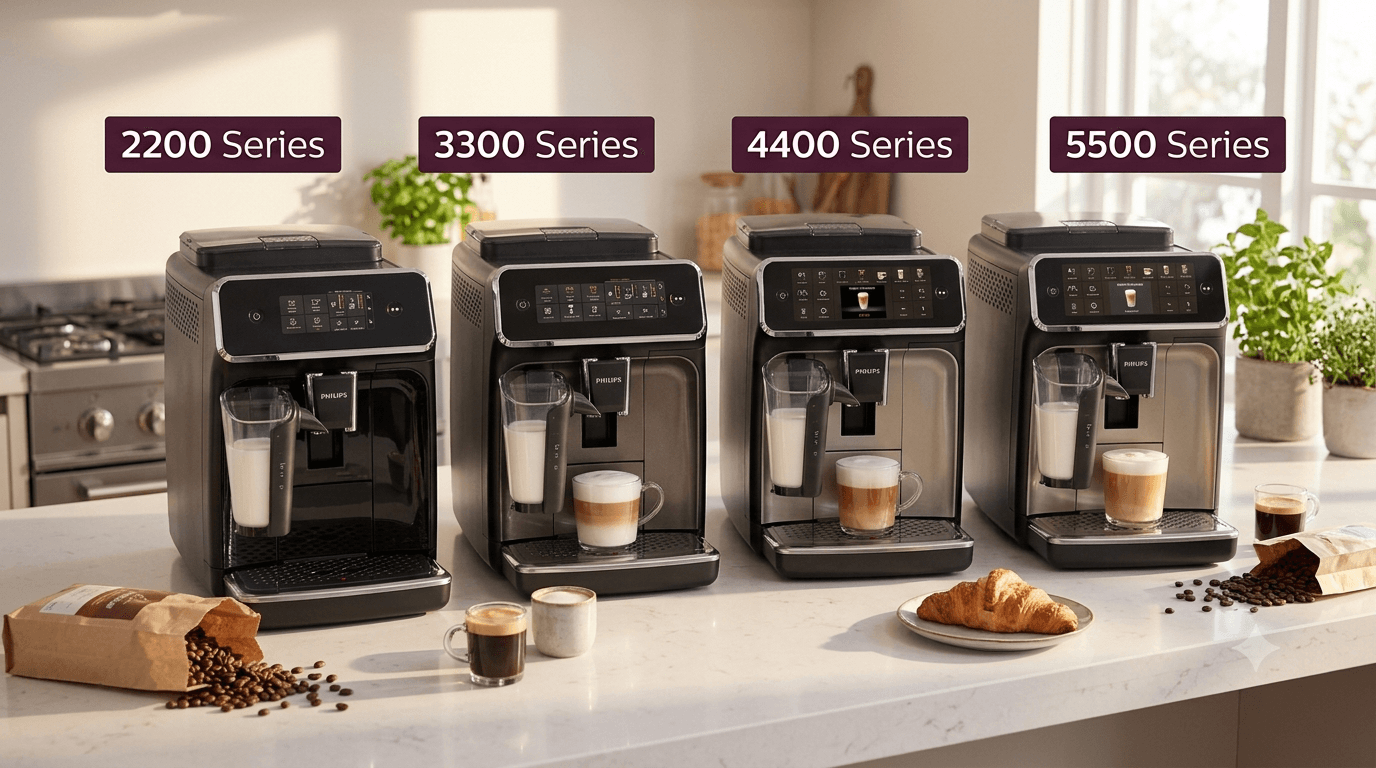
Here’s what’s going on. Philips recently renamed and refreshed its whole espresso range. The machines you’ve seen recommended for years — the 1200, 2200, 3200 — are the old generation. They’re still on shelves and still sold. But the current generation is numbered differently: 2300, 3300, 4400, 5500.
So when you google “Philips 2200 vs 3200” (as thousands of people still do) and then open Amazon, you’re staring at a wall of 2300s and 3300s and 4400s wondering if you’ve lost your mind. You haven’t. Roughly speaking:
- 1200 / 2200 (old entry) → succeeded by the 2300
- 3200 (old mid-range) → succeeded by the 3300
- Above that, the 4400 and 5500 are the newer upper tiers with bigger displays, more drink presets, and hot & iced options
- And off to the side there’s the Baristina — a compact machine that isn’t really part of this ladder at all
Both generations work fine. The older ones are often discounted, which makes them legitimately good buys while stock lasts. But you should know which generation you’re looking at before you compare prices — otherwise you’ll end up comparing a discounted old model against a full-price new one and drawing the wrong conclusion.
With that decoded, the actual decision is much simpler than the naming suggests.
The Quick Answer: Which Philips for Which Person
- Tightest budget, black coffee mostly: the 2200 (old gen, often around $420) or 2300 — entry level, classic manual milk frother on the base versions.
- You want milk drinks without learning anything: a LatteGo model — the 3300 LatteGo (usually ~$490–530) is the sweet spot of the current range and the one I’d point most people to.
- You want more drink presets and a nicer screen: the 4400 LatteGo (~$650).
- You want the top of the line, hot and iced everything: the 5500 LatteGo (~$740+).
- Tiny kitchen, espresso-first, simplicity: the Baristina (~$250) — but understand it’s a different kind of machine, not a smaller version of the others.
That’s the whole map. The rest of this article is the reasoning, so you can sanity-check my shortcuts against your own priorities.
The One Decision That Actually Matters: Milk
Strip away the model numbers and the entire Philips range splits on a single question — the same question that splits every super-automatic lineup, including my DeLonghi’s: how do you want your milk handled?
Philips gives you two answers:
The classic milk frother (on base 1200/2200/2300 versions) — a steam wand with a frothing sleeve. You hold the pitcher, you texture the milk, you wipe the wand after. Every time. I’ve lived with exactly this kind of system on my Magnifica Start for two years, so let me tell you what the spec sheet won’t: it makes perfectly decent cappuccino foam, it never makes café microfoam, and the real cost isn’t the frothing — it’s the wipe-right-now rule. Skip wiping the wand after milk and an hour later you’ve got a small cleaning project instead of a five-second swipe. If you drink milk drinks daily, that ritual adds up. Ask me how I know.
LatteGo — Philips’s automatic milk system, and honestly the reason to buy a Philips over anything else. It’s a two-part milk container with no tubes at all: milk goes in, the machine froths and pours it, and the container snaps apart and rinses under the tap in seconds. Owner consensus on the cleanup is remarkably consistent — it’s the easiest milk system to live with in this class, precisely because there’s nowhere for milk to hide. I can’t speak to the foam quality from my own hands (flag: not tested personally), but the design logic is sound and the owner reports back it up.
So before you compare any two model numbers: decide whether you’re a wand person or a LatteGo person. If you drink mostly black coffee, the wand versions save you real money. If milk is daily, LatteGo is the whole reason Philips deserves your shortlist — and you should only be comparing LatteGo models from here on.
The Ladder: What You Get As You Climb
Okay — you’ve picked your milk camp. Now the tiers, from an owner-report and spec standpoint (I’ll keep the model-by-model short, because the differences are genuinely smaller than the price gaps suggest):
1200 / 2200 / 2300 — the entry floor. Ceramic burr grinder, a couple of coffee presets, simple touch panel, AquaClean filter compatibility. The 2200 at ~$420 is the classic budget pick and the machine I compared directly against my own in DeLonghi Magnifica Start vs Philips 2200. The 2300 is its current-gen replacement — same idea, refreshed design. At this tier you’re getting the core Philips promise (quiet-ish ceramic grinder, dead-simple operation) with fewer presets.
3300 (and the outgoing 3200) — the sweet spot. More drink presets (including iced options on the 3300), the same core internals, LatteGo on most configurations. This is where most buyers should land, because it’s the cheapest tier where the machine feels complete rather than cut down. When Amazon’s bestseller lists and owner threads keep converging on one Philips, it’s this one. And a small reality check from someone who’s owned a machine with fewer presets: most owners end up making the same three drinks anyway. The 3300 covers those three with room to spare.
4400 — the comfort tier. Bigger display, more one-touch drinks, quick-start, more customization per drink. None of it changes the coffee; all of it changes the interaction. From owner threads, the display matters more than you’d expect in one specific case — when several people use the machine. A partner or teenager who’d never touch a fiddly menu will happily poke a big bright screen. If the machine is yours alone, that argument mostly evaporates.
5500 — the flagship. Everything the 4400 has plus more drink varieties, hot & iced across the board, the most polished interface, SilentBrew branding. At ~$740–870 it’s priced against serious competition (including DeLonghi’s upper range), and my honest take from the outside: you’re paying for convenience breadth, not better espresso. The shots from a 2300 and a 5500 are far more alike than the price gap implies — that’s just how super-automatics work, and it’s as true for Philips as it is for the machine on my own counter.
Baristina — the outlier. Compact, cheaper (~$250), and not a bean-to-cup super-automatic in the same sense — it’s a simplified espresso-first machine. If your kitchen is tiny and you mostly want straight espresso with minimal footprint, it’s interesting. If you want the full automatic-milk-drink experience, it’s not the machine you’re shopping for, despite sharing the shelf.
Things I’d Think About Before Buying a Philips
An honest navigator owes you the uncomfortable parts too. None of these are dealbreakers — but they’re the recurring themes in owner threads that the marketing pages won’t volunteer, and a couple of them come straight from specs. (Standard flag: patterns from owner reports, not my personal testing.)
The AquaClean cartridges are a subscription in disguise. Philips’s big maintenance pitch is that with AquaClean filters changed on schedule, you can go thousands of cups before descaling. True as far as it goes — but the filters cost real money and need replacing regularly, so you’re trading descaling labor for a recurring line item. Budget for it, or skip the filters and descale like the rest of us.
“Ceramic grinder” is a material, not a superpower. Philips leans hard on the ceramic burr in its marketing — durable, cooler grinding. Fine claims, but owner experience doesn’t suggest the cup tastes different because of it. Treat it as a neutral fact, not a reason to pick Philips over a steel-burr competitor.
Customization has a ceiling. Compared to what I can nudge on my own machine — and especially compared to prosumer gear — Philips keeps the adjustable range deliberately narrow. Great for simplicity, frustrating if you’re the type who’ll want to fine-tune temperature or push the strength beyond the presets. Tinkerers consistently bump into the walls here.
A lot of plastic for the money. Recurring owner theme, especially at the 4400/5500 price point: the machines are lighter and more plastic-bodied than the price suggests. They’re not fragile, but if you expect $800 to feel like $800 on the counter, temper that.
The lineup is narrower than DeLonghi’s. Fewer models, fewer price steps, fewer configurations. That’s partly a feature — less confusion — but it also means less chance the range has exactly your machine.
If none of those gave you pause, good — you’re probably the right buyer. On to the head-to-head question.
Philips vs DeLonghi: The Cross-Shopping Question
This is the part where two years of living with the other side comes in useful.
If you’re deciding between a Philips and a DeLonghi — and most people at this price point are — the honest split is this: Philips wins on milk cleanup, DeLonghi wins on range and options. LatteGo’s no-tube design is simply easier to live with than DeLonghi’s systems at comparable prices; nothing on my counter rinses that fast. On the other side, DeLonghi’s lineup is broader and more granular — more models, more price steps, features like dual bean hoppers on the upper end — which means you can match a DeLonghi to your exact needs more precisely.
I broke down the head-to-head in detail in Magnifica Start vs Philips 2200, and if you’re leaning DeLonghi, here’s my guide to that whole lineup. The short version: pick Philips if hands-off milk with minimal cleaning is your top priority. Pick DeLonghi if you want more choice in where your money goes. Neither is a mistake; they’re just optimizing for different owners. And if you’re still deciding whether a super-automatic is the right category at all, start with what a super-automatic actually is and who it’s for.
So Which Should You Buy?
My honest recommendations, by person rather than by spec sheet:
Most people: the 3300 LatteGo. It’s the cheapest complete Philips — LatteGo, enough presets, current generation, usually ~$490–530. The tiers above add comfort, not coffee.
Budget buyers who mostly drink black: the 2200 while it lasts. At ~$420 with the old-gen discount it’s real value — just know the milk frother is manual, with everything I said about wands and wiping.
Preset collectors and interface lovers: the 4400. If you’ll genuinely use the drink variety and want the nicer screen, it’s the rational upgrade. Be honest with yourself about the twelve presets, though.
“I want the best one”: the 5500 — with my honest asterisk that the espresso itself won’t taste $300 better than the 3300’s. You’re buying the experience around the coffee.
Small kitchen, espresso purist on a budget: the Baristina — different machine, different promise, but the right answer for a specific person.
Whichever tier you land on, the pattern to hold onto is the one that took me two years of ownership (of the competitor!) to fully internalize: in this class, the coffee quality plateaus early — it’s the daily living with the machine that differs. Milk system, cleanup, the interaction. Buy for your Tuesday morning, not for the spec sheet.
And one last thought, since we started with a confession. After two years with my own machine, I’ve noticed that nobody falls in love with an espresso machine because it has two more drink presets. They fall in love because it quietly fits into their mornings — the right milk system for their habits, a cleanup routine they don’t resent, a button their half-asleep brain can find. Every model on this page can be that machine for somebody. The whole trick is figuring out which somebody you are.
Frequently Asked Questions
Which is the best Philips espresso machine?
There’s no single best — but the 3300 LatteGo is the best starting point for most people: cheapest current-generation model with LatteGo and a complete set of presets. Climb higher only if you’ll genuinely use the extra drinks; the espresso itself doesn’t improve on the way up.
What’s the difference between the Philips 4400 and 5500?
Breadth and polish. The 5500 adds more drink varieties and the most refined interface; the brewing hardware is very similar. If the extra presets don’t excite you, the 4400 covers everything you’ll actually make.
What’s the difference between the Philips 3300 and 4400?
A bigger display, more one-touch presets, more per-drink customization on the 4400. The coffee in the cup is effectively the same — which is exactly why I call the 3300 the sweet spot.
Is LatteGo worth the extra money?
If milk drinks are daily — yes, and it’s arguably the single best reason to choose Philips at all. Two-part container, no tubes, rinses in seconds. I’ve spent two years wiping a manual frothing wand; the difference in daily effort is not subtle. Black-coffee drinkers can skip it and save the money.
Are the old Philips models (1200, 2200, 3200) still worth buying?
While stock lasts, yes. They’re the previous generation, not worse machines, and the discounts are real — the 2200 around $420 is legitimate value if a manual milk frother doesn’t scare you. Just compare generation to generation, or the prices will mislead you.
Philips or DeLonghi — which is better?
Neither, categorically. Philips wins on milk-system cleanup; DeLonghi wins on lineup breadth and configurability. The full head-to-head is in my Start vs Philips 2200 breakdown — start there if this is your real question.