I’ll be upfront, because it changes how you should read everything below: I learned espresso on a Gaggia Classic. It was my first real machine. It taught me most of what I know about pulling a shot — and, more usefully, most of what I’d been doing wrong. I’ve never owned a Breville Barista Express.
So when I talk about the Gaggia, that’s a couple of years of my own mornings. When I get to the Breville, I’m working off its specs, the manual, and a pile of owner reports, and I’ll say so every time it matters — because I’d rather you trust the half I actually lived than pretend I lived all of it.
Quick housekeeping first: the Gaggia I owned was the original Classic. What’s on shelves now is the Gaggia Classic Pro — basically the same machine with a nicer steam wand and a few updated bits. When I describe living with mine, assume it maps onto the Pro unless I flag a difference.
And here’s the thing this comparison is actually about, which isn’t “which one makes better coffee.” Both make good coffee. The real question is about you. Do you want a machine that does some of the work for you, or one that quietly refuses to and makes you learn? That’s really the only fork that matters here. Everything after this is just detail filling it in.
The Short Answer: Convenience in One Box, or Learning the Fundamentals
If you don’t want the full read, here’s the compressed version:
- Breville Barista Express if you want one box that handles everything — grinder built in, dose sorted, a softer landing into real espresso. It shortens the learning curve on purpose, and there’s no shame in that.
- Gaggia Classic Pro if you actually want to learn the craft from the ground up, you don’t mind buying a separate grinder, and you like a simple, stubborn little machine you can keep running (and tinkering with) for years.
The thing most of these comparisons skate past: the Gaggia needs a separate grinder to work at all. Not “works better with” — needs. And that one fact reshapes the price more than any spec sheet lets on. I’ll get to it properly below, because I learned it the expensive way and I’m still a little annoyed about it.
I Learned on a Gaggia Classic — Here’s What That Taught Me
The best thing the Gaggia did for me was refuse to help.
No presets, no automation, no grinder in the box. Every part of the shot was mine to get right or wrong, and for the first few weeks I mostly got it wrong. That sounds like a complaint. It isn’t. It’s exactly how I finally understood what grind, dose, and tamp actually do — because the machine handed me instant, unsentimental feedback on every one of them. Pull a bad shot and you see it: too fast, sour, thin. Change one thing, pull again, watch what moved.
What it drilled into me, specifically: grind size is the whole ballgame. A shot gushing out in twelve seconds almost always means the grind drifted, not that I did something exotic wrong. Fresh beans and week-old beans behave like different ingredients, and a super-automatic hides that from you completely. The Gaggia made all of it impossible to ignore, because there was nothing standing between me and the mistake.
If your goal is to genuinely understand espresso — not just drink it — a bare semi-auto like this is a better teacher than something that smooths the edges for you. I believe that. But learning has a daily price, and I’d rather be straight with you than romantic, so let me start with the part nobody warned me about.
The Hidden Cost Nobody Mentions: The Grinder
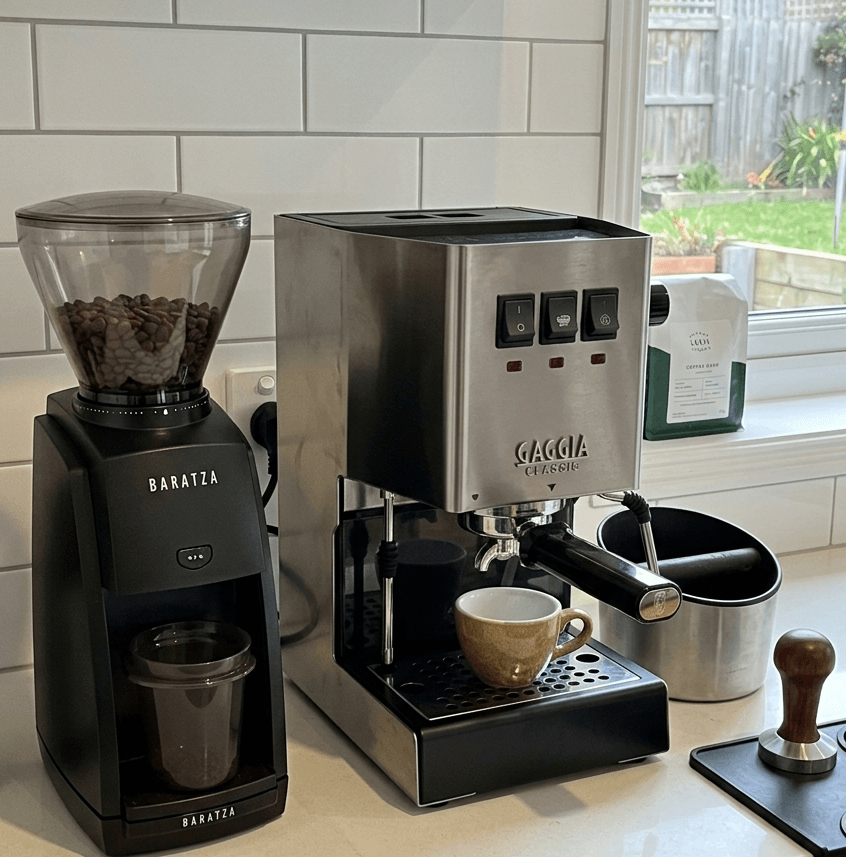
The Gaggia Classic has no grinder. None. It cannot make espresso on its own — you need a separate one, and not a $40 blade thing from the supermarket, an actual espresso-capable burr grinder.
I wish someone had said that to me before I bought, in those exact words, so here it is in those words.
I paired mine with a Baratza Encore ESP, and it added about $200 on top of the machine. That genuinely caught me off guard. I’d assumed the espresso machine was the expensive, important part and the grinder was an accessory you’d sort out later. Wrong, and backwards. For espresso the grinder matters as much as the machine — a weak one will choke everything the Gaggia is capable of, and you’ll spend weeks blaming the machine for shots that are actually the grinder’s fault.
So the real comparison was never “Gaggia price vs Breville price.” It’s “Gaggia plus a proper grinder vs Breville.” Add a ~$200 grinder to the Gaggia and the gap to the Barista Express — which has one built in — shrinks a lot. Sometimes to nothing.
And it isn’t only money. It’s a second machine on the counter, a second thing to wipe down every morning, one more variable to dial every time I cracked open a new bag of beans. The Breville folds the grinder into the same body, which is honestly just less to think about at 7 a.m. If “all in one, fewer moving parts” sounds good to you, that’s the entire pitch of the Breville — and it’s a fair one.
Breville Barista Express — The All-in-One Shortcut
Honest flag, since I keep promising them: everything in this section is from Breville’s documentation and what owners consistently report, not from my own counter. I’ll stick to what’s well established and skip anything I’d just be guessing at.
The Barista Express exists to delete the exact friction I just described. Its headline feature is the built-in conical burr grinder — beans in the top, and it grinds straight into the portafilter at a dose you set. That alone erases the separate-grinder problem that defines life with a Gaggia.
A few things owners come back to again and again:
- Built-in grinder with dose control — a usable range of grind settings plus adjustable dosing, so you’re tuning inside one system instead of coordinating two machines.
- PID temperature control — steadier brew temp than a basic thermostat, which is one of the quiet reasons shots come out more consistent.
- Pre-infusion — a gentle low-pressure ramp before full pressure, which tends to make dialing in more forgiving when you’re still learning.
- Single ThermoCoil boiler — and here’s the real limitation, the same one the Gaggia has: you can’t brew and steam at the same time. There’s a short wait to switch over. Fine for one or two drinks, mildly annoying when you’re making milk drinks for a table of guests.
The honest read: the Barista Express is the gentler on-ramp. It doesn’t make espresso for you — you still grind, tamp, and steam yourself — but it removes the assembly problem and sands down the learning curve with PID and pre-infusion. For a lot of beginners that’s worth real money, and I’d never talk someone out of it just to prove a point about character-building. (Whichever one you land on, you’ll be descaling it on a schedule — if it’s the Breville, here’s how I descale a Breville.)
(If your real question isn’t “Express or Gaggia” but “is the Express worth buying at all” — I answered that one separately in Is the Breville Barista Express worth it?)
Gaggia Classic — The Machine That Makes You Learn
Back to the side I actually know. The Gaggia Classic — and the current Pro — is minimalist on purpose: a rugged, commercial-style single boiler, a manual steam wand, a 58mm portafilter, and nothing automated anywhere. It’s still the machine half of r/espresso recommends as a first “real” espresso machine, and after living with one I get why. It’s simple, it’s repairable, and there’s a modding community around it deep enough that almost any problem has a known fix.
That simplicity cuts both ways, though, and I’d be doing you a disservice if I only sold you the romance.
What wore me down, in the end, was the cleanup. Knock out the puck, rinse the portafilter, wipe the basket, purge and wipe the steam wand after every milk drink — none of it is hard on its own. But every single morning, before work, before I’d had any coffee myself, it added up into a small chore I started to resent. And I got tired of chasing the grinder. Some mornings yesterday’s setting was perfect; the next morning the same beans ran too fast for no reason I could see, and there I’d be making grind adjustments at 7 a.m. with no caffeine in me yet. On a Gaggia, that’s just the contract: it assumes you’ll show up and do the work, every day, no exceptions.
A word on modding, because it comes up constantly and you’ll trip over it the second you start reading forums. I looked hard at the PID mod — half of Reddit swears by it — and I came close to ordering one more than once. What stopped me was noticing that I was about to spend more money and a couple of weekends improving a machine I was already, quietly, using less. So I left mine stock. And that told me something honest: the Gaggia wasn’t the problem. It was a perfectly good machine. It just wasn’t the morning I actually wanted anymore.
Milk, Grind, and the Daily Reality
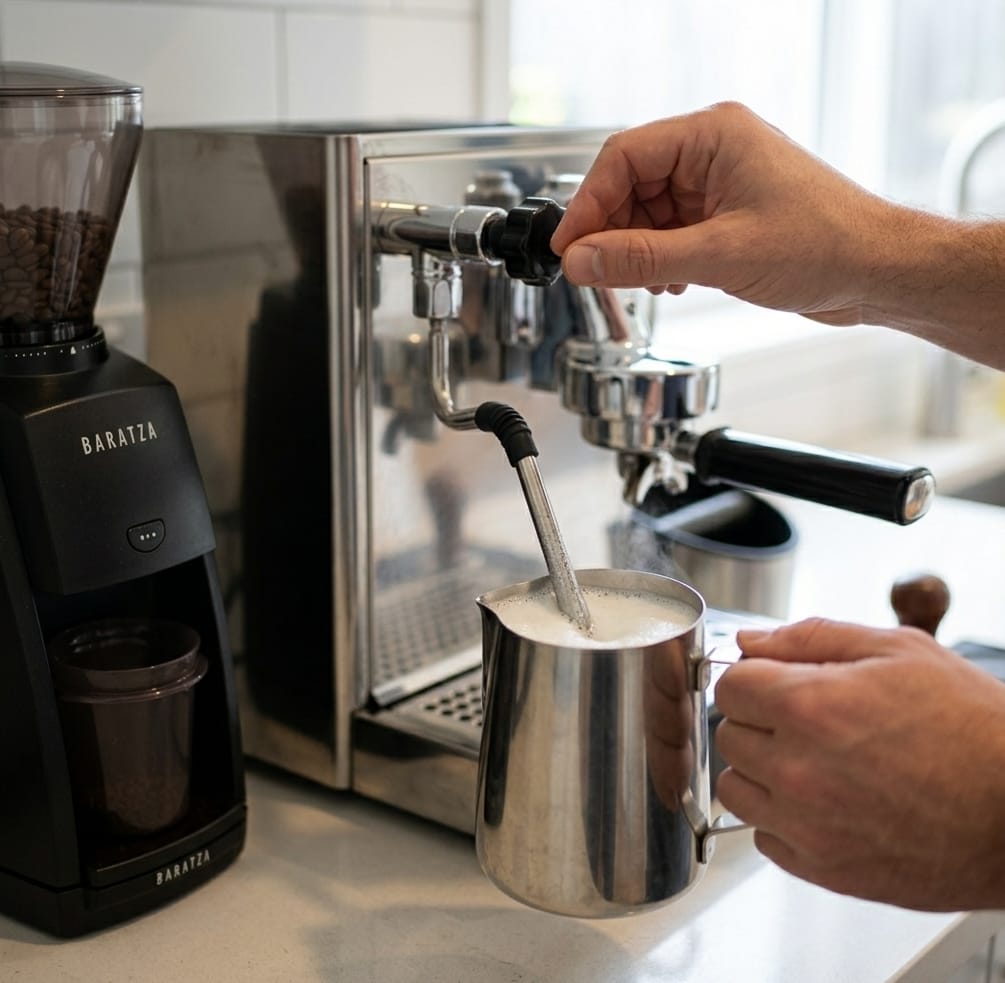
Both machines give you a manual steam wand, so milk is on you either way. You texture it yourself, and you wipe and purge the wand after every drink. If you’ve never done it, fair warning: there’s a real curve to getting tight microfoam instead of big airy bubbles, and neither of these machines does it for you. (This is the one area where my years behind a commercial machine helped more than either of these — wand technique transfers, the muscle memory carries over.)
On grinding, it’s the same story as before, just lived out daily. With the Breville the grinder is part of the machine and the dose lives in one system. With the Gaggia the grinder is a separate decision you make, buy, clean, and dial — every variable sits on a second device. Neither is automatically better in the cup. A Gaggia with a good grinder can absolutely match or out-pull an all-in-one; it has the higher ceiling, honestly. It comes down to how much daily coordination you actually want to sign up for. Some people find that fiddling meditative. Some people find it’s the only thing standing between them and coffee. Worth knowing which one you are before you buy.
One More Thing: Should You Even Be Looking at Semi-Autos?
A lot of people cross-shopping these two are secretly wondering something else entirely — should I just skip semi-autos and get a super-automatic, the press-one-button kind? It’s a fair question. It’s also, full disclosure, the decision I personally landed on in the end (more on that in a second).
If that’s rattling around in the back of your head, it’s a different comparison than this one. I dug into the hands-on-vs-hands-off question directly in my Breville Barista Express vs DeLonghi Magnifica breakdown, and if you want the broader “how involved do I even want to be” framing, I laid that out in super-automatic vs semi-automatic espresso machines. For here, I’ll stay in my lane and keep it to the two semi-autos.
Price and What You Actually Get
[Editor note: drop in current prices at publish — and double-check the live Gaggia model is the Classic Pro, not the older Classic.]
The sticker comparison is genuinely misleading, so here’s the honest one:
- The Barista Express costs more as a single unit — but that price already includes a grinder.
- The Gaggia Classic Pro costs less as a machine — but it can’t pull a shot without a grinder you buy separately. Budget somewhere around $150–250 for one that’s actually up to espresso; mine, the Baratza Encore ESP, ran about $200. Add that in, and the two land much closer than the shelf prices suggest.
So you’re not really deciding on price. You’re deciding on what kind of setup you want sitting on your counter — one integrated box, or a machine plus a grinder you chose yourself. Just don’t let the smaller Gaggia number trick you into thinking it’s the cheaper road. For most beginners, once the grinder’s in the cart, it isn’t.
So Which Should You Learn On?
Here’s how I’d actually decide, as someone who lived the Gaggia side and then walked away from it.
Learn on the Breville Barista Express if you want espresso to be one purchase and one machine on the counter, you’d rather a gentler curve (PID and pre-infusion really do help early on), and the idea of researching and buying a separate grinder sounds like a chore you’ll quietly resent. It’s the lower-friction door into real, hands-on espresso, and that’s a perfectly good reason to pick it.
Learn on the Gaggia Classic Pro if you genuinely want to understand espresso from the ground up, you’re fine buying and dialing a separate grinder, and you like a simple, rugged machine with a huge community and years of life left in it. It’s the better teacher — as long as you actually want the lessons and not just the certificate.
And the person I’d gently steer away from the Gaggia: anyone who, if they’re being honest with themselves, mostly wants a good coffee in under two minutes on a Tuesday. That turned out to be me. I still think the Gaggia could out-pull my current machine on its best day — but my best days were never every day. The great shots were the product of having time, fresh beans, a dialed grinder, and the patience to line all four up. Most weekday mornings I had maybe two of those. Once I admitted I was choosing convenience over chasing the perfect shot, my next machine basically picked itself. If that sounds like you too, read the hands-off comparison up above before you spend money on either of these.
Frequently Asked Questions
Does the Gaggia Classic come with a grinder?
No — and it’s the single most important thing to know before you buy. The Classic (and the current Classic Pro) has no built-in grinder, so it physically can’t make espresso on its own. You’ll need a separate espresso-capable grinder; mine was a Baratza Encore ESP, about $200 on top. Treat the grinder as part of the machine, not an optional add-on, because the Gaggia genuinely doesn’t function without one.
Is the Breville Barista Express good for beginners?
From its design and what owners report, yes — it’s one of the friendlier ways into hands-on espresso, mostly because the grinder’s built in and features like PID and pre-infusion make dialing in more forgiving. You still grind, tamp, and steam yourself, so it isn’t push-button. It just removes the separate-grinder hurdle and softens the early frustration.
Breville Barista Express vs Gaggia Classic — which makes better espresso?
Honestly? A Gaggia Classic paired with a good grinder can match or beat the Barista Express in the cup — it’s a capable machine with a higher ceiling for someone willing to tinker. But the Breville gets you to a reliably good shot with less coordination, because everything lives in one tuned system. The Gaggia rewards effort; the Breville rewards needing to put in less of it. Which one is “better” depends entirely on which of those you want day to day.
Do you need a separate grinder for the Barista Express?
No — the grinder’s built in, and that’s its biggest practical edge over the Gaggia. Beans go in the top, it grinds straight into the portafilter. That’s the whole appeal of the all-in-one: one machine, one purchase, less to clean and coordinate.
Is the Gaggia Classic worth it in 2026?
For the right person, absolutely. It’s simple, rugged, repairable, and has a modding community that keeps it alive long past when most machines get tossed — which is exactly why it’s still a go-to first “real” espresso machine. But it’s worth it only if you actually want to be hands-on: buy the grinder, dial it in, clean it daily. If that already sounds like more than you signed up for, the honest answer is that a more convenient machine will make you happier — even on the days the Gaggia’s shot would’ve been better.