
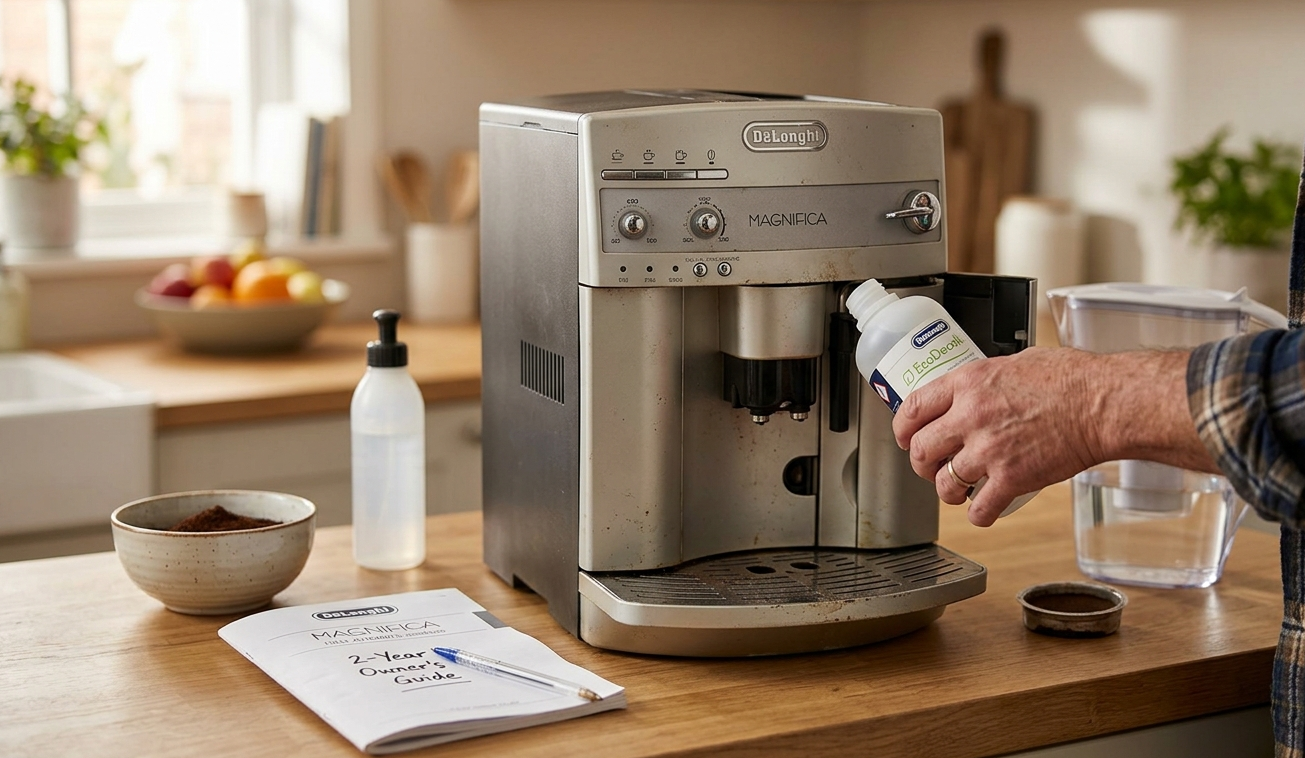
Last updated: May 2026 | Machine owned: DeLonghi Magnifica Start ECAM22022SB | Time owned: ~2 years | Descaler used: DeLonghi EcoDecalk
TL;DR: To descale a DeLonghi Magnifica: empty the tank and remove the water filter, mix 100 ml of EcoDecalk with water up to the “B” line on the tank (~1 liter total), start the descaling cycle, then run two full rinse cycles with clean water. Total time: about 30 minutes, of which 5 minutes is active. Cost: roughly $2 in EcoDecalk per cycle. The part nobody explains clearly: the machine isn’t measuring actual scale buildup — it’s counting water based on the hardness setting you gave it. If the hardness setting is wrong, the light comes on at the wrong time. And if your descale light is already on, you’ve got a buffer of maybe 150–200 cups before performance starts dropping noticeably — but I noticed thinner crema and cooler shots within 30 cups of ignoring it. Don’t wait.
The full cycle takes about 30 minutes, costs around $2 in EcoDecalk, and is genuinely simple once you’ve done it once. The part nobody explains clearly: the machine isn’t measuring actual scale buildup, it’s counting water based on the hardness setting you gave it. So if you set the hardness wrong, the light comes on at the wrong time.
This guide on how to descale a DeLonghi Magnifica is the one I wish I’d had open on my phone the first time my descale light came on. The manual was in the basement, I couldn’t remember which button to hold, and I ended up watching a DeLonghi YouTube video at 1.25x while the coffee got cold.
A quick disclosure: I own the Magnifica Start, which I’ve written about in detail in my full review. I’m on fairly soft municipal water and have the DeLonghi water softener filter installed. Over two years I’ve run the descaling cycle eight to ten times. If you’re on hard well water, your interval will look very different — covered in the next section.
When the Descale Light Comes On (And What It Actually Means)
Here’s the thing most guides skip: the descale light isn’t telling you there’s scale in your machine. It’s telling you the counter hit a threshold.
This super-automatic machine doesn’t have a sensor that detects calcium buildup. What it has is a flow meter and a setting — the water hardness level you (or DeLonghi, by default) configured during the first-time setup. Based on that setting, it calculates roughly how many liters of water should pass through before scale becomes a problem. When you hit that number, the light comes on.
This matters because if the hardness setting is wrong, the light comes on at the wrong time. If your water is harder than the setting assumes, scale is already building up before the light triggers. If your water is softer, you’ll be running unnecessary descaling cycles. Most people leave the factory default — level 4 of 4, i.e. “hard” — without ever testing their actual water. That’s fine if your water is genuinely hard. If it isn’t, you’re wasting descaler.
What happens if you ignore it for too long: the heating element and internal piping accumulate calcium scale, which is a poor conductor of heat. The machine has to work harder and longer to reach brewing temperature, and it often doesn’t quite get there. Your espresso starts pulling colder, which means under-extraction, which means sour, thin shots. Crema gets paler. I let it go once for about 30 cups past the light coming on, just to see — espresso temperature dropped noticeably, crema turned thinner, and drinks went from being ready immediately to needing a moment before they tasted right. After descaling, the next shot tasted like the machine again.
The longer-term concern is heating element damage. Severe, prolonged scale buildup will eventually kill the boiler, and on a machine in this price range, major boiler repairs usually don’t make financial sense compared to replacement — labor alone on a sealed-unit repair often runs close to the cost of a new machine. This is why DeLonghi excludes scale-related damage from warranty coverage — the warranty itself stays in force, but anything traceable to skipped descaling isn’t covered.
By the way, if your Magnifica’s shots have turned bitter and you’re not sure scale is the culprit — here’s the full bitter-espresso diagnosis, including the causes that have nothing to do with descaling.
How Often You’ll Actually Need to Descale
DeLonghi’s official answer is “every two months” at the default settings. The real answer depends on three things, in roughly this order of importance:
- Water hardness — by far the biggest variable
- Whether you have the water softener filter installed
- How much coffee you actually drink
These are real-world estimates from owner experience, not official DeLonghi intervals — the machine’s counter will always have the final word.
| Water hardness | Without filter | With DeLonghi filter |
|---|---|---|
| Soft (< 7 °dH / 125 ppm) | Every 3–4 months | Every 4–6 months |
| Medium (7–14 °dH / 125–250 ppm) | Every 6–8 weeks | Every 2–3 months |
| Hard (14–21 °dH / 250–375 ppm) | Every 3–4 weeks | Every 5–7 weeks |
| Very hard (> 21 °dH / 375+ ppm) | Every 2–3 weeks | Every 3–4 weeks |
Assuming around three drinks a day. One important caveat: this table reflects how often scale actually needs removing — not how often the machine’s counter will trigger. DeLonghi sets the counter conservatively, so the descale light typically comes on earlier than the table suggests.
For reference: I’m on soft municipal water with the filter installed, drinking 3–4 drinks a day, and the light comes on every 2–3 months — about twice as often as the “real” interval. That’s fine. I’d rather descale slightly too often than slightly too late, and following the light keeps you safely ahead of any actual buildup.
How to figure out your actual water hardness — two methods, both straightforward:
The easiest method is the test strip that came in the Magnifica box. There’s a small paper strip in the accessories pouch. Dip it in cold tap water for one second, shake off excess, wait one minute. The number of pink squares tells you the hardness level — one square is soft, four squares is very hard. This is the method DeLonghi designed the machine around, and it’s accurate enough for setting the hardness level in the menu. The strip is single-use; replacements are cheap on Amazon if you’ve lost yours.
The more accurate method is your local water utility’s annual water quality report. In the US, every utility is required to publish one — search “[your city] water quality report” or “[your ZIP] annual water report” and you’ll find a PDF. Hardness will be listed somewhere, usually as ppm or as grains per gallon (gpg — multiply by ~17 to get ppm). It’s measured at the source, so it doesn’t account for what happens between the treatment plant and your tap, but for most municipal water that’s a minor variation.
Once you know your hardness, set it in the machine: Menu → Water Hardness → select level 1–4. The Magnifica Start uses the bean icon + temperature button combo; on the Evo it’s straightforward through the touchscreen. After this is set, the descale counter will trigger at intervals that actually match your water — not the factory default.
What You’ll Need
For one descaling cycle:
- DeLonghi EcoDecalk — 100 ml per cycle. The standard 500 ml bottle is good for five cycles, so one bottle typically lasts 10–15 months at normal descaling intervals.
- Water — around 900 ml of tap water to mix with the descaler, plus another full tank for rinsing
- A container holding at least 2 liters — the descaling cycle dispenses about 1 liter of descaler solution, and the first rinse pass that follows pumps through another full tank. You won’t be there to swap containers between phases on every model, so size for the worst case. Anything wide and shallow enough to fit under the spouts works. I use a glass mixing bowl. Don’t use a coffee mug; you’ll overflow it.
- About 30 minutes during which you’re around but not actively doing anything. The machine runs the cycle on its own with pauses; you just need to be there for the rinse step at the end.
A word on the descaler choice. I’ve used the same DeLonghi EcoDecalk for two years on my Magnifica Start — same blue bottle, refilled every nine months or so. Not loyalty to the brand; three specific reasons.
Warranty. According to DeLonghi’s warranty language, damage linked to the use of non-approved descalers may not be covered. Third-party descalers marketed as “DeLonghi-compatible” exist; some of them probably work fine; none of them put you in a stronger position if a claim ever comes up. For a $400–$1,000 machine, paying $12 a bottle, roughly a year of use, about $1 a month.
Chemistry. EcoDecalk is a buffered lactic acid formulation, designed to balance descaling effectiveness with safety on the materials DeLonghi uses in the heating circuit. Citric acid works — it’s the active ingredient in most generic descalers — but homemade solutions are unpredictable in concentration, and the wrong strength on aluminum components is a real concern that purpose-made descalers are formulated to avoid. Vinegar is the worst of the DIY options: harsher on rubber gaskets, leaves a residual smell that takes five or six full rinse cycles to clear, and any resulting damage falls outside warranty coverage.
Math. $12 a bottle, nine months of use, roughly $1.30 a month. The DIY math doesn’t move the needle.
If you’re going to use a non-DeLonghi descaler anyway — especially outside the US where EcoDecalk is harder to source — look for a product that explicitly says it’s pH-balanced and safe for aluminum boilers. Avoid anything that just lists “citric acid” without a concentration spec.
What I use
De’Longhi EcoDecalk Universal Descaler (5 uses)
The bottle in my own cabinet — lactic acid based, works in any brand of machine, and one bottle covers about a year of descaling on a typical schedule.
Check price on AmazonStep-by-Step Descaling
Here’s how to descale a DeLonghi Magnifica step-by-step. This procedure is for the Magnifica Start (ECAM22022SB), but the flow is essentially identical on the Magnifica Evo (ECAM29084SB) and on the original Magnifica S. The buttons you press to start the cycle differ by model — I’ll note where — but everything else is the same.
Total active time: about 5 minutes of attention spread across 30 minutes.
1. Prep the machine. Empty the drip tray and the grounds container. Pull out the water tank and dump whatever’s in it. If you have the water softener filter installed, take it out of the tank for the descaling cycle — it’ll get saturated with descaler otherwise, and you’ll waste the remaining capacity. Set the filter aside on a paper towel; you’ll put it back at the end.
2. Mix the descaler. Pour 100 ml of EcoDecalk into the water tank. The cap on the bottle is marked as a measuring cup — fill it to the “A” line, which is 100 ml. Then add cold tap water up to the “B” line marked on the tank itself (around 1 liter total). Shake the tank gently to mix, then re-seat it in the machine.
3. Place the container. Put your 2-liter container under both the coffee spouts and the steam wand. The machine will pulse water through both during the cycle, so the container needs to catch from both. On the Start the spouts and the wand are close together; on the Evo with the LatteCrema system, the wand sits a bit further out — you may need a wider container.
4. Start the descaling cycle.
- On the Magnifica Start (ECAM22022SB): Press and hold the descaling button (the one with the indicator that just lit up) for about 5 seconds, until you hear the machine acknowledge. The descale light will switch from solid to blinking.
- On the Magnifica Evo (ECAM29084SB): Navigate to Menu → Maintenance → Descaling, and confirm on the touchscreen.
- On older Magnifica S models: There’s usually a dedicated descale button on the right-hand side panel; press and hold for 5 seconds.
If you’re not sure on your specific model, the manual has a one-page descaling section near the back — it’s the same procedure with model-specific button assignments.
5. Let the cycle run.
The machine will start pulsing the descaler solution through in stages — about 30 seconds of pumping, then a pause of 1–2 minutes while the solution sits in the heating circuit, then more pumping. The full cycle takes around 25 minutes from this point. Don’t unplug the machine. Don’t open the water tank mid-cycle. Don’t try to make coffee.
The first time I ran this, I panicked at about minute 8 when the machine paused for what felt like 30 seconds and didn’t make any noise. That’s normal. The pauses are when the descaler is actually doing the work — sitting in contact with the scale long enough to dissolve it. If the machine were pumping continuously, the descaler would just flush through without time to react.
6. Rinse cycle — first pass.
When the descaling cycle finishes, the machine will indicate it’s ready for rinsing (on the Start, the lights change pattern; on the Evo, the touchscreen prompts you). Pull out the water tank, rinse it thoroughly with tap water to remove descaler residue, fill it to MAX with clean water, and re-seat it. Empty your 2-liter container and put it back under the spouts.
Start the rinse — same button or menu path as the descaling start. The machine will pump the full tank through to flush descaler out of the heating circuit and pipes.
7. Rinse cycle — second pass (recommended).
DeLonghi’s manual considers one rinse cycle sufficient. In my experience, it isn’t quite — the first two or three drinks after a single-rinse descaling have a faint chemical aftertaste, not strong but detectable. After two rinse cycles, the next drink tastes like the machine should.
To run a second rinse: empty the tank, refill to MAX with clean water, and trigger another rinse cycle. On the Start, this means manually running a hot water dispense from the wand until the tank is empty. On the Evo, there’s usually a “rinse” option in the maintenance menu you can run independently. Adds 5 minutes and uses an extra liter of water — worth it.
8. Reset the descale counter and reinstall the filter.
On most Magnifica models, the descale counter resets automatically when the rinse cycle completes successfully. On some older units it doesn’t, and the descale light stays lit even after a clean cycle. If that happens, see the troubleshooting section below.
Put the water softener filter back into the tank if you removed it in step 1. Empty the drip tray one more time — there’s usually a small amount of leftover descaler-water that pooled there during the cycle.
You’re done. The first espresso after descaling sometimes pulls slightly fast for the first few seconds before settling, because the brewing temperature stabilizes after the cycle. By the second or third drink, everything’s back to normal.
A note on milk system cleaning (Evo and other LatteCrema models): The descaling cycle does not clean the milk frother. It only runs descaler through the coffee path and the steam wand. If you have the LatteCrema automatic milk system, the milk carafe has a separate “Clean” cycle that uses a different product (DeLonghi Milk System Cleaner) and runs through a different menu path. Don’t try to use the descaling cycle to clean the milk system — at best it doesn’t work, at worst you contaminate the milk path with descaler residue.
Common Problems
Four things go wrong on a first descaling, in rough order of how often they happen:
The descale light won’t turn off after the cycle
This is the most common issue, and it almost always traces to one of three things.
First: the rinse cycle wasn’t completed in full. The counter only resets when the machine confirms a complete rinse — usually one full tank of clean water pumped through. If you stopped the rinse early, refilled the tank halfway, or the rinse triggered before the tank was actually filled to MAX, the machine doesn’t register it. Refill the tank to MAX with clean water and run a complete second rinse from start to finish.
Second: on some older Magnifica S models, the counter doesn’t reset automatically and needs a manual reset. The procedure varies by model, but usually involves holding the descale button for 10–15 seconds (longer than the 5 seconds to start the cycle) until the light goes out. Check your manual for the exact procedure for your unit.
Third: the cycle was interrupted. If you unplugged the machine, the power went out, or you manually stopped the cycle midway, the descale routine logs as incomplete. Run the full cycle again, start to finish.
If none of these work, try unplugging the machine for 30 seconds and powering it back on; the machine’s electronics occasionally need a hard reset. If the light is still on after that, there’s a chance the descale sensor itself has failed — rare but not unheard of, and at that point it’s a service call.
Water leaking from the bottom during the cycle
Most often: the drip tray isn’t fully seated. The descaling cycle pushes more water through than a normal brew, and a slightly-misaligned drip tray can let overflow run out the front of the machine onto the counter. Pull the tray out and re-seat it firmly.
Second possibility: your 2-liter container under the spouts overflowed without you noticing. This is more likely than it sounds — the cycle pulses water in batches, and if you walked away for 10 minutes, half a liter can build up. Check container capacity before starting.
The coffee tastes off after descaling
For the first two or three drinks, a faint chemical or “different” taste is normal — even after two rinse cycles. By the third drink, it should be gone.
If the off-taste persists past the first five drinks, you didn’t rinse enough. Run another full rinse cycle (one tank of clean water pumped through). This almost always clears it.
If the taste persists past that — sour, metallic, or distinctly chemical — there’s a chance descaler residue is sitting in a low point of the heating circuit. Run a third rinse, this time with hot water dispensed manually from the steam wand for 30 seconds in the middle of the cycle, which clears that path specifically.
The descale light came on too early
If the light triggers in less than 4–6 weeks at normal use, your water hardness setting is almost certainly set higher than your actual water hardness. The machine is over-counting.
Run the water hardness test (strip from the box, or check your utility report), then adjust the setting in the menu. Most Magnifica machines ship with hardness set to level 4 (hard) by default, which is conservative — fine if your water is actually hard, but means soft-water owners are descaling twice as often as they need to.
The Water Filter Question
The DeLonghi water softener filter sits inside the water tank, in a clip-in housing near the top. It’s an ion-exchange resin filter — it pulls calcium and magnesium ions out of the water before they reach the heating circuit, replacing them with sodium ions, which don’t form scale.
What it actually does for you:
On medium-hard to hard water, the filter extends descaling intervals by roughly 1.5–2x. It doesn’t eliminate the need to descale — some minerals still get through, and the boiler still accumulates scale over time, just more slowly. On soft water, the effect is smaller, because there’s not much for the filter to remove in the first place.
Whether it’s worth installing:
- Soft water (under 7 °dH / 125 ppm): Marginal benefit. The filter is doing very little because the water doesn’t have much hardness to remove. I have one installed mostly because it came with the machine; I wouldn’t pay for a replacement pack specifically. The descaling interval is about the same with or without.
- Medium water (7–14 °dH): Worth it. You’ll descale every 2–3 months instead of every 6 weeks, which adds up over the life of the machine. Replacement filters cost around $25 for a pack of three (good for six months of use), which is cheaper than the equivalent extra EcoDecalk you’d otherwise burn through.
- Hard water (14+ °dH): Strongly worth it, and worth pairing with a pre-filter pitcher (Brita or similar) for the water you pour into the tank. The combination roughly halves your scale exposure compared to filling straight from the tap.
A note from my own experience: I’m supposed to change the filter every two months or 50 liters, whichever comes first. Realistically I change it closer to every three months, because I forget, and because the machine doesn’t strongly nag about it the way it does about descaling. On soft water this hasn’t mattered — my descale interval is the same with a slightly-old filter as with a fresh one. If you’re on hard water, staying on schedule matters more, because that’s where the filter is doing the most work.
The replacement schedule DeLonghi sets — every two months or 50 liters — is conservative and assumes daily use. If you drink 3–4 cups a day, you’ll hit the 50-liter mark before the 2-month mark, so volume is usually the trigger. Some Magnifica models track filter use in the same way they track descaling and will prompt you; the Start doesn’t.
DeLonghi water softener filter replacement on Amazon — it fits all Magnifica models with the filter housing.
Maintenance Beyond Descaling
Descaling is the maintenance task with the biggest consequence if you skip it, but it’s not the only one. Quick rundown of what else the machine needs:
Daily: Empty the drip tray and the grounds container. The Magnifica’s grounds container holds 12–14 pucks before it fills up; the drip tray fills faster than people expect because every brew dispenses a small flush of water at the end.
Weekly: Pull out the brew unit (the dark gray cartridge behind the side door), rinse it under the tap with no detergent, let it air dry, and put it back. Takes 90 seconds and prevents coffee oils from building up in the gasket seal area. If your espresso has been pulling slightly inconsistently, this is the first thing to try before anything more involved.
Monthly: Wipe down the steam wand or LatteCrema spout with a damp cloth, including the small holes at the tip. If milk residue has crusted on, soak the wand tip in warm water for a few minutes first.
Every 2–3 months (or when prompted): Descaling — covered above.
Every 6 months: Lightly grease the brew unit’s piston seal with food-grade silicone grease. Prevents the seal from drying out — the single most underrated maintenance task on these machines, and a dry seal is the most common cause of slow leaks and premature brew unit failure.
I’ll write a separate guide on weekly brew unit cleaning at some point — there are enough small details there that it deserves its own walkthrough.
Bottom Line
Descaling a DeLonghi Magnifica takes about 30 minutes of mostly-passive time, costs around $2 in EcoDecalk per cycle, and is the single thing that determines whether the machine lasts three years or eight.
The procedure itself is simple once you’ve done it once — mix the descaler, run the cycle, rinse twice, reset. The first time feels intimidating because there are lights and beeps and pauses and you’re not sure if you broke it. You didn’t. By the third descaling, it’s a routine you do while answering email.
I’ve used the same Magnifica Start for two years with no performance degradation, and the only maintenance I’ve done religiously is descaling. The filter changes — honestly, I’m late more often than I’m on time, and the machine has been fine. The weekly brew unit rinse — also inconsistent on my end. The grease on the brew unit seal — I did it once at the one-year mark.
But the descaling — every time the light came on, within a week. That’s the one that matters. Everything else is upside.
Frequently Asked Questions
How long does descaling a DeLonghi Magnifica take?
The full cycle takes about 25–30 minutes of machine time, plus 5 minutes for a second rinse cycle (which I recommend). Your active attention is needed for maybe 5 minutes total — the rest is the machine running on its own.
Can I use vinegar instead of EcoDecalk?
Technically yes — vinegar is acidic enough to dissolve scale. In practice, it’s a bad trade. Damage from vinegar use isn’t covered by DeLonghi’s warranty, it leaves a residual smell that takes 5–6 rinse cycles to clear, and it’s harsher on the rubber gaskets in the heating circuit than purpose-made descalers. EcoDecalk costs about $12 a bottle and lasts roughly 9 months of normal use. The DIY math doesn’t justify it.
How do I know if my Magnifica needs descaling?
Two signals. The first is the descale indicator light on the front panel — when it lights up, you’ve hit the counter threshold. The second is taste and temperature: if your espresso starts pulling cooler than usual, with thinner crema and a sour finish, that’s scale buildup affecting heat transfer. If the light is on, descale within a couple of weeks; if the taste has shifted, descale this weekend.
Does the water filter replace the need to descale?
No. The filter slows down scale formation but doesn’t prevent it entirely. With the filter installed on medium-hard water, you’ll descale every 2–3 months instead of every 6 weeks. Without the filter, every 6 weeks on the same water. The filter extends the interval; it doesn’t eliminate the task.
The descale light came on but I just descaled — what’s wrong?
Most often, the descale counter didn’t reset because the rinse cycle wasn’t fully completed. Refill the tank to MAX with clean water and run another rinse from start to finish. If the light still doesn’t go out, your model may need a manual counter reset (hold the descale button 10–15 seconds, longer than the cycle-start press). Unplugging the machine for 30 seconds and powering back on also clears stuck states on some Magnifica models.