
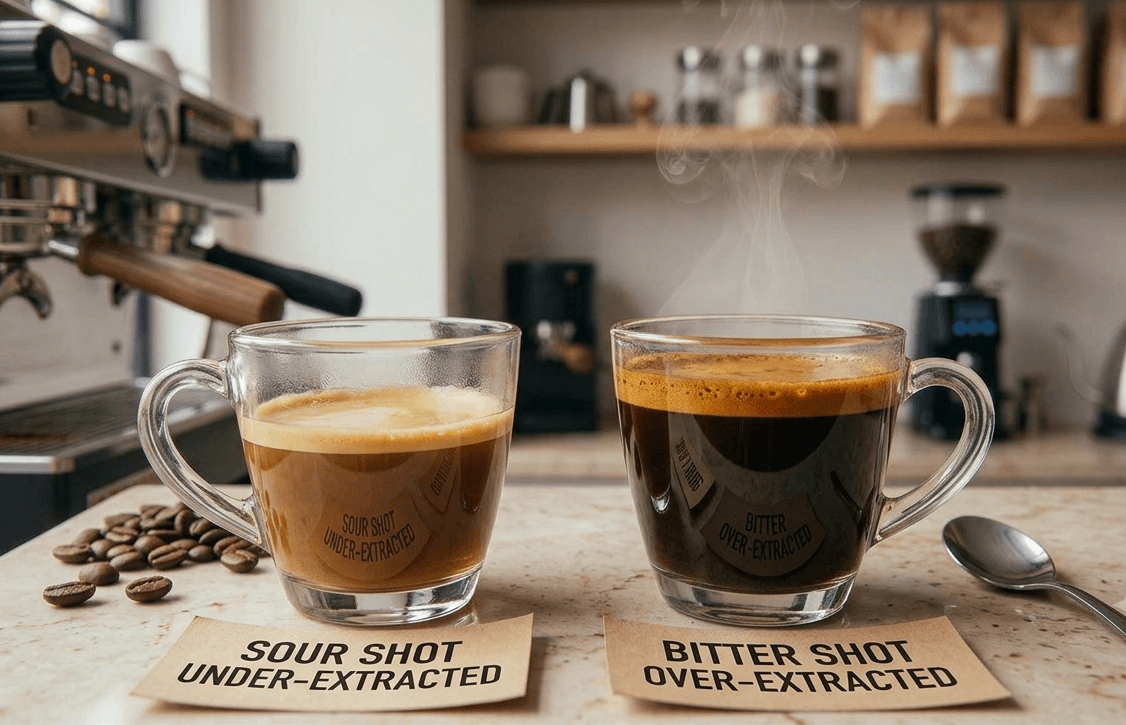
The single most common mistake in the whole sour vs bitter espresso confusion — one I made myself, back when I was learning on a used Gaggia Classic — is adjusting in the wrong direction. Sour needs one fix, bitter needs the opposite one — and most of us grew up calling every bad coffee “bitter,” because that’s the only word anyone ever used at the family dinner table. Turn the dial the wrong way and you’ll make your next shot worse, then conclude the machine is broken.
It isn’t. You just need ten seconds and one honest sip.
The 10-second taste test
Four years on a commercial La Marzocco taught me to diagnose a shot from one sip. Sounds like barista mystique — it’s not. The trick is just noticing where and when the taste hits, which anyone can do.
Take a sip and pay attention to the timing. Sourness is immediate — it hits the sides of your tongue in the first second, sharp and almost lemony, and your mouth waters. Bitterness arrives late. It creeps up at the back of your tongue as you swallow and leaves a dry, ashy film that lingers. Sour shots often feel thin and end abruptly; bitter shots feel heavy and won’t end at all.
One more tell: aftertaste. Thirty seconds after a sour shot, your mouth feels clean, maybe a little puckered. After a bitter one, you’re still tasting it — and not in a good way.
Quick reference: sour vs bitter
| What you notice | Sour (under-extracted) | Bitter (over-extracted) |
|---|---|---|
| When it hits | Instantly, first sip | Late, on the swallow |
| Where | Sides of the tongue | Back of the tongue |
| Sensation | Sharp, lemony, mouth waters | Dry, ashy, mouth feels coated |
| Body | Thin, watery | Heavy, harsh |
| Aftertaste | Short, clean | Long, drying |
| The fix direction | Extract more | Extract less |
Wait — is espresso supposed to be a little sour?
A little, yes. Espresso concentrates everything in the bean, including its natural acidity, and a good shot has some brightness to it — that’s part of what separates it from bitter drip coffee left on a hot plate. Light roasts in particular are designed to taste brighter, so if you’re pulling a light Ethiopian and getting citrus notes, that may be the roaster’s intent, not a defect.
The line is comfort. Pleasant brightness makes you want another sip. Sourness that makes you wince, like biting a lemon, is under-extraction, and that one you fix.
Your espresso is sour: causes and fixes
Sour means the water didn’t pull enough out of the grounds. In my experience, the causes rank like this:
Grind too coarse. The big one. Water rushes through, extraction stops early, acids dominate. Go one step finer and pull again. (Yes, finer — sour espresso almost never means the grind is too fine. More on that in the FAQ, because the question comes up constantly.)
Shot ran too fast. Same disease, different symptom. If your shot finishes in 15 seconds instead of 25–30, the water didn’t have time to do its job. On a superautomatic like my Magnifica, you don’t control shot time directly — the grind setting and dose do it for you, which is why the grind adjustment above covers most of it.
Water not hot enough. First shot of the morning on a cold machine is the classic case. Run a blank shot or a cup of hot water through first. Commercial machines idle hot all day; home machines need that minute of grace.
Coffee too fresh. Counterintuitive, but beans roasted three days ago are still off-gassing CO2, which disrupts extraction. If the roast date is under a week out, give the bag a few more days.
If you’re on a Breville or another semi-automatic
Semi-autos deserve their own paragraph because they give you more rope. On a Barista Express you control grind size, dose, and tamp pressure — three ways to cause sourness instead of one. I haven’t run the Barista Express long-term myself, but the diagnosis logic is identical to what I did on the commercial machine daily: watch the shot timer. Under 20 seconds to fill a double = go finer or tamp firmer. Fix one variable at a time, or you won’t know which change worked.
If you’re deciding whether that level of involvement is for you at all, I wrote an honest breakdown of who the Barista Express suits — and who it frustrates.
Your espresso is bitter: the short version
Bitter means the water stayed too long at the party and started pulling out things nobody wanted. Grind too fine, shot running long, machine running hot, or (the quiet one everyone skips) a machine overdue for cleaning: old coffee oils turn rancid-bitter and season every shot that follows.
I’ve covered every bitter cause I’ve actually seen, with fixes, in the full guide to bitter espresso — if your ten-second test pointed that way, that’s your next read.
What if it’s both sour AND bitter?
Then the water is cheating. When the puck isn’t even — uneven tamp, clumpy grounds — water finds one easy path and floods it. The channel over-extracts, the neglected zones under-extract, and your cup gets both defects at once — what people usually describe as “harsh,” which is honestly the right word for it. This is mostly a semi-automatic problem; superautomatics tamp mechanically and rarely channel. The fix is puck prep: distribute the grounds evenly before tamping and keep the tamp level.
FAQ
Does sour espresso mean the grind is too fine?
The opposite. Too coarse = water passes too quickly = under-extraction = sour. Too fine = water struggles through = over-extraction = bitter. This gets mixed up constantly because people assume “sharp taste = sharp little particles.” Taste, not intuition.
Should espresso be sour or bitter?
Neither should dominate. A balanced shot has mild brightness up front, sweetness in the middle, and a pleasant, quickly-fading bitterness at the end. If any one of the three takes over the whole sip, something in the recipe is off.
How do I fix sour espresso fast?
One step finer, pull again, taste. That fixes most of them. Cold machine? Temperature first.
Why is my espresso sour even with good beans?
Because sourness is about extraction, not bean quality. Expensive beans pulled at 15 seconds through a coarse grind will taste sour every time. Good beans set the maximum. Whether you get anywhere near it is all extraction. I once watched a customer bring in a $28 bag to prove our café coffee was the problem. Same machine, proper extraction — his beans were fine. His home grinder wasn’t.