
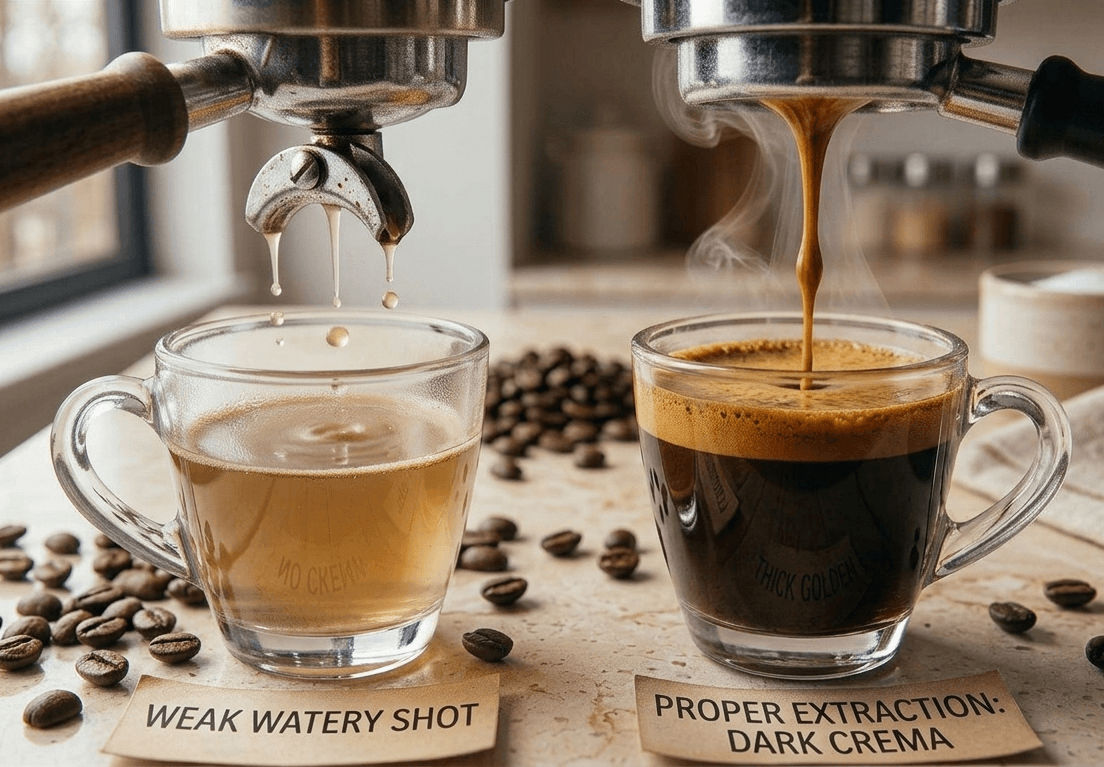
When someone tells me their espresso tastes weak, my first question is always the same, and it annoys people: weak how? Because “weak” is one word doing two completely different jobs. Sometimes it means the flavor is faint — coffee that tastes like it’s apologizing for itself. Sometimes it means the body is thin — watery texture, no weight on the tongue, gone before you noticed it. Those need different fixes — and if you grab the wrong one, you can lose a week adjusting things that were never broken. Ask me how I know.
I heard “make it stronger” from customers for four years behind a commercial machine, and I’d guess less than half of them actually wanted more caffeine or more coffee. Most wanted more presence — darker taste, heavier texture, that punch-you-in-the-nose quality. Which, good news, is very fixable once you name the right problem.
The 30-second sort
Taste your shot and ask two questions. Actually, one question with two possible answers.
Does it taste like coffee, just… quiet? Flavors are there but faded, like a photocopy of a good espresso? That’s weak flavor — a ratio problem. Too much water met too little coffee.
Or does it feel thin — watery in the mouth, pale, runs off the tongue like tea? That’s thin body — a pressure and extraction problem. The water went through without picking up the heavy stuff.
They can overlap, sure. But one usually dominates, and that’s the one you chase first.
Weak flavor: the ratio went wrong
You’re pulling a lungo without meaning to. Embarrassingly common on superautomatics — I want to say most “weak espresso” complaints I’ve fielded from superautomatic owners were this, though I never counted. The machine has a programmed water volume per drink, someone bumped it up (or it shipped generous), and every “espresso” is actually a small lungo — same coffee, twice the water, half the intensity. So before touching the grinder, the beans, or anything else with a warranty — check the volume setting. On my Magnifica, the espresso button is programmed to a proper short volume, but I’ve seen plenty of machines in the wild set to fill half a mug. That’s not a broken machine. That’s a diluted recipe.
The dose is too small. Less coffee in, less flavor out — there’s no trick around arithmetic. On a semi-auto, weigh your dose once instead of eyeballing; a couple of grams short shows up in the cup immediately. On a superautomatic, this is what the strength/aroma setting controls (more on that button below, it deserves its own section).
The beans are past it. Stale coffee doesn’t just lose crema — the aromatics fade too, and aromatics are most of what you experience as “strength of flavor.” Roast date over two months back, opened bag: the coffee is quiet because there’s less of it left to taste. Same check as always — fresh bag, same settings, compare.
Fast shots also come out thin — if “weak” is closer to your complaint than “sour,” start here instead.
Thin and watery: pressure never happened
Watery body with a fast, pale pour is the under-extraction picture: grind too coarse, water walked through without resistance, nothing emulsified. If your shot also has little or no crema — that’s the same problem showing on the surface, and the no-crema guide walks the full checklist. Short version: one grind step finer at a time until the shot takes roughly 25–30 seconds and darkens up.
If the taste has also gone sharp and lemony, you’re firmly in under-extraction territory and the sour vs bitter test will confirm which direction to adjust. Fast, watery, and sour travel together.
Watery espresso on a DeLonghi specifically
This search gets its own heading because DeLonghi owners ask it constantly, and the answer is usually not what they fear.
On a Magnifica-family machine, watery espresso is almost always one of three settings, checked in this order. First, the programmed drink volume — hold the espresso button to reprogram it shorter, or check the menu, depending on your model. Second, the aroma/strength setting sitting on minimum — that’s the dose control, turn it up. Third, the grinder dial on too coarse — adjust one notch while the grinder is running, then judge after two or three shots, because the old grounds have to clear the chamber first. That last detail skips past almost everyone, and then they conclude the dial does nothing.
Hardware is the distant fourth. If all three settings are sensible and shots are still watery after fresh beans, then we’re talking about a cleaning cycle or a worn brew unit seal — but genuinely, it’s the settings. If you’re comparing models and panels anyway, the Start vs Evo breakdown covers what each one actually lets you control.
“Watery puck” — when it’s the puck, not the drink
Different complaint, same search. If you’re on a semi-auto and the spent puck comes out soupy and collapses out of the basket: usually the dose is too low for the basket, or the grind too coarse — the puck never compressed into a solid cake. Bump the dose, tighten the grind, and the puck firms up along with the shot.
If you’re looking at wet, sloppy pucks in a superautomatic’s waste container — stop worrying. That’s normal. Superautomatics brew through a compact unit that rinses with water between cycles, and the discarded pucks sit in a drawer collecting drips. Mine have been damp for two years. The pucks in the bin tell you nothing about the coffee in the cup; judge the drink, not the garbage.
What the “strong” button actually does
On DeLonghi machines the aroma/strength control changes the dose — how many grams get ground per shot. It does not change the water, the temperature, or apply any secret intensity. More grams, same water: a stronger ratio. Which means it genuinely works — but it maxes out, and past that point the machine physically can’t fit more coffee per cycle. That ceiling is the honest limit of superautomatic strength, and it’s why espresso from my Magnifica will never be a café ristretto. Two years in, I’ve made peace with it: pick the highest strength, shortest volume, freshest beans, and you get a legitimately good shot — just not a commercial one.
Want it stronger? The legitimate ways, ranked
Shorter volume first. Same coffee, less water — it’s the biggest strength move there is, and it costs nothing, which is why nobody believes it. Dose up second, if your machine allows. Darker roast third, honestly labeled: dark roasts taste stronger through roastiness and body even at identical ratios, and if that’s the flavor you’re missing, that’s a bean decision, not a settings one. What doesn’t work: running the machine twice through the same grounds (you extract bitter dregs, not strength) and tamping like you’re mad at it (a firmer tamp past “level and snug” changes almost nothing).
FAQ
Does stronger espresso mean more caffeine?
Barely — and this surprises people. Intensity of taste is mostly ratio and roast; caffeine is mostly total coffee used. A “weak-tasting” lungo made from 14 grams has more caffeine than a punchy ristretto made from 9. If caffeine is the actual goal, use more coffee, not less water.
Why is my espresso weak on a DeLonghi?
Nine times out of ten: programmed volume too high, strength setting too low, or grind too coarse. I’d check them in that order. None of them are defects — the machine is doing exactly what it’s set to do, which is sometimes the most irritating kind of problem.
Is espresso supposed to taste strong?
Concentrated, yes; aggressive, no. A balanced shot is intense the way a reduction sauce is intense — dense flavor, not harshness. If “strong” in your head means the bitter slap of a gas-station espresso, that’s robusta and over-extraction, and honestly you can do better.
My espresso is watery AND bitter — how?
Uneven extraction: water found a channel, over-extracted that path (bitter), skipped the rest (thin). Mostly a semi-auto puck-prep issue — even distribution, level tamp. On a superautomatic this combination usually means it’s time for a cleaning cycle.