
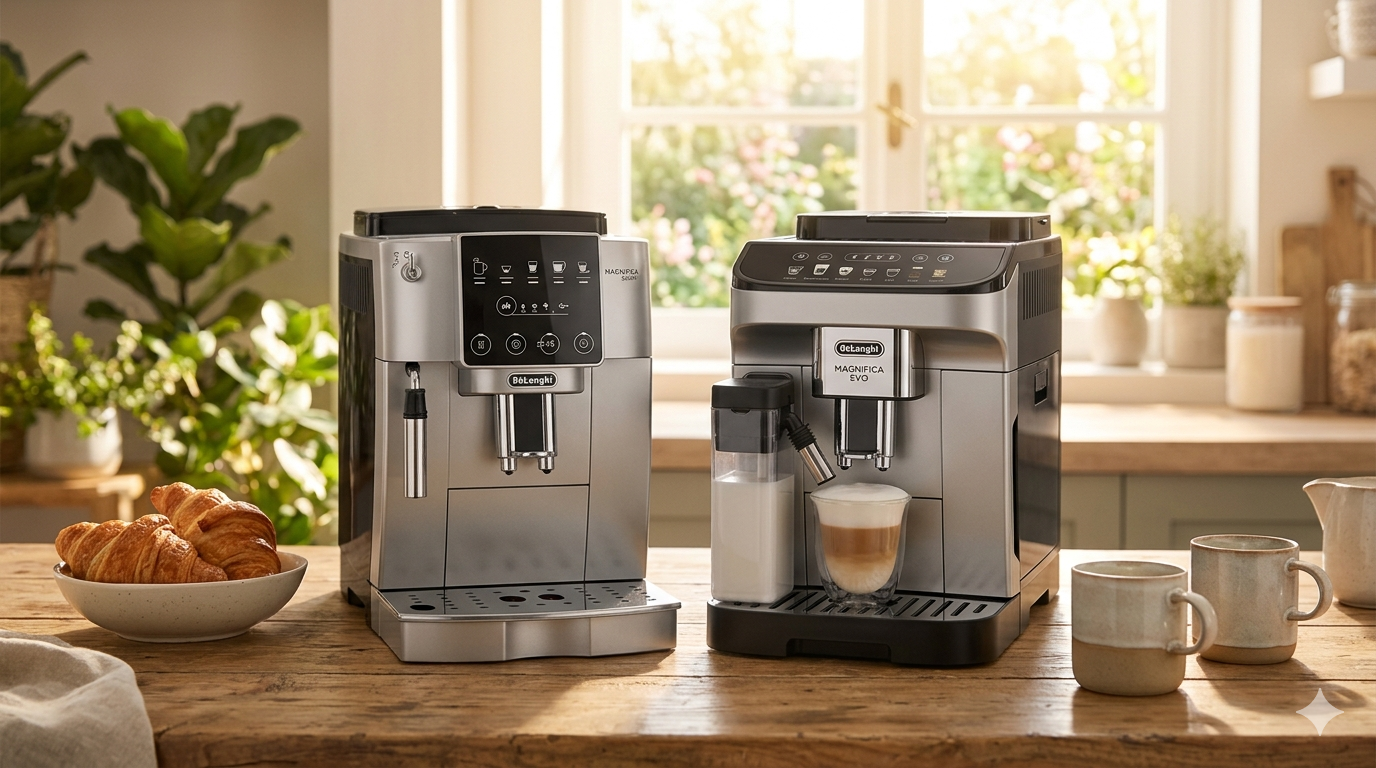
I’ve had the Magnifica Start on my counter for a little over two years. A friend bought the Evo about three months after I got mine, and since I’m the one everybody texts about coffee, I set hers up, walked her through her first descale, and pulled a lot of shots in her kitchen while we talked. Two years with one, a couple hundred mornings with the other.
Almost every Start-vs-Evo article out there is a spec sheet, though. Features lined up, price gap pointed at, Evo crowned “the upgrade.” Which is true and useless at the same time, because it skips the only thing you care about — where that extra $150 actually goes, and whether you’ll ever feel it on a normal morning.
So this is what I’d text my sister if she asked.
I’ve written each one up on its own — a full review of the Magnifica Start and a separate one on the Evo — so this page is only the choosing-between-them part. Both are super-automatics; the whole comparison stays inside one category. If you’re not sure a super-auto is even right for you, go read the super-auto vs semi-auto piece first.
Quick Verdict
The Start and the Evo pull basically the same espresso. The $150 is the milk system. That’s the whole decision; everything below is me showing my work.
Get the Start if you mostly drink espresso, doppio, or americano and milk is occasional. Get the Evo if there’s a cappuccino or a latte in your hand most mornings — the one you actually make right now, not the one you keep picturing.
Side-by-Side
| Feature | Magnifica Start (ECAM22022SB) | Magnifica Evo (ECAM29084SB) |
|---|---|---|
| Price | $499–599 | $649–749 |
| Brew group | Removable | Removable (same design) |
| Grinder | Conical burr, 13 settings | Conical burr, 13 settings |
| Pump pressure | 15 bar | 15 bar |
| Espresso quality | Good, once dialed in | Good, once dialed in |
| Milk system | Manual panarello wand | LatteCrema automatic carafe |
| Display | Soft-touch icons, no text | TFT touchscreen with text |
| Drinks menu | 3 | 7 |
| Water tank | 1.8 L | 1.8 L |
| Bean hopper | 250 g | 250 g |
| Auto-rinse | Startup + shutdown | Startup + shutdown |
| Footprint | 9.4 × 17.5 × 13.8 in | 9.4 × 17.0 × 14.0 in |
| Warranty | 2 years (US) | 2 years (US) |
| Best for | Espresso drinkers, budget | Milk drinks, convenience |
What’s Actually the Same
The brew group is one part. Literally the same removable unit — same seals, same weekly rinse — and if you pulled it out of both machines and set the two pieces on the counter, you could not tell me which is which. The grinder’s the same steel conical burr, 13 settings. The pump’s the same 15 bar, real pressure landing around 9 at the puck. Pre-infusion, same. Thermoblock, same warm-up, about 40 seconds, and the first shot of the day runs a few degrees cool on both.
I did the blind-ish thing once on her counter. Same beans, same dial-in, a shot from each, side by side. Nothing. Couldn’t call it.
Which is the part the marketing doesn’t want sitting up front: the bits that actually decide the cup are shared between the two. The $150 isn’t in there. It’s in what’s bolted on around them.
A Word on the Model Numbers, Because DeLonghi Won’t Help You Here
This nearly cost me a return once, so it’s going in even though it doesn’t really belong in the espresso-vs-milk argument.
DeLonghi names the Magnifica line like they’re trying to lose you on purpose. “Start” and “Evo” are marketing words. The thing that matters is the ECAM code on the box. The Start I own is the ECAM22022SB. The Evo my friend has is the ECAM29084SB. Those two exact codes are what this entire page is about. But search “Magnifica Start” and you’ll also pull up a spread of ECAM220-something variants — slightly different button layouts, the odd one in chrome instead of silver, at least one that ships with no proper frother at all. Same platform underneath, different scoop of features on top, all wearing the same name. The Evo’s worse for it: there’s an Evo with the LatteCrema carafe — the one you actually want if you’re buying the Evo — and an Evo with a plain manual wand that looks nearly identical in a thumbnail and costs less for a reason that isn’t a deal.
So before you click buy, find the ECAM number in the listing, not the pretty name. If a seller doesn’t print it, that’s its own red flag; the reputable ones always do. I won’t tell you to avoid a refurb — mine’s been bulletproof and DeLonghi’s own factory-renewed units are fine — but check the refurb still carries a real warranty, because some third-party “renewed” listings quietly drop it and you find out the hard way.
One owner thing while I’m on the subject, since it’s exactly the kind of detail that never makes a spec sheet: both machines have a bypass chute — a little hatch up top where you tip in pre-ground coffee instead of running the grinder. I use mine every evening for decaf, so I’m not digging beans out of the hopper and back again just for one cup. Small thing. I reach for it constantly. It’s on both, identical on both, and it’s the feature I’d have missed most if either one had skipped it.
Espresso: Where They Differ (Mostly They Don’t)
I just said the shot’s the same and I’ll say it again, because reviews keep inventing a difference that isn’t there. “Richer crema.” “More nuance.” On what evidence, exactly. I went looking for it on the Evo the first morning — her beans, actively trying to catch the pricier machine winning — and got nothing back.
The Evo’s one genuine edge here isn’t flavor, it’s the saved profiles. Per-user volumes and temps on the screen. Handy if two of you want different shots.
Light roasts, neither one. Fixed temp in the low 90s, no PID, grinders that won’t go fine enough. If you live on those pale Scandinavian roasts I’d talk you out of both.
And the beans swamp the machine anyway. Lavazza Oro on mine, setting 3. My friend runs Illy. Her coffee tastes like Illy, mine tastes like Lavazza.
If your shots taste weak on either machine, it’s nearly always the volume and strength settings — here’s the full checklist.
Milk Drinks: Where the $150 Actually Lives
Okay. This is the real decision, so I’m slowing down.
The Start gives you a panarello — a plastic sleeve over a steam wand, little holes that suck air into the milk. Dunk it in cold milk, hit the steam, hold the pitcher at the right angle, and forty-ish seconds later there’s foam. Thick, white, stands up on a cappuccino. It works, and I want to be fair to it, because it carried me for a while.
Here’s how it actually went, and this is the part I’d make you read if I could only keep one. Daily for the first six months — I was into it, I’d bought a machine with a wand specifically to do this. Once a week by maybe month eight. By year two, basically never. Two things killed it. The cleanup tax, which lands on every single use: you purge the wand and wipe it the second you finish, every time, or the milk dries inside the holes and tomorrow opens with a deep-clean instead of a coffee. And the ceiling — I got decent, I never got café. That glassy, paint-thick microfoam you watch a good shop pour, the panarello won’t make it, and I burned an embarrassing number of mornings deciding whether that was me or the wand before I admitted it was the wand.
Now I drink espresso. Anyway.
The Evo deletes that whole saga with the LatteCrema carafe. Fill a separate jug with cold milk, clip it on the front, press cappuccino, and it pours steamed milk and foam into the cup itself. No wand, no angle, no purge. And the foam beats the panarello — finer, more even, holds a few minutes instead of going flat on the walk to the table. Not café microfoam. Closer than the wand gets, though.
The carafe’s catch is the carafe. 500 ml, and when you’re done you cap it and stick it in the fridge, and once a week you pull it into four plastic parts plus the dip tube and wash the lot. More steps than wiping a wand. But it’s scheduled — you always know what it wants and when, where the panarello’s whole trick is punishing you the one morning you forget.
Honest about your froth count is the only thing that decides this, and aspirational doesn’t count. A drink a day or more, the carafe earns the premium. Once or twice a week, the wand’s plenty.
And — look, I’ll just say it. When I bought the Start I was certain I’d make cappuccinos every day. Dead certain. Bought the wand on purpose. Two years on, I make espresso and a milk drink shows up on a slow Sunday if at all. I’d still buy the Start again. The cappuccinos I planned for just never turned into cappuccinos I made, and no machine was going to fix that, because it was never the machine.
Living With Them Day to Day
Both do an auto-rinse on power-up — forty seconds, a little water through the group into the tray. After the first week you stop clocking it. Hit power, go feed the cat, come back, coffee. Both grinders are loud enough to wake someone through an open door at six a.m. The Evo’s is a hair less harsh; if noise is a real problem for you, neither is the fix.
The screens are where the Evo looks expensive — color TFT, words, color-coded warnings — versus the Start’s wordless little icons. You’ll stop looking at either inside two weeks. You press the same button every morning.
The thing nobody warns you about, and I’m going to be a little unkind because I’ve earned it: the Magnifica platform has habits. Both machines refuse to start if the grounds container isn’t shoved fully home, and “fully home” means harder than feels reasonable, every time, on both. Both flash a descale warning at the precise moment your hands are full. Neither of these is a Start thing or an Evo thing. It’s a Magnifica thing. You inherit it whichever you buy.
And the Evo is not faster. I keep seeing this and it’s wrong. Ninety seconds to first cup either way — they share the thermoblock, they share the warm-up curve. Anybody calling the Evo quicker is reading the marketing, not making coffee.
Cleaning and Maintenance
Most of this is identical and dull to write out, so fast: descale every couple months, same EcoDecalk, same 25-minute cycle; brew group out under the tap once a week, light grease a couple times a year; grounds container and drip tray emptied daily; the optional DLSC002 filter swapped every two months if you run one, which I do.
The Evo’s extra is the carafe — fridge after use, full teardown once a week. The Start’s extra is the wand purge — five seconds, but skip it and tomorrow’s ruined. Daily milk drinker, the two even out. Mostly-espresso, the Start’s less to deal with.
Build and Longevity
Both are built like the $500 machines they are — competent, plastic, around 20 pounds, not heirlooms. They share the brew group, pump, thermoblock, and grinder, so the owner-forum complaints are the same for both: brew-group seals somewhere around years three to five, thermoblock a bit later, the tray sensor whenever somebody jams the tray. The Evo has one extra failure point the Start doesn’t, the carafe valve, but it’s a replaceable part, not a funeral. Five to eight years on either if you descale on time.
What It Costs Over Five Years
I’m not building you a spreadsheet, because the answer’s boring: the gap basically holds. After the $150 sticker difference it’s small running costs — descaler, filters, the Evo’s bit of milk cleaner on top — plus maybe one repair down the line that’s a coin flip on both. The Evo lands a couple hundred ahead over five years and not more.
And it doesn’t matter much, because a daily café cappuccino is most of two grand a year, and both machines pay for themselves before the first summer’s out. The five-year number isn’t the deciding factor. The deciding factor is still milk, same as it was three sections ago.
The One Reason to Skip Both
If you’re after café-grade light roast or real latte-art microfoam, neither of these is your machine — same fixed-temp thermoblock, same grinder ceiling, no way around it. Put the money toward a prosumer setup with PID and a dedicated grinder and you’ll be glad in two years. For everyone else, which is most people pulling shots at home, it’s just Start or Evo.
Final Verdict
Two years in, what stuck with me is how little of this was ever about espresso. The shot’s the same. The $150 buys the LatteCrema and a screen you stop noticing by week two, and the LatteCrema only earns its keep if you froth often enough to feel it.
So skip “Start for budget, Evo for premium.” It’s narrower than that. The Start’s for people who mostly want espresso; the Evo’s for people who mostly want milk drinks. Buy for who you are at the counter.
Don’t know which one that is yet? Most first-time owners don’t, and the Start’s the safer miss — same espresso, $150 still in your pocket, and a separate frother later if milk drinks take over. Paying for the Evo and never filling the carafe is the more expensive way to be wrong. I’ve watched people do it.
Not sure the Evo is your tier? I mapped out which DeLonghi Magnifica fits which person.
Frequently Asked Questions
Can the Start make latte art?
No. The panarello makes foam, not microfoam — there’s nothing pourable to draw with. Wrong category for that goal; you want a bare steam wand and a separate grinder.
Do the Start and Evo make the same espresso?
Effectively yes. Same hardware pulls the shot. Match the beans and the dial-in and you can’t reliably tell the cups apart.
Does the Evo come with the LatteCrema carafe, or is it sold separately?
On the ECAM29084SB, it’s in the box — that’s the standard US configuration, shipped with a scoop, a hardness strip, a brush, and a starter bottle of descaler. One warning, because this catches people: DeLonghi sells several Evo variants in other markets and a couple ship with a plain manual frother instead of the carafe. I’ve had two people email me confused about exactly this. Check the listing before you buy. For the ECAM29084SB on Amazon US specifically, the carafe’s included.
Which is easier to clean?
The Start, if you skip milk. Once you’re frothing daily it roughly evens out.
Should I wait for an Evo sale or just buy the Start now?
DeLonghi knocks the Magnifica line down a few times a year and the Evo regularly dips into the $599–649 range during the big events. I don’t track prices day to day so I won’t pretend to know next week’s — but if price is the only thing stopping you and you can wait a couple of months, it’s usually worth it. Need a machine now? The Start at full price beats the Evo at full price for most people.
This comparison comes from two years of owning the ECAM22022SB and regular hands-on use of a friend’s ECAM29084SB, backed by manufacturer specs and long-term owner discussion in coffee forums. No manufacturer provided compensation or machines. As an Amazon Associate, this site earns from qualifying purchases — it doesn’t change the assessment.
Last reviewed: May 2026. Next update: November 2026, or sooner if either machine gets a hardware revision.