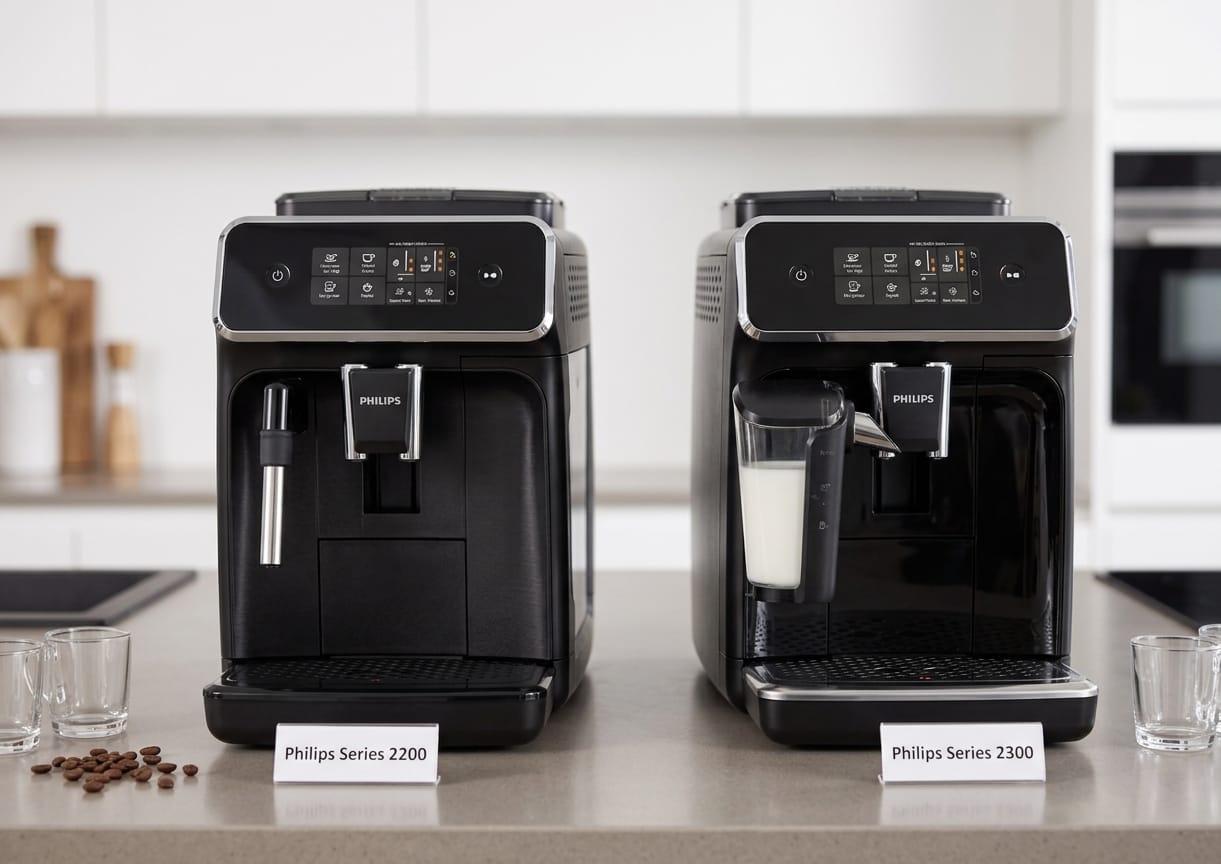
Same disclosure as always: my counter belongs to a DeLonghi, so this is spec-sheet analysis plus a lot of owner threads (attributed when I lean on them), not a machine I’ve lived with. What I do know cold is this class of machine and this exact decision shape — because the 2200 vs 2300 question isn’t really about features. It’s about a discount.
Here’s the setup. The 2200 is the previous generation. Philips moved it to the retail clearance lane when the current lineup (2300, 3300, 4400, 5500) rolled out, which means it’s permanently “on sale” somewhere. The 2300 is its direct replacement: same job, current design. Nobody cross-shops these at equal prices — the only reason this comparison exists is that the 2200 is cheaper, and you’re wondering what exactly you give up for the savings. Short version: less than the retail pages imply, and more than nothing.
Short answer:
- Get the 2200 LatteGo if the discount in front of you is deep. The espresso and the milk foam are the same; you’re buying last year’s dashboard at a real discount.
- Get the 2300 if the price gap is small, you want iced drinks on a button, or you just don’t want to start ownership one generation behind on parts and firmware.
- Either way, buy the LatteGo version (third digit 3, e.g. EP2230, EP2331) unless you genuinely want to froth milk by hand. The panarello versions save money by deleting the machine’s best feature.
What’s identical
The actual coffee-making guts? Identical. Same ceramic grinder, same 12 settings, same brew group, same AquaClean, same LatteGo carafe — that two-piece, no-tube thing that shows up on basically every Philips until you hit the Aromis. I went through a ton of owner threads looking for foam complaints that were specific to one model — there just aren’t any, because the hardware is the same: a cappuccino from a 2230 and a 2331 is the same cappuccino. If someone tells you the 2300 “makes better coffee,” they’re reading marketing, not spec sheets.
The complaints are shared too: coffee runs cooler than café habit expects (max the temperature setting, warm the cup), and the body is still plastic. One generation did not fix any of that.
The one thing Philips did actually fix in the 2300 is the noise. They added sound insulation around the grinder (“SilentBrew”), which turns the 2200’s high-pitched morning screech into a muffled hum. Grinding, that is — the pump still announces itself mid-brew, so don’t expect a silent machine, just a less rude one. If mornings in your house start before everyone’s awake, this is the one mechanical upgrade with a real payoff.
What the 2300 actually adds
Three things:
The iced button. The 2300’s headline feature is one-touch iced coffee — lower brew temperature, adjusted extraction, so the ice doesn’t turn it into brown water. On the 2200 you improvise with regular espresso over ice, which works but isn’t tuned. If cold drinks are half your year, this matters.
The current-generation panel. Refreshed touch panel, clearer icons, drink selection that feels less like programming a microwave from 2018. Real but cosmetic — it controls the same machine.
Being current. Harder to quantify, but not nothing. The 2300 still has years of parts and firmware support ahead of it; the 2200 is kind of already getting quietly shelved. For parts, accessories, and resale in year four, newer is quietly worth something. I wouldn’t pay a lot for it. I’d pay a little.
What the 2300 does NOT add: better espresso, better foam, more grind settings, a different water system. So the honest bill: quieter mornings, iced coffee, a prettier panel.
The math that decides it
I don’t quote prices — they move weekly, especially on a clearance-lane machine. The structure is what holds: when the 2200 LatteGo sits at a shallow discount to the 2300, the old generation is a bad deal — you’re saving lunch money to start a year behind. When the gap is deep (the 2200’s whole reason to exist in 2026), the calculus flips: the parts that make your morning coffee are identical, and the difference buys a lot of beans.
Yes, I just said I don’t quote prices — percentages age better than dollars, so those I’ll risk. Gap under roughly 15%? Take the 2300; quieter grinding and the iced button are worth that much. Past a quarter off, the 2200 gets hard to argue with — same brew unit, same LatteGo, and the leftover buys a genuinely long run of beans. Between those two marks, flip a coin or ask how much you hate grinder noise.
One trap while you compare: make sure you’re comparing LatteGo to LatteGo. Retail loves to headline the panarello 2200 (EP2220) price against the LatteGo 2300 — that gap is mostly the milk system, not the generation. Third digit: 2 means panarello, 3 means LatteGo. My model number decoder translates any code if the listing is being coy.
What owners report
The 2200 has years of ownership record at this point, and it’s a known quantity: the recurring threads are lukewarm-coffee grumbles, descaling-airlock panics (fixable — my descale guide covers it), and a steady stream of “still going after three years.” The 2300 is newer, so its record is shorter, but the early threads read like the 2200’s did — same praise for LatteGo cleanup, same temperature grumbles. I haven’t found anything alarming specific to either generation — and honestly, for machines in this price range, that’s kind of a win. Reddit’s r/superautomatic is where I lurk; go read an evening’s worth before buying.
Comparison table
| 2200 LatteGo | 2300 LatteGo | |
|---|---|---|
| Generation | Previous (clearance lane) | Current |
| Espresso and grinder | Same | Same |
| LatteGo milk system | Same | Same |
| Noise | Louder grinding | SilentBrew (40% quieter grinding) |
| Iced drinks | Improvised | One-touch |
| Panel | Older icons | Refreshed touch |
| Typical price position | Discounted | Full price |
Verdict
A deeply discounted 2200 LatteGo is still, as far as I can tell, the cheapest real entry point into automatic milk drinks — not the cheapest-looking, the cheapest actual. That was true when I compared it against my DeLonghi Start, and it’s still true against its own successor. Take the deal, skip the guilt.
The 2300 is the same machine a generation younger, quieter at the grinder, plus real iced coffee. At a small gap, or if cold drinks matter, it’s the better buy — and it’s the version of “cheap Philips” you can still recommend in two years.
If your budget conversation is happening one shelf up — display, profiles, bigger menus — that’s the 3300 vs 4400 vs 5500 fork, not this one. And if you’re not sure a super-automatic is your category at all, the 60-second quiz is faster than another comparison.
FAQ
Is the Philips 2300 worth it over the 2200?
Depends entirely on the gap. Small gap — take the 2300 and its quieter grinder without overthinking. Deep 2200 discount — the machines make identical coffee, so the “upgrade” you’d be skipping is mostly a panel and an iced button.
Do the 2200 and 2300 use the same LatteGo?
Yes, the identical two-piece carafe — same foam, same fifteen-second rinse. The milk system doesn’t change until you reach the Aromis at the top of the range. Any listing implying the 2300’s milk is upgraded is decorating the same hardware.
Can the Philips 2200 make iced coffee?
Espresso over ice — sure, and it’s fine. What it lacks is the 2300’s adjusted brew cycle that keeps ice from watering the drink down. Summer-only iced drinker? Improvise and keep the savings.
Which exact model numbers should I look for?
LatteGo versions carry a 3 as the third digit: EP2230 or EP2231 for the 2200, EP233x for the 2300. A 2 in that spot (EP2220, EP2321) means the panarello wand instead. The suffix after the slash is just the sales channel — ignore it and buy the cheaper box.