
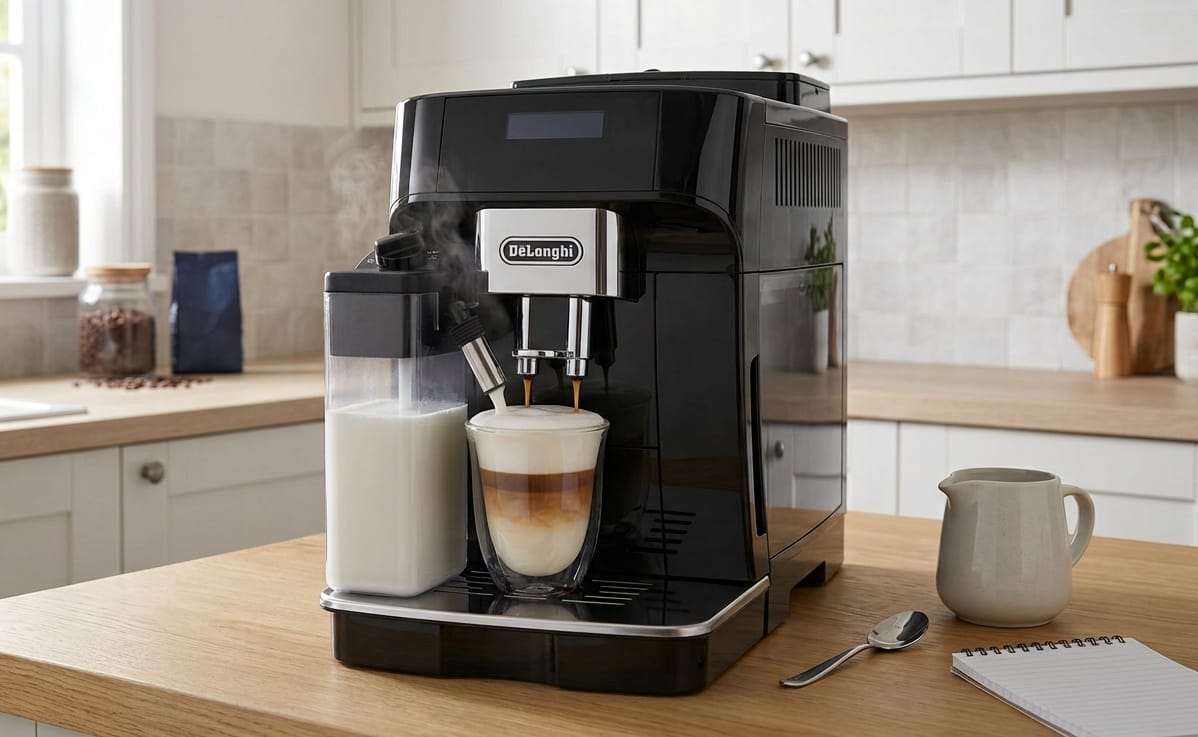
Let me be upfront about the weird position this ECAM22080 review is written from. I don’t own the ECAM220.80. I own its two halves: the Magnifica Start has been on my counter for two years (the ECAM22022, the panarello version), and the LatteCrema carafe system runs on the Evo in my family that I get to use regularly. The 220.80 is those two things bolted together — same Start body, carafe instead of wand. So this is not a review of a machine I unboxed; it’s a review from someone who knows both of its parts on a first-name basis. Where owner threads add what I can’t know — how the exact combo behaves — I’ll say so and point at them.
Exact models covered: ECAM220.80.SB / ECAM22080SB (US retail writes it solid, EU with dots — same machine; SB is the silver-black finish and means nothing mechanically). If your listing shows a different code, run it through my model number decoder before assuming anything.
TL;DR: The 220.80 is the cheapest way into DeLonghi’s one-touch milk, full stop. Same espresso as my Start — which is to say good daily espresso once dialed in, not café espresso — with the carafe doing cappuccino and latte macchiato on a button. If there’s a milk drink in your hand most mornings, this is the version of the Start to buy. If milk is occasional, it’s a fridge shelf and a weekly teardown you’ll resent — get the regular Start and my five-second wand purge instead.
What it is in the lineup
DeLonghi’s budget shelf now splits three ways: Start with a wand (my 22022), Start with LatteCrema (this one), and the Evo with LatteCrema one step up. The 220.80’s pitch is simple — Evo-style milk automation without Evo pricing. What you give up against the Evo is the sleeker finish and the dedicated color display interface—the Start body uses a chunkier, all-plastic chassis with monochrome touch icons that feel more utilitarian, and its footprint takes up a fraction more visual weight on the counter, even though the actual footprint is nearly identical. What you keep is everything that makes coffee: this platform shares the brew group, grinder, and thermoblock across the whole shelf — I’ve written about that at length in the Start vs Evo comparison, and it’s the reason this review doesn’t need a “how’s the espresso” chapter twice. The espresso is my espresso. Two years of it.
The espresso half (the part I own)
Thirteen grind settings, 15-bar pump, the same removable brew group I rinse weekly. Dialed to grind size 3, maxed-out coffee strength (3/3), and medium volume, it pulls a balanced shot that beats any pod system and doesn’t pretend toward third-wave. The soft-touch icon panel is the same as mine: no text, no screen, zero learning curve after day one. Warm-up to first cup is a real morning metric and the Start does fine on it. Everything I wrote in the ECAM22022 review about seals, trays, and the year-three owner-forum complaints applies here unchanged — same skeleton.
The milk half (the part I borrow)
LatteCrema is the reason this machine exists, so let me describe the actual routine, not the brochure. You pull the milk carafe out of the fridge door, snap it onto the spout (takes three seconds), press cappuccino, and walk away. When it finishes, you run the three-second auto-clean dial directly into the drip tray, wipe the tip, and put the carafe right back in the fridge. The whole interaction adds less than 20 seconds to your morning. The upside is effortless, non-custodial workflow; the annoyance is that if you leave a splash of milk sitting in the carafe for three days, cleaning those tiny internal silicone channels quickly turns into an unwanted tooth-brushing exercise. The foam it makes is denser than what any panarello produces, closer to what you tip a barista for, and it does cappuccino and latte macchiato as separate one-touch programs.
The tax is cleanup. The carafe self-rinses after each session, which handles the daily part — but once a week it wants a full teardown into its pieces. The main point of friction is taking apart the dial assembly and pulling out the tiny inner silicone suction tube; if you don’t run hot water and a pipe cleaner through that micro-channel, old milk residue builds up right at the seal, and the next cappuccino comes out sputtering, thin, and watery. It takes about 3 to 4 minutes under the tap, but it’s 3 minutes of tedious, finicky work. Owner threads on the 220.80 repeat the same arithmetic I live with on the Evo: daily milk drinker — the teardown is a fair trade for never touching a wand; weekend-cappuccino person — the ratio flips and the carafe becomes the most demanding appliance in the kitchen. That’s the entire buy/don’t-buy of this machine, and it’s about your habits, not the hardware.
What owner threads add
The combo-specific record is young but consistent (r/superautomatic and the DeLonghi owner threads, openly attributed as always): praise clusters on “cappuccino without thinking,” complaints cluster on milk temperature — LatteCrema foam runs warm-not-hot, same as on the Evo — and on the fridge-space reality of a carafe household. Nothing mechanical stands out beyond the platform’s known year-three seal grumbles. Refurbished units come up often in these threads because the price gap is tempting; my standing rule from the flagship comparison holds — DeLonghi factory-renewed with a real warranty is fine, third-party “renewed” that quietly drops the warranty is how you find out the hard way.
Cost of ownership
Same consumables as every machine on this platform: descaler on the schedule your water dictates (the descale guide has the how and how often, and the calculator spits out your interval), water filters if you use them, and nothing carafe-specific to buy — the LatteCrema parts wash, they don’t get replaced. The one running cost the wand version doesn’t have is milk itself: one-touch convenience quietly doubles how often you make milk drinks. Ask me how I know.
Who should buy it
Buy the 220.80 if: a cappuccino or latte macchiato is your default order; two people in the house drink milk drinks; you want the cheapest DeLonghi that does milk on a button and you’ve made peace with a weekly teardown.
Skip it if: you’re mostly espresso/americano — the regular Start is cheaper and simpler; you want hotter, denser milk than any carafe system makes — that conversation ends at a steam wand, and the quiz will tell you if you’re actually that person; or your budget stretches to the Evo with LatteCrema, where the Start vs Evo fork takes over.
FAQ
Is the DeLonghi ECAM220.80 good for cappuccino?
That’s specifically what it’s for — LatteCrema makes denser, more consistent foam than any manual panarello at this price, on one button. The honest caveat owners repeat: the milk runs warm rather than hot. Cup-warming and maxing the temperature setting close most of that gap.
What’s the difference between ECAM220.22 and ECAM220.80?
The milk system, and that’s it. Same body, panel, grinder, brew group. The 22 has a manual panarello wand you purge in five seconds; the 80 has the LatteCrema carafe with one-touch drinks and a weekly teardown. You’re choosing a milk routine, not a coffee machine.
How long does a Magnifica Start last?
The platform’s owner record says the first real complaints — brew-group seals, mostly — show up around years three to five, and the carafe adds washable parts, not failure points. Mine is at two years on the same skeleton and counting. Treat descaling as non-optional and the horizon is realistic.
Is the Start with LatteCrema worth it over the regular Start?
Count your milk drinks per week. Daily or near-daily — yes, without hesitation; it’s the cheapest one-touch milk DeLonghi makes. A few per week or fewer — no; you’d be paying extra to store a carafe in the fridge and disassemble it on Sundays for drinks a wand handles fine.