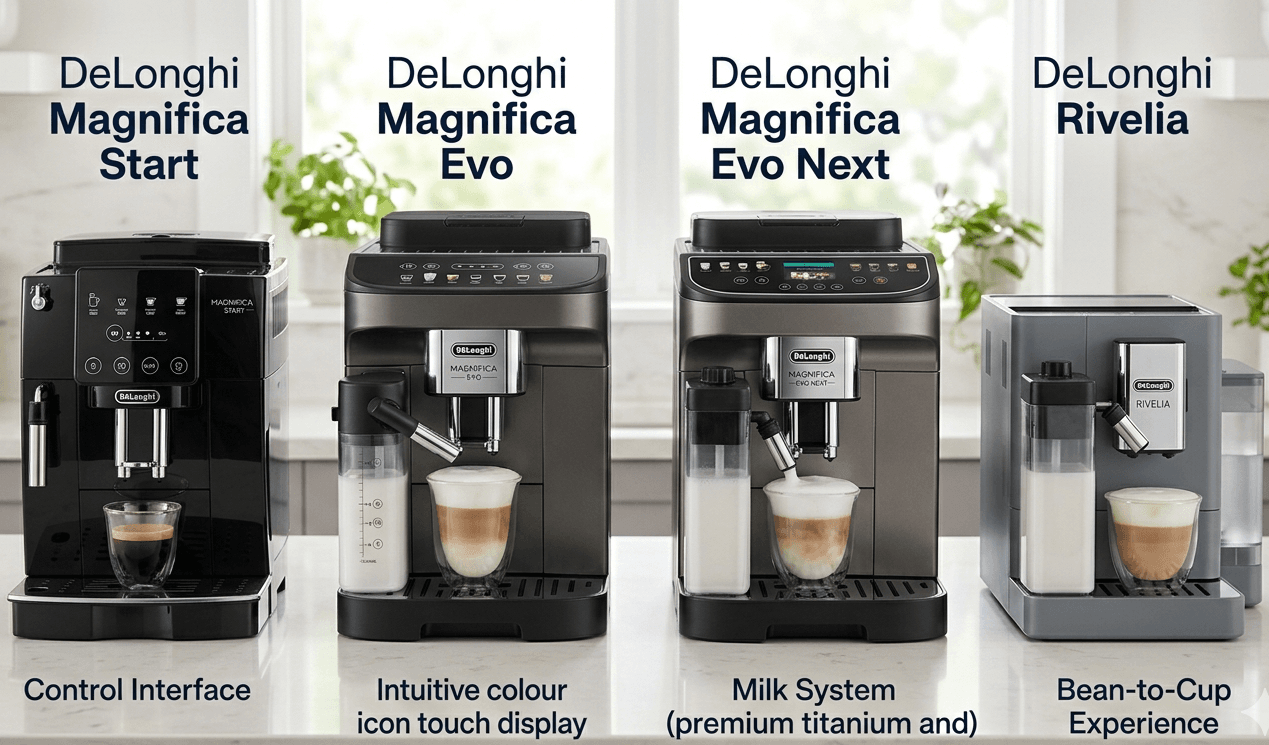
I’ve had a DeLonghi Magnifica Start sitting on my counter for two years now, and it still surprises me how confusing the rest of the lineup is to make sense of from the outside. There’s the Start. The Evo. The Evo Plus. The Evo Next. The Rivelia. They mostly look like the same matte-black box with a different screen bolted on, and DeLonghi has a habit of releasing a new one before you’ve finished reading the manual for the last one.
So if you’re standing in front of five Magnificas with no idea which one is actually for you — that’s a normal place to be. It’s not you. The naming is genuinely bad.
I’ll be straight about what I can and can’t help with here. I own the Start and I’ve used it daily for two years. I wrote a full review of the Evo, so I can talk about that one with my hands on it. The Evo Plus, Evo Next, and Rivelia I have not had on my own counter — I’m going off specs, DeLonghi’s own documentation, and other owners’ reports for those, and I’ll flag it every time so you know which parts are lived-in and which are research. I’d rather tell you that up front than pretend I’ve tested everything.
Quick context on me: I spent four years pulling shots behind a La Marzocco, then a decade making espresso at home (a Gaggia Classic was my first machine, and I still have feelings about it). The Start was my move into super-automatics. So I’m coming at these as someone who knows what a good shot tastes like and what a steam wand is supposed to do — not as someone who thinks the machine does magic.
Let’s sort this out.
Quick gut-check before we dive in: if you’re not even sure a Magnifica is the right DeLonghi for you — as opposed to a Dinamica, an Eletta, or the manual La Specialista — start with my broader which DeLonghi espresso machine guide and come back once you’ve landed on Magnifica. This page assumes you already have.
The Quick Answer: Which Magnifica for Which Person
If you don’t want to read 3,000 words about milk frothers — totally fair — here’s the short version. Find the row that sounds like you.
| If this is you… | Look at the… |
|---|---|
| Tight budget, fine doing milk by hand, want a real espresso machine without the fuss | Magnifica Start |
| Want the milk handled for you but don’t want to pay flagship money | Magnifica Evo (the auto-milk version) |
| Want drink presets, a touch screen, and hot and cold drinks | Magnifica Evo Next |
| Want maximum hands-off — auto milk, two bean hoppers, the works, and price isn’t the deciding factor | Rivelia |
The two real poles of this lineup are the Start at the bottom and the Rivelia at the top. Almost everything else is a step somewhere between “you froth your own milk and keep it simple” and “the machine does literally everything and you just press a picture of a latte.”
If one of those rows already clicked for you, you can stop here and go read the deeper section on that specific machine below. If you want to actually understand why the lineup is shaped this way — keep going. It makes the choice a lot less stressful.
How the Magnifica Lineup Actually Breaks Down
Here’s the thing nobody tells you: the Magnifica models aren’t really “better” and “worse” in a straight line. They move along a few specific axes, and once you know what those axes are, the whole lineup snaps into focus. You stop asking “which is best” (there isn’t a best — best for what?) and start asking “where on each axis do I want to land.”
There are basically four things that change as you move up.
1. How the milk gets made. This is the big one. At the bottom, you steam milk yourself with a manual frother — a panarello wand. Higher up, the machine has an automatic milk carafe that froths and pours for you at the press of a button. This single difference is most of what you’re paying for as the price climbs. If you drink your coffee black, a huge chunk of the upgrade ladder is irrelevant to you, and that’s worth knowing before you spend.
2. The interface. The cheaper models use physical buttons and dials. As you go up, you get a small TFT color touchscreen, then a bigger one, with drink icons you tap. Nicer to look at, faster to learn for a household where not everyone wants to think about coffee. Doesn’t change what’s in the cup, though.
3. User profiles and drink customization. Lower models give you a handful of recipes. Higher ones let you save profiles — so your “long, strong, extra hot” and your partner’s “small and mild” each live behind one tap. More presets, more saved settings, more drink types (including iced/cold on the newer ones).
4. The bean system. This one only shows up at the very top. Most Magnificas have a single bean hopper. The Rivelia has DeLonghi’s Bean Switch — two swappable hoppers — so you can keep, say, your morning beans and a decaf loaded at the same time and flip between them without dumping and refilling. I’ll come back to this because it solves a real, specific annoyance I live with daily on the Start.
That’s it. Milk, screen, profiles, beans. Every Magnifica is just a different combination of those four sliders. The grinder and the core brewing are broadly similar across the range — the conical burr grinder with adjustable grind settings shows up on basically all of them, which is honestly why the espresso itself doesn’t change as dramatically as the price tags suggest. You’re mostly paying for convenience and milk automation, not a fundamentally better shot.
Keep that in your back pocket. It’ll save you money if you don’t actually need the milk robot.
Magnifica Start — The Honest Entry Point (What I Actually Live With)
This is the one I can talk about without any hedging, because it’s been on my counter for two years.
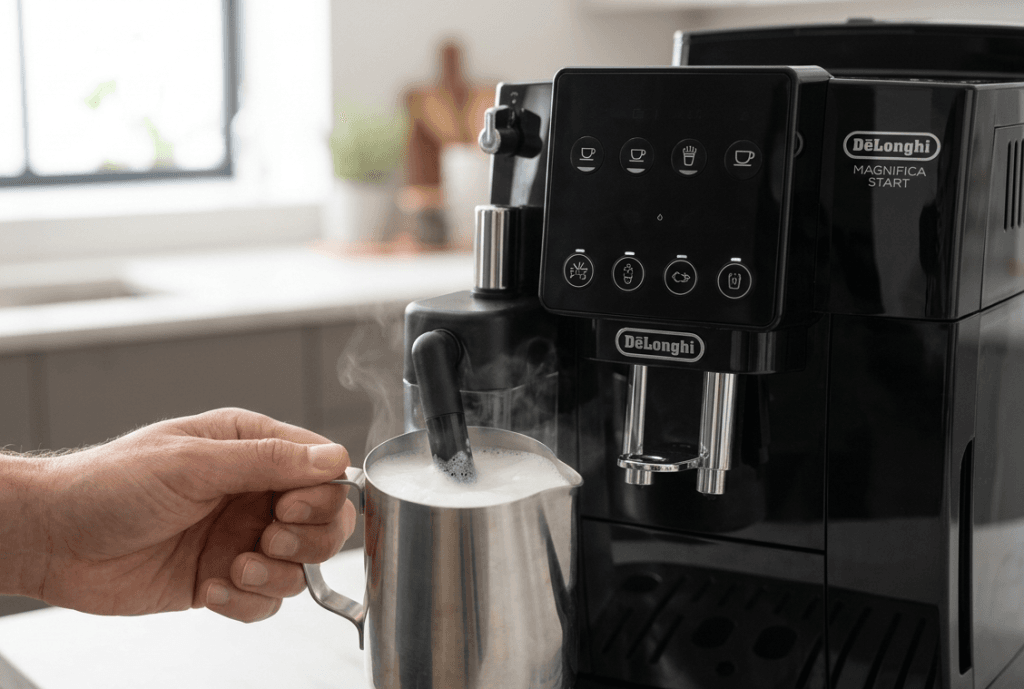
The Start is DeLonghi’s entry point into super-automatics: built-in grinder, automatic brewing, and — on the version I own — a manual milk frother, the panarello wand. You steam the milk yourself. Coming from years with a real steam wand, I actually like this. I have control, I can get decent microfoam if I pay attention, and there’s no plastic carafe to disassemble and rinse every time.
(There’s also a Start variant with LatteCrema automatic milk — I haven’t used that one, so I won’t pretend to. If hands-free milk matters to you, jump to the Evo section; that’s the cleaner version of that idea.)
What two years has taught me:
The predictability is the actual selling point. I press the button, I get the same espresso I got yesterday. For a home machine that’s running every single morning before I’ve fully woken up, “boring and consistent” is a feature, not a complaint. I dialed in Lavazza Oro at grind setting 3 ages ago and barely touch it now.
The grinder is loud. Not broken-loud, just — it’s a small burr grinder in a plastic body, and it announces itself. If your kitchen is next to a bedroom and you’re up first, you’ll notice. Nobody mentions this in the spec sheet.
The drip tray fills faster than you’d think. Because the machine rinses on startup and shutdown, the tray collects water fast. I empty it more often than I empty the grounds. Minor, but it’s a real daily-life detail.
The bypass chute is a one-shot, single-dose thing. If I want to make a cup with pre-ground coffee — usually decaf in the evening — I use the bypass chute, and it takes exactly one scoop for one drink. If I wanted two decafs, I’d be running it twice. And if I wanted to switch the whole machine over to decaf beans for a stretch, I’d have to empty the bean hopper of my regular beans first. That hopper-dumping is the single most annoying part of owning this machine. Hold that thought — it matters when we get to the Rivelia.
Who the Start is genuinely right for: you’re on a budget, you drink mostly espresso or you don’t mind frothing milk by hand, and you value a machine that just does the same thing reliably over one with a lot of buttons. It’s a great first super-automatic precisely because it doesn’t overwhelm you.
If you want the full breakdown — including the stuff I’d change and the maintenance reality — I went deep on it in my full Magnifica Start review.
Magnifica Evo & Evo Plus — The Middle Ground
The Evo is the one I’d point most people toward if the Start feels a notch too bare-bones, and it’s the other machine in this lineup I’ve actually used hands-on.
Compared to the Start, the Evo is a cleaner, slightly more refined version of the same idea, and — importantly — it comes in an automatic-milk (LatteCrema) configuration. That’s the upgrade most people are actually reaching for when they “want better than the Start”: not better espresso, but milk that handles itself. You get the carafe, you press the button, the cappuccino arrives. It uses the same grinder family with adjustable settings, so the shot quality sits right in line with the Start. The differences are around the edges — interface, milk handling, a few more drink options.
My honest take from using it: it’s a sensible machine, not an exciting one. It does the job, the milk drinks come out fine, and for a home kitchen that wants iced and hot milk drinks without spending flagship money, it’s a reasonable landing spot. I put the whole thing in my Magnifica Evo review, and if you’re torn specifically between this and the Start, I wrote a head-to-head on exactly that: Magnifica Start vs Evo.
The Evo Plus I have not used, so this is specs-and-reports only: it’s a variation on the Evo — generally a step up in customization and drink options, sitting between the standard Evo and the Next. If the Evo is “Evo, base,” the Plus is “Evo, with more presets.” I can’t tell you how it feels in daily use because I haven’t lived with one, and I’m not going to invent details about a machine I’ve never touched. If you’re choosing between Evo and Evo Plus specifically, the deciding question is just whether the extra recipes and customization on the Plus are worth the bump — the core experience is the same family.
Magnifica Evo Next — More Automation, More Profiles
The Evo Next is the newer, more automated middle-upper option, and it’s one of the machines getting the most attention right now. I’ll be clear again: I haven’t tested it personally. What follows is from DeLonghi’s specs and from other owners’ and reviewers’ reports, not my own counter.
What it adds over the Evo, as best I can tell: a proper TFT color touchscreen with soft-touch buttons, user profiles so different people in the house get their own saved drinks, a wider customizable drink menu, and hot and cold preparation built in. It runs the LatteCrema milk system on the milk-equipped versions. So the pitch is essentially “the Evo’s bones, with a real screen, presets you can save, and the ability to make cold drinks without a workaround.”
Reviewers who’ve actually tested it tend to land on the same conclusion: it’s a more sophisticated machine than the plain Evo, and the user profiles plus the broader drink menu are the meaningful additions — but the espresso itself isn’t a different league, because it’s the same grinder-and-brew DNA.
Who it’s for, by my read: you want presets and a touch interface, you’d use the saved-profile feature (a two-coffee-preference household is the obvious case), and cold drinks matter to you — but you don’t want to climb all the way to flagship pricing. It’s the “I want it to feel modern and do most of the thinking” pick without going to the top of the range.
If that’s you, this is the one to look at:
Rivelia — The Top of the Range (Bean Switch + Hands-Off Milk)
The Rivelia is the ceiling of this conversation — technically its own line rather than a Magnifica, but it’s the machine most people step up to from a Magnifica, so it belongs in this guide. Again — not on my counter, going off specs and other owners’ reports — but it’s worth understanding even if you don’t buy it, because it’s where DeLonghi put all of its “what if the machine did everything” ideas.
Two things make it stand apart from everything below it.
The Bean Switch system. This is the headline, and it’s the part I keep coming back to. The Rivelia has two swappable bean hoppers instead of one. You can keep your regular beans in one and decaf (or a different roast) in the other, and switch between them without dumping and refilling anything.
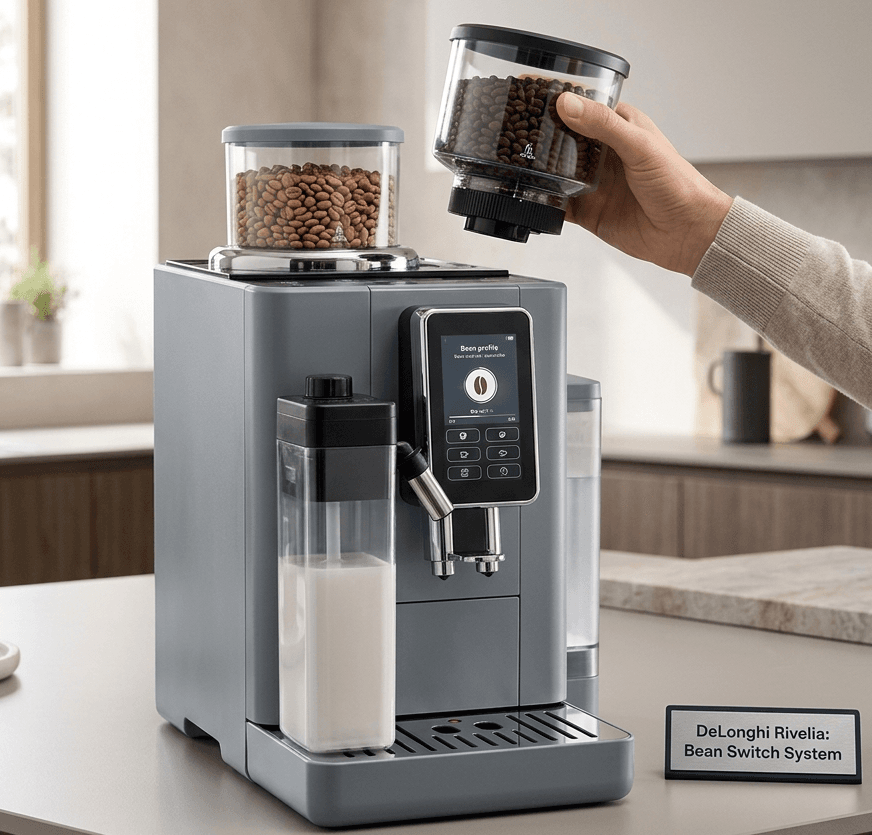
Remember the most annoying thing about my Start? That to run decaf beans I’d have to empty the whole hopper of my morning beans first — and the bypass chute only does one cup at a time. The Bean Switch is the exact, specific fix for that problem. I’m not saying that as marketing; I’m saying it as the person who lives with the annoyance the feature was built to remove. If you, too, are a “regular beans most of the time, decaf sometimes, and I hate the dumping” person, this is the only machine in the lineup that actually solves it. (Worth noting from owners’ reports: a few grams of coffee do stay in the grinder chamber when you switch, so it’s not surgically clean — but it’s a world away from emptying a hopper.)
Fully hands-off milk, hot and iced. Automatic milk carafe, automatic frothing, both hot and cold drinks. Combined with DeLonghi’s Bean Adapt setup — where the machine asks about your beans and adjusts — the whole thing is built around you pressing one button and walking away.
Who it’s for: you want the maximum-convenience machine, you’d genuinely use the two-hopper system, and the higher price isn’t the thing that decides it for you. It’s the flagship, and it’s priced like one — so it only makes sense if the convenience and the Bean Switch are things you’ll actually use, not just admire on the spec sheet.
So Which One Should You Buy?
I’m not going to give you a single “winner,” because that’s not an honest way to answer this. The right Magnifica depends entirely on two questions: how much do you care about milk being automatic, and how much variety do you want from one machine? Here’s how I’d actually advise four different people.
You’re cost-conscious and you mostly drink espresso (or you don’t mind frothing milk yourself): Get the Start. It’s the machine I own, it’s reliable, and you will not feel like you’re missing anything if milk automation isn’t a priority for you. Don’t pay for a milk carafe you won’t use.
You want milk handled for you, but you’re not trying to spend flagship money: Get the Evo in its auto-milk version. It’s the sensible middle. Hot and iced milk drinks, no manual steaming, reasonable price. If you’re stuck between this and the Start, my Start vs Evo comparison is the fastest way to decide.
You want a modern machine with a touchscreen, saved profiles, and cold drinks — but still short of the top: Look at the Evo Next. The profiles are the real reason to go here, especially in a household where two people want two different drinks. (Reminder: I’m recommending this on specs and others’ reports, not my own testing.)
You want everything automated, you’d use two bean hoppers, and price isn’t your deciding factor: The Rivelia is the only one that gives you the Bean Switch, and that feature genuinely solves a problem I deal with every week. If that problem is yours too, it’s a real reason — not just a luxury upsell.
And if you’re cross-shopping outside DeLonghi entirely — say, against a Philips at a similar price — I compared my Start directly against one here: Magnifica Start vs Philips Series 2200.
One last honest note: any of these will make you good coffee. The grinder and brewing core are similar enough across the range that the espresso in the cup won’t be wildly different from model to model. What you’re really choosing is how much the machine does for you — and how much you’re willing to pay for that. Buy for the milk and the convenience you’ll actually use, not for the spec sheet.
FAQ
What is the difference between the DeLonghi Magnifica models?
They mainly differ along four things, not one. First, how milk is made — manual frothing on the entry models, automatic milk carafes higher up. Second, the interface — buttons on cheaper models, touchscreens on newer ones. Third, profiles and presets — more saved drinks and user profiles as you go up. Fourth, the bean system — only the top model (Rivelia) has two swappable hoppers. The grinder and core espresso brewing are broadly similar across the lineup, so most of the price difference is convenience and milk automation, not a fundamentally better shot.
Which is the best DeLonghi Magnifica model?
There isn’t a single best one — it depends on what you want. The Rivelia is the most capable and most automated (and the most expensive). The Start is the best value if you’re fine frothing milk by hand. The Evo and Evo Next sit in between for people who want automatic milk without flagship pricing. “Best” only makes sense once you decide how much milk automation and variety you actually need.
What’s the difference between the Magnifica Evo and the Start?
The Start is the entry model and the version I own comes with a manual milk frother — you steam the milk yourself. The Evo is a step up that’s commonly bought in its automatic-milk (LatteCrema) form, so the machine froths and pours milk for you, with a slightly more refined interface and a few more drink options. Espresso quality is similar; you’re mostly paying for hands-free milk. I broke this exact matchup down in my Start vs Evo comparison.
What is the difference between the Magnifica Evo and the Evo Plus?
They’re the same core machine; the Plus is a variation that generally adds more drink customization and presets over the standard Evo. The brewing and grinding are the same family, so the espresso experience is essentially identical — the question is just whether the extra recipes and customization on the Plus are worth the price bump for you. (I’ve used the Evo, not the Evo Plus, so I’m going on specs for the Plus side.)
Which DeLonghi Magnifica is best for milk drinks?
If you want to make the milk yourself with control, the manual frother on the Start is perfectly capable — I get decent microfoam with it after years of practice. If you want the machine to do the milk for you, hands-free, look at the Evo (auto-milk version), Evo Next, or the Rivelia, which all use an automatic milk carafe. The Rivelia goes furthest, doing both hot and iced milk drinks automatically. So it comes down to whether you enjoy steaming milk or want to never think about it.