
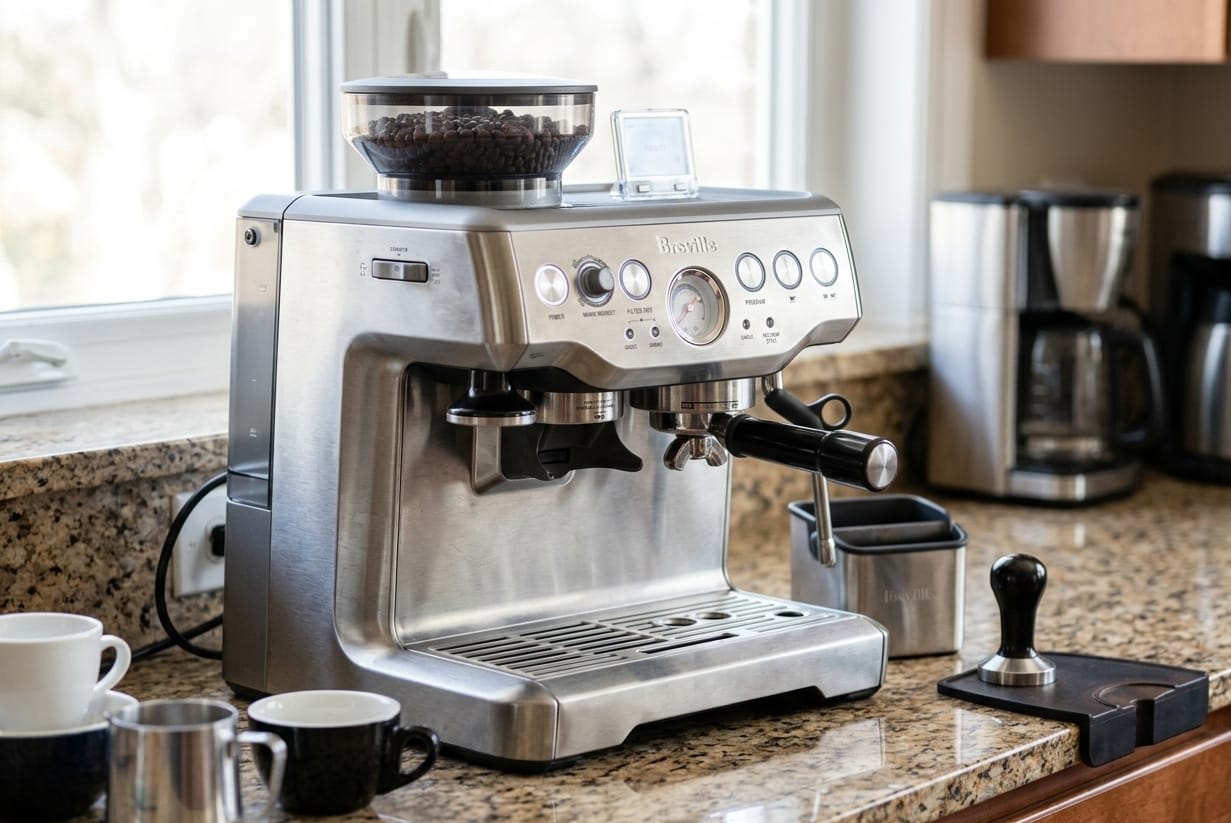
I’ll say this upfront: I’ve never owned a Breville Barista Express. What I owned was a Gaggia Classic — a bare semi-automatic with no grinder, no PID, no help of any kind — and before that I spent four years pulling shots on a La Marzocco in a college café. So I know the life the Barista Express is inviting you into, intimately. The grinding, the tamping, the wiping, the little rituals you don’t notice you’ve built until the machine is gone. When I talk about the Express itself — the BES870XL, its specs, its quirks — that’s research and owner reports, and I’ll say so. When I talk about what it’s like to live with a machine like this, that part I lived.
And “worth it” is really a question about that life, not about the machine.
The Short Answer
Worth it: if you want to learn actual hands-on espresso, you like that the grinder is built in, and the idea of a ten-minute morning ritual sounds pleasant rather than exhausting.
Not worth it: if what you actually want is good coffee, fast, with nothing to clean. That’s a super-automatic, and there’s no shame in it — I ended up there myself, and I’ll tell you why in a minute.
There’s also a third path that experienced people will push you toward — a bare machine plus a separate grinder — and I’ll get to that too, because I lived that exact setup and I have opinions.
What the Barista Express Actually Is
Specs first, and quickly, because they’re the least interesting part. The BES870XL usually runs somewhere in the $500–700 range. For that you get a semi-automatic espresso machine with a conical burr grinder built into the top, dose control, PID temperature stability, pre-infusion, a manual steam wand, and a single ThermoCoil boiler — which means you pull your shot first, then wait a beat while it switches over to steam. You can’t do both at once. People make it sound like a bigger deal than it is; it’s a pause, not a flaw.
The one spec that actually matters is the first one. The grinder is built in. Everything else about this machine’s popularity flows from that.
A word on the steam wand, though, because milk is where most beginners quietly give up. The Express has a proper manual wand — you’re texturing milk yourself, no automation, no assist. I spent four years on a commercial La Marzocco wand, and I’ll tell you what nobody selling you this machine will: manual milk has a genuinely awkward first month. Your foam will be soapy. Your latte art will be an insult to the word “art.” And then one morning it clicks, and after that it’s yours forever — wand technique transfers across every machine you’ll ever own. The Express’s wand is smaller and less powerful than a café machine’s, which actually makes it easier to learn on, because everything happens slower. Just know that “manual steam wand” on the spec sheet translates to “a skill you’ll be acquiring,” not a feature that works out of the box.
The Grinder Thing (Where My Money Went)
My Gaggia had no grinder. Nobody warned me loudly enough what that meant, so let me be the person who warns you: a bare espresso machine cannot make espresso. I paired mine with a Baratza Encore ESP — I keep saying it cost $200, though honestly with shipping it was closer to $220 — and that purchase stung, because I’d assumed the machine was the expensive part and the grinder was some accessory. It is not an accessory. For espresso the grinder matters as much as the machine, maybe more.
It also meant two things on the counter. Two things to clean. Two things to think about. Every new bag of beans came with its own small ceremony: I’d pull the first shot knowing it probably wasn’t the one I’d drink, taste it, nudge the grinder a notch, and treat the second shot as the real start of the bag. After a while I stopped resenting that first sacrificial shot — it was just what opening beans meant. But it was time, and it was attention, every single bag.
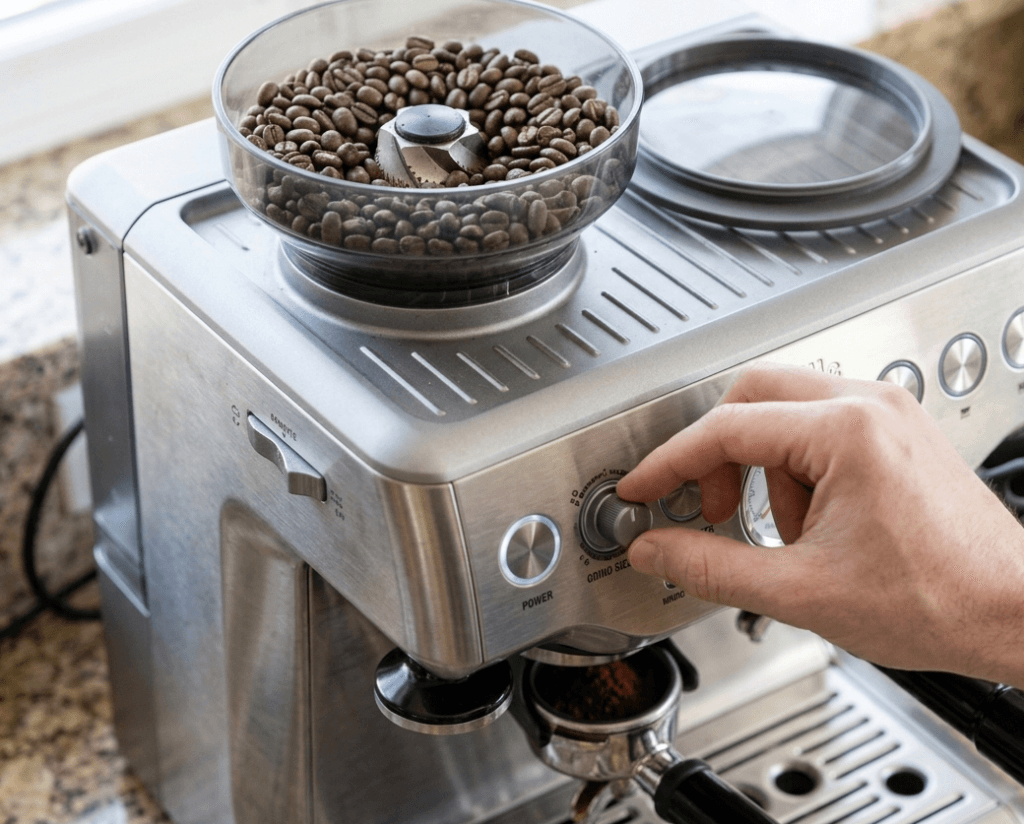
The Barista Express folds all of that into one box. One purchase, one footprint, grind and dose living inside the same system you’re already using. That’s the pitch, and having paid for the two-piece version of this life, I think the pitch is legitimate. For most beginners the built-in grinder isn’t a compromise — it’s the feature that saves them from buying a bad separate grinder, which is the classic first mistake.
Is the built-in grinder as good as a dedicated one? No. Owners are consistent on this: it’s good, it’s matched well to the machine, and a serious hobbyist will eventually want more. But “eventually” is doing a lot of work in that sentence. Most people never get there.
What This Kind of Machine Asks of You Daily
Here’s what the spec sheet won’t tell you, and what I only understood after two years with the Gaggia.
You don’t just make coffee on a machine like this. You keep a small station. I had one folded microfiber towel that lived next to the Gaggia — it wiped the steam wand, caught the drips off the portafilter, cleaned up after knocking out the puck. When I eventually packed the machine away, the towel went too, and weirdly that’s what made the kitchen feel different. Not the missing machine. The missing towel.
You build habits you don’t notice. I used to lock the portafilter back into the group head after washing it — not because it needed to be there, but because leaving it loose on the counter looked unfinished. Wash, dry, twist it back in, now the morning is done. I’d run the steam wand for one extra second before shutting the machine off, every time, even after wiping it. I couldn’t tell you when that started. I can tell you I felt strangely uneasy the few times I forgot.
Even the sounds become information. One solid tap on the knock box meant a clean puck and, usually, a shot I was happy with. Two or three taps meant something had gone wrong upstream — grind, dose, distribution — and I’d half-know the espresso was mediocre before I even looked at the basket.
I’m telling you all this because this is what “worth it” hinges on. The Barista Express softens the edges — PID and pre-infusion genuinely make dialing in more forgiving than my bare Gaggia ever was — but it does not exempt you from the ritual. The towel, the wiping, the puck, the wand. If reading that paragraph made you smile, this machine is probably worth it to you. If it made you tired, believe that feeling.
One more thing about the ritual, since we’re being honest: it doesn’t feel the same every day, and nobody tells you that either. There were stretches where I looked forward to the whole sequence — grinding, tamping, the hiss of the wand — like a small ceremony before the day started. And there were weeks where I’d stand in front of the machine at 7 a.m. thinking, I just want the coffee to exist already. Both of those were me. Both will be you. The question isn’t whether you’ll love the ritual — you will, sometimes — it’s what proportion of your mornings can absorb it.
The Two-Piece Alternative (What the Purists Will Tell You)
Ask on any espresso forum whether the Barista Express is worth it and someone will answer, within minutes, that you should buy a Breville Bambino and a separate grinder instead. The logic: a dedicated grinder outperforms any built-in one, and you won’t outgrow the setup.
They’re not wrong. They’re just answering for a different person.
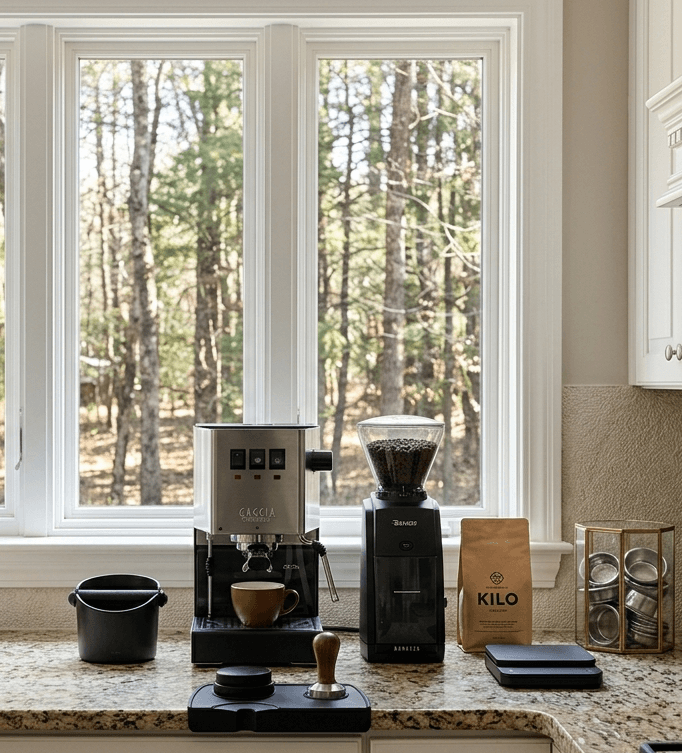
I ran the two-piece setup — Gaggia plus Baratza — and yes, the ceiling is higher. It’s also two machines to clean, two counters’ worth of space, and a grinder to re-dial with every new bag. The purist path assumes you’ll enjoy that coordination. Some people genuinely do. But I’d guess most people who think they’ll become tinkerers actually just want a reliable, hands-on cup — and for them, one integrated box beats a theoretically better system they’ll be slightly annoyed by.
There’s also a small, unglamorous factor nobody puts in comparison tables: kitchen real estate. My Gaggia-plus-grinder setup ate a solid corner of counter, plus the knock box, plus the towel, plus the little cup where the tamper lived. It stopped being a coffee machine and became a coffee zone — and everyone else in the house had opinions about the zone. The Express consolidates most of that footprint into one appliance. If you share a kitchen with people who don’t share your hobby, that’s not a trivial argument.
So: Bambino-plus-grinder if you already know you’re the upgrading type. Barista Express if you want the craft without the assembly project. (I went deeper on this exact fork in my Barista Express vs Gaggia Classic comparison, if you’re torn.)
The Morning That Changed My Answer
I want to tell you about one specific morning, because it’s the most honest thing I can offer on the “worth it” question.
Toward the end of my Gaggia years, I pulled what was probably the best espresso I’d ever made. Rich crema, syrupy body, exactly the flavor I’d been chasing. I was genuinely proud of it. Then I looked at the clock and realized I’d spent almost twenty minutes getting there — adjusting, purging, re-tamping, fussing.
That was the morning I started wondering whether I enjoyed making espresso more than drinking it. And I noticed something else once I started paying attention: I loved the whole ritual on Saturdays. On Tuesdays, the exact same routine felt like one more item on a to-do list. Same machine, same steps, completely different experience depending on what the day was asking of me.
Eventually convenience won, and I moved to a super-automatic. Not because the semi-auto life is bad — because I finally admitted which person I was on a Tuesday, not which person I was on a Saturday.
That’s the real test for the Barista Express. Don’t ask whether it’s a good machine (it is). Ask which version of you will be standing in front of it on a random Wednesday in November. If Wednesday-you still wants to grind and tamp and wipe the wand, buy it. If Wednesday-you just wants coffee, be honest about that now — it’s a much cheaper lesson before the purchase than after. I compared the hands-on and hands-off paths directly in Barista Express vs DeLonghi Magnifica if that’s the fork you’re actually standing at.
Long-Term Ownership: The Part People Skip in the Math
Two more real costs before the verdict. Daily: the portafilter rinse, the wand wipe, the puck. Periodic: descaling, which any machine in this class needs to protect the boiler — Brevilles have their own routine and their own quirks, which I covered in how to descale a Breville espresso machine. None of it is hard. All of it is real. Factor it in.
And here’s why the upkeep actually matters, from someone who occasionally slacked on it: neglect shows up in the cup before it shows up anywhere else. On my Gaggia, if I let the cleaning slide for a couple of weeks, the shots went subtly muddy — nothing dramatic, just a flatness I’d only notice after I finally cleaned everything and the next espresso tasted bright again. Scale and old coffee oils are quiet saboteurs. The machines don’t complain; the coffee does. So when you’re doing the “worth it” math, count the maintenance not as a chore tax, but as the thing standing between you and slowly worsening espresso you won’t be able to explain.
Verdict
The Breville Barista Express is worth it for the person who wants hands-on espresso in one box — the built-in grinder alone saves you the $200-and-change I spent learning that lesson separately, and PID plus pre-infusion make the learning curve kinder than what I climbed on my Gaggia. For that person, and it’s most people seriously considering this machine, I think it’s one of the most sensible purchases in entry espresso.
It’s not worth it for the person who wants coffee without a ritual — that’s a super-automatic — or for the confirmed tinkerer who’ll be shopping for a dedicated grinder within a year anyway.
I’d only add this: whichever person you are, be that person on purpose. The machine’s fine either way. It’s the Tuesdays you have to be honest about.
Frequently Asked Questions
Is the Breville Barista Express worth the money?
For someone who wants hands-on espresso with everything in one box — yes. The built-in grinder alone offsets the $150–250 a decent separate grinder costs (mine was $220 with shipping, a lesson I learned the hard way). If you want zero-effort coffee, spend the money on a super-automatic instead.
Is it good for beginners?
Yes, and honestly it’s kinder to beginners than what I learned on. PID and pre-infusion forgive small mistakes that my bare Gaggia punished. You’ll still pull some sad shots the first couple of weeks. That’s the tuition.
Do you still need a separate grinder?
No. That’s the entire point of this machine.
Can it make café-quality espresso?
The machine can. Whether you can is a technique and fresh-beans question, not a hardware one — and that stays true for your first year at least. I pulled my best-ever shot on a much cruder machine than this; it just took me twenty minutes and two years of practice.
Barista Express vs Bambino Plus — which one?
Express if you want one integrated box and less to manage. Bambino Plus if you’re building a two-piece setup with a dedicated grinder — higher ceiling, more coordination. Having lived the two-piece version: it’s better on paper and more annoying on a weekday.
What about the Barista Express Impress?
Same idea plus an assisted-tamping system, at a higher price. Nice if puck consistency worries you; not essential. The standard Express covers the fundamentals fine.