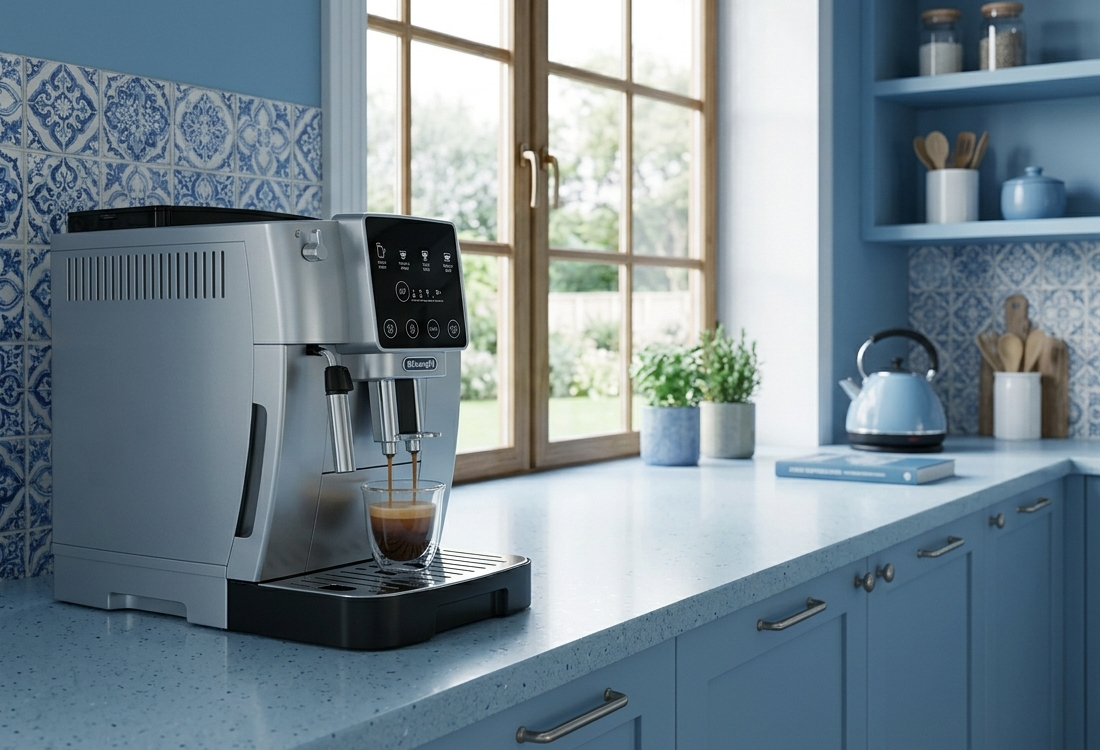
Last updated: May 2026 | Model owned: ECAM22022SB (Silver/Black, manual panarello, with Americano recipe) | Time owned: ~2 years
TL;DR: The Magnifica Start is the cheapest way to get bean-to-cup espresso at home from a brand that won’t surprise you. After two years of daily use, my honest take: if you mostly drink espresso, this machine gives you the same shot as the more expensive Evo for $150 less — same brew group, same grinder, what’s in the cup is nearly identical. Skip it if you want one-touch milk drinks (the panarello is fine, not magic), or if you’re chasing café-grade espresso (you’re not getting that from any super-automatic at this price, full stop).
Price range: $499–599 | Verdict: 7.6/10
Why This Review Is Different
Most Magnifica Start reviews are written by people who unboxed the machine, ran ten shots through it, and called it a review. This one isn’t.
I’ve owned the ECAM22022SB for about two years. Daily double espresso. Long coffee in the afternoon when I want something less intense. Panarello milk a few times a week in the first months and almost never now, because mornings are short and washing a steam wand for one cup gets old fast. Two descaling cycles. One frustrated evening when I thought the machine had died and it turned out the grounds container wasn’t fully seated — more on that later, because it caught me out twice.
Two years is enough to be past the honeymoon and not yet at the point where I’m pretending to be objective about a machine I’ve already accepted. That’s the angle here.
The Magnifica Start is DeLonghi’s entry-level super-automatic espresso machine — if you’re not sure whether super-auto is the right category for you in the first place, that guide is the place to start.
If you’re cross-shopping the Start against the Magnifica Evo, I have a separate piece on the Evo here — and a detailed head-to-head comparison covering where the extra $150 actually goes.
What Changed After the Honeymoon Period
The first month with this machine, I noticed everything. The noise. The lights. The fact that it asked for water on day three. After two years, here’s what actually shifted:
- The shot got better, not because the machine changed, but because I stopped fighting it. Reprogrammed volumes shorter, settled on grind 3, stopped expecting Ethiopian single origins to taste like anything. Once I matched my expectations to what the machine does well, the morning espresso became reliably good instead of inconsistently disappointing.
- I gave up on the panarello. Used it weekly for the first three months. Rarely now. Cleanup cost outweighed the cappuccino payoff for a one-cup household.
- I learned the maintenance rhythm by feel. Water tank every two days, drip tray every two-three, grounds container every three. No alarm needed.
- The “quirks” became routine. The grounds container that has to be pushed in firmly. The fact that the shutdown rinse runs whether you like it or not. The first-shot-of-the-day temperature drop. None of these annoy me now. They’re just how this machine is.
- Nothing has broken. Two years, two descaling cycles, one episode of a squeaky brew group I lubricated. That’s it.
If I were buying again today, I’d buy this machine again. Knowing what I know now, I’d also buy a counter-top knock box on day one and skip ordering replacement panarello parts I never needed.
Quick Specifications
| Specification | ECAM22022SB |
|---|---|
| Pump pressure | 15 bar (vibration pump) |
| Brew pressure (actual) | ~9 bar at the group head |
| Heating system | Thermoblock (single) |
| Grinder | Steel conical burr, 13 settings |
| Bean hopper | 250 g |
| Water tank | 1.8 L (removable) |
| Milk system | Manual panarello steam wand |
| Drinks menu | Espresso, coffee, Americano, hot water |
| Iced coffee function | No |
| Auto-rinse | Yes (startup + shutdown) |
| Display | Soft-touch panel (icons, no text) |
| Dimensions (W × D × H) | 9.4″ × 17.5″ × 13.8″ |
| Weight | ~20 lbs |
| Warranty | 2 years (US), 1 year (international) |
| Power | 1450 W, 120V |
Who This Machine Is For
Before you read 2,000 more words, use this filter. I’d rather talk you out of buying the wrong machine than have you email me in six months.
Buy the Magnifica Start if you:
- Drink mostly espresso, double espresso, or long coffee — milk drinks are occasional, not the main event
- Want a bean-to-cup machine at the lowest reasonable price point from a brand that’s been making them forever
- Don’t want to learn anything and don’t want a touch screen pretending to teach you things
- Are okay running consumables on schedule — what you save on the machine, you spend on descaler and cleaning tablets over the years
- Are upgrading from a pod machine, drip, or instant, and want a clear jump without a hobby project
Don’t buy it if you:
- Make 2+ milk drinks per day and don’t want to clean a steam wand every time — get the Evo with LatteCrema, or a Start auto-frother variant (ECAM22080SB)
- Want light-roast single-origin espresso to taste like it does at a third-wave café — no super-automatic in this price range delivers that
- Need a quiet morning — the grinder and rinse cycles are loud enough to wake people in adjacent rooms. The first week I had it, I winced every time
- Hate maintenance — even a “set and forget” super-automatic isn’t actually set and forget. You’ll still descale, still clean the brew group, still get warning lights on the worst possible mornings
- Already own an older Magnifica S in working condition — the Start’s improvements are real but not worth replacing a working machine
If this filter didn’t eliminate you, keep reading.
If you’re weighing super-auto against a traditional semi-auto setup, I’ve written a full comparison of the two categories based on living with both for years.
Espresso Quality: What You Actually Get
This is where most super-automatic reviews either oversell or completely dismiss the result. After two years of double espressos and the occasional Americano, here’s the actual middle.
What the machine does
The Start pre-infuses for about a second, then extracts at roughly 9 bar at the group head. The “15 bar” you see on every retailer page refers to the maximum pump pressure, not what’s hitting your puck — a confusion the marketing leans into. The Americano recipe pulls a regular espresso first, then automatically tops it with hot water — better than just brewing a long coffee from a single dose, because you avoid over-extracting the puck.
In the cup:
- Body: Medium-thick crema that holds for about a minute. Acceptable. Not the dense, persistent crema you’d get from a proper espresso machine with a fresh basket and a dialed-in grinder.
- Flavor profile: Works honestly with medium and medium-dark roasts. Chocolate, nuts, caramel, dark fruit — all readable. Push it toward light roast and it falls apart.
- Consistency: This is what the Start does best. Shot after shot, week after week, the variance is tiny. Whatever it gives you today, it’ll give you again tomorrow. That’s worth a lot more than super-automatics usually get credit for.
- Temperature stability: The thermoblock heats fast but isn’t as stable as a dual boiler. The first shot of the day comes out a few degrees cooler than the second. If you’re particular, pull a “throwaway” hot water shot first to warm the group.
Why light roasts don’t work here
Three reasons:
- Grinder steps too coarse. The 13 settings work for medium roasts but light roasts often need a setting between numbers, and you can’t have it.
- Thermoblock runs too cool for proper light-roast extraction. You can nudge brew temperature up in the menu, but you’re moving a ceiling, not removing it.
- No pressure profiling. Fixed 9-bar extraction doesn’t let you slow-ramp, which is how modern light-roast espresso is meant to be pulled.
If you’ve been buying single-origin Ethiopian and hoping it’ll work here — it won’t. Stick to medium-roast espresso blends. Lavazza Oro is what I drink most days.
Settings worth changing on day one
Factory defaults are too long across the board. What I run:
- Espresso: ~30 ml (default 40 ml, comes out diluted)
- Coffee: ~90 ml (default 180 ml, over-extracts)
- Americano: I leave at default — calibrated correctly out of the box
Hold the relevant drink button for ~3 seconds while it pours to reprogram volume. Doing this changed how the machine tasted to me more than switching beans ever did.
Milk Frothing: The Honest Reality
Two years in, I make milk drinks maybe once a week. Here’s why.
What the panarello does
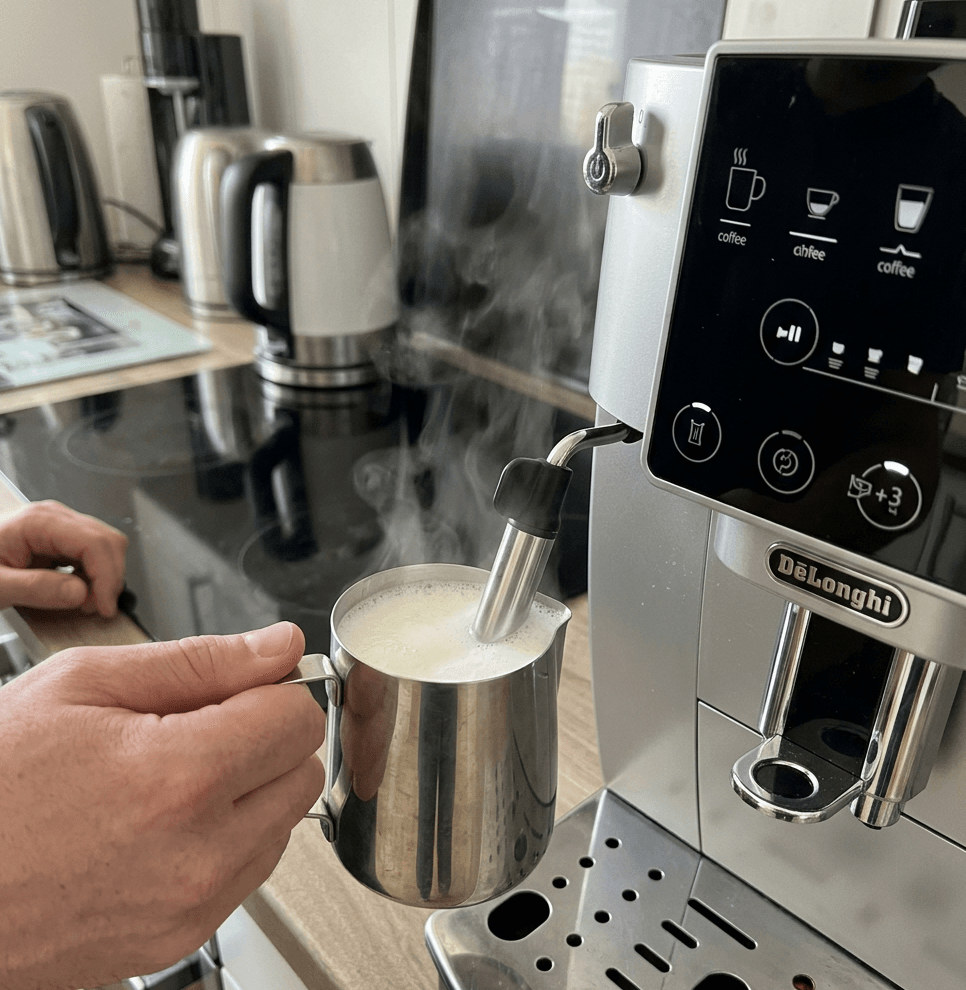
The panarello is the basic manual frother — a plastic sleeve over a steam wand that pulls in air through small holes as steam comes out. Not the bare wand you’d find on a prosumer machine, not the automatic carafe on an Evo top variant. The in-between option, doing the in-between job.
I used cold whole milk straight from the fridge. Small ceramic pitcher. Hold the wand at the right angle and you get plausible cappuccino foam in about 40 seconds. Plausible — meaning thick, dense, white, with no obvious large bubbles if you positioned it well.
What I never got, even after weeks of trying:
- Silky microfoam, the glossy paint-like texture you see on café lattes
- Latte art that holds its shape
- Foam thin enough to pour smoothly into espresso for actual flat whites
The panarello introduces too much air at once and doesn’t give fine control over aeration. You can get closer with practice, but you’ll hit a ceiling well below what a half-decent café delivers.
What works on this thing
- Cappuccino: Yes. Dense foam scoop on top of espresso. Looks fine, tastes fine, no latte art.
- Café au lait / steamed milk drinks: Yes. Just heat without much aeration.
- Hot chocolate base: Yes, the wand heats milk to drinkable hot in under a minute.
- Latte art: No. Don’t try.
- Flat white: No, not properly.
Why I stopped using it
Two reasons.
First, the cleanup. After every use you need to purge the wand (run steam through it for a few seconds), then wipe it immediately with a damp cloth before the milk dries. Skip this and milk crusts on the wand and the panarello sleeve. A few days of skipping means a deep clean. For one cup in the morning, the maintenance overhead just wasn’t worth it.
Second, the steam wand drips. Briefly, after every use. Not a lot, but enough to leave a small puddle on the counter. Combined with the cleanup, the whole process turns “morning cappuccino” into a 10-minute project, and I don’t have 10 minutes most mornings.
If you make milk drinks daily, the auto-frother variant (ECAM22080SB) is genuinely a different machine in this department. Or jump to the Evo with LatteCrema. The panarello is the wrong tool for daily cappuccino.
Grinder & Dialing In
The integrated burr grinder is the Start’s most underrated component. People expect it to behave like a standalone $200 grinder. It can’t. At this price, the alternative is no grinder at all.
Settings that work, by roast
| Roast type | Recommended setting | Notes |
|---|---|---|
| Dark Italian blend | 4–5 | Prevents bitterness |
| Medium-dark | 3–4 | Sweet spot for this machine |
| Medium (standard espresso) | 3 | Default, fine starting point |
| Light/medium-light | 2 (borderline) | Risk of choking the group |
| Light roast (Scandinavian) | Don’t bother | Won’t extract properly anyway |
I run mine at 3 most of the time. Dropped to 3.5 for a while, back to 3 when I switched beans. When I went finer than 3, the grinder started sounding strained — like it was working harder than it wanted to. That’s the audible cue you’re at the edge of what this machine can grind comfortably.
How to actually dial in
DeLonghi’s manual says “grind to taste.” That’s useless if you’ve never dialed in a shot before. Here’s the actual process:
- Pull a shot of 30 ml. Time it on your phone.
- If the shot completes in under 20 seconds → too coarse → go one step finer
- If the shot takes more than 35 seconds → too fine → go one step coarser
- Target: roughly 25–30 seconds for 30 ml at the medium strength setting
The one rule you don’t break
Never adjust the grind setting without beans actively running through the burrs. The burrs can jam if you turn the dial dry. Always change settings while the grinder is running (mid-shot prep). This is buried in the manual, and ignoring it is the most common cause of “my grinder broke after a month” complaints in forums. Almost nobody reads the manual, which is why this warning ends up in reviews instead.
Daily Life With It
Specs and dial-in advice are real, but they don’t tell you what it’s like to live with this machine. Two years in, here’s the texture.
The morning routine
Wake up. Walk to kitchen. Press power. Hear the machine click on, then the warmup whine, then the rinse cycle. Set my cup under the spouts because the first hot water always goes there anyway. While it’s heating (40–60 seconds), I either open the window, feed the cat, or just stare at the kettle. By the time I’m back, it’s ready.
Press double espresso. Wait about 25 seconds. The smell of the first shot reaches me before the machine finishes pouring — slightly sharper than the second, because the group is still settling into temperature. Pick up the cup. Drink while still hot, because in a thin mug it cools fast and I’ve learned to use heavy ceramic.
Total time from press-power to first sip: about 90 seconds. That’s the appeal. No grinding, no weighing 18 g, no tamping, no flushing the group, no purge-and-recover routine. You press a button and there’s coffee.
Things that still catch me out
- Forgetting to put a cup under the spouts before pressing a button. Hot espresso into the drip tray. Small life event. Happens about once a month.
- Running out of beans mid-shot. The hopper holds 250 g, which sounds like a lot until you realize most beans come in 250 g bags and you forget to refill until you’re already halfway through pressing a button.
- The drip tray full warning at the worst moment. Always when my hands are full of something else.
What Annoyed Me After Year One
This is the section I wish more reviews wrote, because it’s the stuff you only learn by living with the machine. None of these would stop me buying it again. All of them are real.
The water tank empties faster than you think. I refill mine roughly every other day at two doubles per morning, and it always feels sooner than it should. Part of it is the rinse cycles — every startup and shutdown runs water through the system. The first month I genuinely thought something was leaking. It wasn’t.
The drip tray fills surprisingly fast for the same reason. Two days of normal use and there’s a small lake of brown water in there with bits of coffee grounds floating on top — not gross exactly, but not something you want to leave out. There’s a little red float that pops up when it’s full; once you know to glance at it, the surprises stop.
Rinse cycles feel excessive until you understand why. Startup rinse, shutdown rinse, sometimes a mid-session rinse if it sat idle long enough. They’re there for temperature stability and hygiene. Turning the shutdown rinse off (you can, in the menu) saves about 30 seconds and roughly nothing else. I leave it on now. Used to turn it off out of principle.
The panarello is messy. Hot milk splashes if you’re not careful with the angle. Steam wand drips for a few seconds after you turn it off. You need to wipe it immediately or the milk dries to a crust — and once it sits overnight, the next morning it gives off that warm-old-milk smell that no amount of rinsing fixes until you actually take the wand apart.
The grounds container gets unpleasant if you ignore it. Coffee pucks dry and start smelling sour if they sit longer than three or four days.
The pre-vacation pucks incident. Once, before a 10-day trip, I rushed out the door and didn’t empty the grounds container. It had maybe three days of pucks in it. Came back to a kitchen that smelled like a damp compost bin from across the room. The container itself had a thin layer of fuzzy grey-green something on the inside. Soaked it in hot water and dish soap, ran a full cleaning cycle on the machine, and it was fine — but I now have a strict pre-trip checklist on the fridge: empty grounds, empty drip tray, empty water tank, unplug. Learn from me.
Oily dark roasts are the grinder’s enemy. I tried a French roast that came as a gift once and didn’t think twice about it. Within a week the grinder went from its usual whirr to a grinding-on-gravel sound that made me wince every morning. Took two weeks of medium-roast use and a thorough chute clean before it was back to normal. Stick to medium and medium-dark for this machine. Politely accept the gift, then keep your daily beans separate.
The grounds container “not seated” trick. Twice in two years, the machine refused to start and acted like something was broken. Both times: grounds container not pushed in fully. The machine doesn’t tell you that’s the problem — you just get a generic warning and a feeling of dread. If yours acts up, pull the grounds container out, push it back in firmly, and try again before you panic.
The footprint is bigger than the spec sheet suggests. Width is fine — about 9.5 inches. But it’s nearly 18 inches deep, and you need extra inches behind it for the water tank to come out. I had to rearrange my counter when I bought it. Measure before you commit.
None of these are dealbreakers. They’re just the texture of owning the machine.
Cost of Ownership
Year 1 operating costs
Expect roughly $80–120/year in consumables. The Start is slightly cheaper to run than the Evo because there’s no automatic milk system to maintain.
Breakdown:
- Descaler (DeLonghi EcoDecalk) — every 2–3 months, depending on water hardness and frequency
- Water filter (DLSC002) — every 2 months if you use one (optional)
- Cleaning tablets — monthly, but you only really need them if the brew group is showing residue buildup
- Brew group lubricant — once or twice a year, if it’s squeaking. Mine has squeaked. I lubricated it with the food-safe grease that came in the box. It stopped squeaking.
Exact prices fluctuate on Amazon. I’d hold off stockpiling consumables until you know your usage rate — most new owners overbuy and find half the bottles unused after 18 months.
Years 3–5 expected costs
Expect one significant repair somewhere in years 3–5, most often brew group seals or the grounds tray sensor. Plan for $50–150 in unscheduled costs over five years.
The expensive scenario is thermoblock failure — repair cost approaches replacement cost. Not common, but possible. No prevention here, just statistical risk that comes with any thermoblock machine in this price range.
Compared to daily café coffee: A $5 cappuccino × 365 days = $1,825/year. Even with consumables and one major repair, the math is decisively in the machine’s favor. The Start pays for itself in about four months of daily lattes.
The water filter question
The DLSC002 filter is optional. Most owners I’ve seen on forums skip it and descale more often instead. If your tap water TDS is over 300 ppm (hard-water regions — much of the US Southwest), use the filter. If you’re under 150 ppm, skip it and descale on schedule. I’m in soft-water territory and don’t bother with the filter.
Setup Tips Most Owners Learn Too Late
If you buy this machine, do these in the first week. Skip them and you’ll spend the next three months troubleshooting things that aren’t actually problems.
- Reprogram drink volumes. Factory defaults are long and weak. Hold the drink button for 3 seconds during pour to set your preferred volume.
- Set grind to 3 and leave it for the first week. Don’t chase grind changes on day one. The machine needs to settle, and you need a baseline to evaluate against.
- Run two full water tanks through before making coffee. Flushes manufacturing residues. Tastes plasticky on the first few shots otherwise.
- Check the grounds container is fully seated every time you reinsert it. This is the source of half the “machine won’t start” panic moments.
- Set your water hardness in the menu. Calibrates how often the machine asks for descaling. Wrong setting = either way too often, or way too rarely (which means scale buildup before the warning).
- Don’t ignore the descaling light. When it’s on, descale that week. The first time I let it sit for two weeks the machine started running noticeably slower.
How It Compares (Brief)
A short version for orientation. If you want the full Start vs Evo breakdown, that’s a separate piece.
| Feature | Magnifica Start | Magnifica Evo (top) | Philips 2200 LatteGo | Magnifica S (older) |
|---|---|---|---|---|
| Price | $499–599 | $649–749 | $599–699 | $499 (when available) |
| Espresso quality | Good | Good | Good | Good |
| Milk system | Manual panarello | LatteCrema auto | LatteGo auto | Manual panarello |
| Latte art capable | No | No | No | No |
| Interface | Soft-touch icons | Soft-touch icons | Touch panel | Knobs |
| Best for | Espresso drinkers on a budget | Same, with auto-milk | Cappuccino with easy cleanup | Cheapskate purists |
Quick logic:
- Mostly espresso, tight budget: Start. This review.
- Mostly milk drinks, hate cleaning: Philips 2200 with LatteGo. The carafe cleans in 15 seconds.
- Mostly milk drinks, want better espresso: Evo with LatteCrema. The next $150 up.
- Already own a Magnifica S that works: keep it.
Beans That Actually Work on This Machine
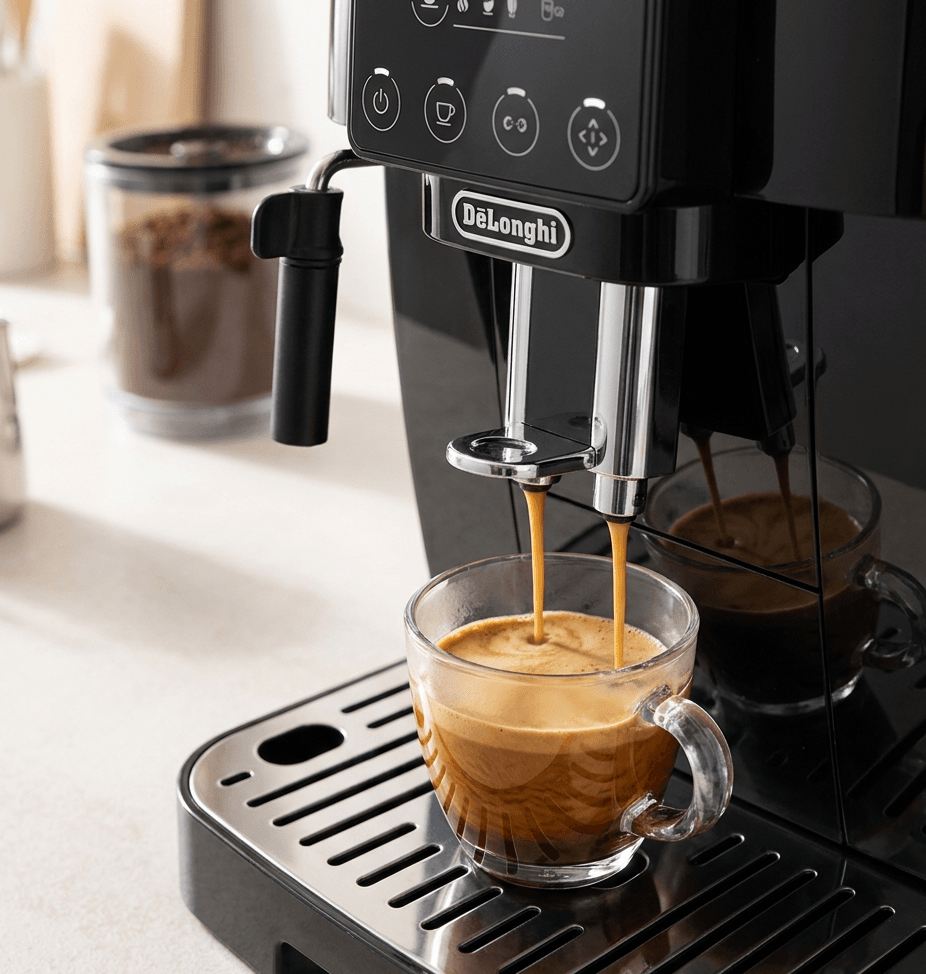
Roast selection matters more here than on prosumer machines.
For straight espresso (medium-dark, crema-friendly):
- Lavazza Oro — what I drink most days. Reliable, balanced, forgiving.
- Lavazza Super Crema — Italian blend, slightly darker
- Kicking Horse Cliff Hanger Espresso — more complexity, still forgiving on this machine
- Peet’s Major Dickason’s Blend — darker, big body if you like that
For milk drinks (cuts through milk):
- Illy Classico — clean, chocolate-forward
- Lavazza Qualità Rossa — budget pick, holds up in milk
Avoid:
- Single-origin Ethiopian or Kenyan light roasts — the machine can’t extract them properly
- Anything labeled “Nordic” or “filter roast”
- Oily dark roasts (Starbucks French, very dark Peet’s) — they clog the grinder
Current pricing (2026)
Pricing on the Magnifica Start moves around a lot. De’Longhi lists a suggested price north of $600, but the ECAM22022SB I’m reviewing here usually lands in the $450–$650 range depending on sales and finish — the silver-black sits toward the top, the plain black dips lower on promotion.
For context, the newer auto-frother version (the .80, with the LatteCrema system) runs higher, closer to $650–$800. Worth knowing if you’re weighing the jump from manual to one-touch milk.
Prices shift week to week, so instead of quoting a number that’s stale by the time you read this:
→ Check current price on Amazon
Not sure the .22 here is even the right Magnifica Start for you? There are now manual-frother and auto-frother versions in the lineup, and the gap matters more than the spec sheet makes it look. If you’re still weighing the Start against the rest of the range, here’s how the whole Magnifica lineup compares.
Frequently Asked Questions
What’s the difference between ECAM22022B and ECAM22022SB?
The colorway. “B” is all black. “SB” is silver and black. Same machine inside.
What’s the difference between the Magnifica Start and the Start with auto frother (ECAM22080SB)?
The auto-frother variant adds an automatic milk carafe (similar to the Evo’s LatteCrema system) and a few extra recipes — cappuccino, latte macchiato. It’s ~$150 more. If you make milk drinks daily, it’s worth it. If you mostly drink espresso, save the money.
Does the Magnifica Start make good cappuccinos?
It makes adequate cappuccinos with the manual panarello. Dense foam, no microfoam, no latte art. If cappuccino is your main drink, look at the Magnifica Start auto-frother (ECAM22080SB) or the Evo with LatteCrema instead.
How long does the Magnifica Start last?
Most owners report 5–8 years with consistent maintenance. Brew group, milk system, and thermoblock are the components most likely to fail in years 4–6. Keep up with descaling and you’re at the upper end of that range.
Can I use pre-ground coffee?
Yes, via the pre-ground chute. Quality is noticeably lower than fresh-ground because the doser isn’t designed for it. I’d use it for decaf only.
How loud is the grinder?
Loud enough to wake people in adjacent rooms. Comparable to a kitchen appliance you wouldn’t run early in the morning if your bedroom is nearby. Not louder than other super-automatics in this price range — they’re all loud.
How often does it need descaling?
Every 2–3 months for a household pulling 4 shots/day with medium-hard water. The machine calculates based on usage and the water hardness setting you input.
Does the Magnifica Start work with oat milk?
Yes, but with caveats. Barista oat milk versions froth better than standard. The panarello won’t give you silky microfoam regardless of milk type — you’ll get foam, not texture. Pre-warm the pitcher to compensate for oat milk’s lower starting temperature.
Is the Magnifica Start better than the Magnifica S?
Marginally. Same chassis, slightly improved usability, soft-touch panel instead of knobs. Not worth replacing a working Magnifica S, but a better choice if you’re buying new today.
Can I turn off the automatic rinse cycles?
The startup rinse, no — required for temperature stability. The shutdown rinse, yes, via menu. I’d leave it on for hygiene. The 30 seconds you save isn’t worth the buildup.
Is the De’Longhi Magnifica Start still worth buying in 2026?
For what it does — fresh-ground espresso, americano and coffee at one touch, with manual milk frothing — it holds up fine in 2026. The lineup has grown (there are now auto-frother versions), but that hasn’t made the core machine here outdated; it’s the same reliable bean-to-cup setup at a lower price. If you froth milk occasionally and don’t need one-touch lattes, it’s still a sensible buy. If milk drinks are your daily ritual, look at the auto-frother version before you decide.
Final Verdict
The DeLonghi Magnifica Start ECAM22022SB is the right machine for a specific buyer. After two years, my position is unchanged from my first month: if you mostly drink espresso, this is the cheapest sensible bean-to-cup option from a brand that won’t surprise you.
The grinder is too coarse-stepped for light roasts. The thermoblock is too limited for proper temperature control. The panarello is fine for occasional milk drinks but a chore for daily ones. None of that matters if you accept what the machine actually is: a convenience appliance that pulls a consistent, decent espresso shot every morning, for less than the cost of two months of café coffee.
If a friend asked me whether to buy a Magnifica Start at $499, my answer would be: if you want decent bean-to-cup coffee at home without becoming a barista — buy it. Just be ready for the noise and the constant rinse cycles.
That’s the whole review in one sentence. Everything above is footnotes.
Score: 7.6/10
- Build quality: 8/10
- Espresso quality: 7/10
- Milk system: 6/10
- Ease of use: 9/10
- Value: 9/10
- Maintenance burden: 7/10
Buy if: mostly espresso, budget-conscious, daily driver Skip if: daily milk drinks, light-roast curiosity, hobby interest
This review is based on two years of personal ownership of the ECAM22022SB, supplemented by manufacturer specifications and community reports from coffee enthusiast forums. No manufacturer provided compensation or machines for this review. As an Amazon Associate, this site earns from qualifying purchases — this does not affect the assessment.
Last reviewed: May 2026. Next scheduled update: November 2026, or sooner if a successor model launches.