
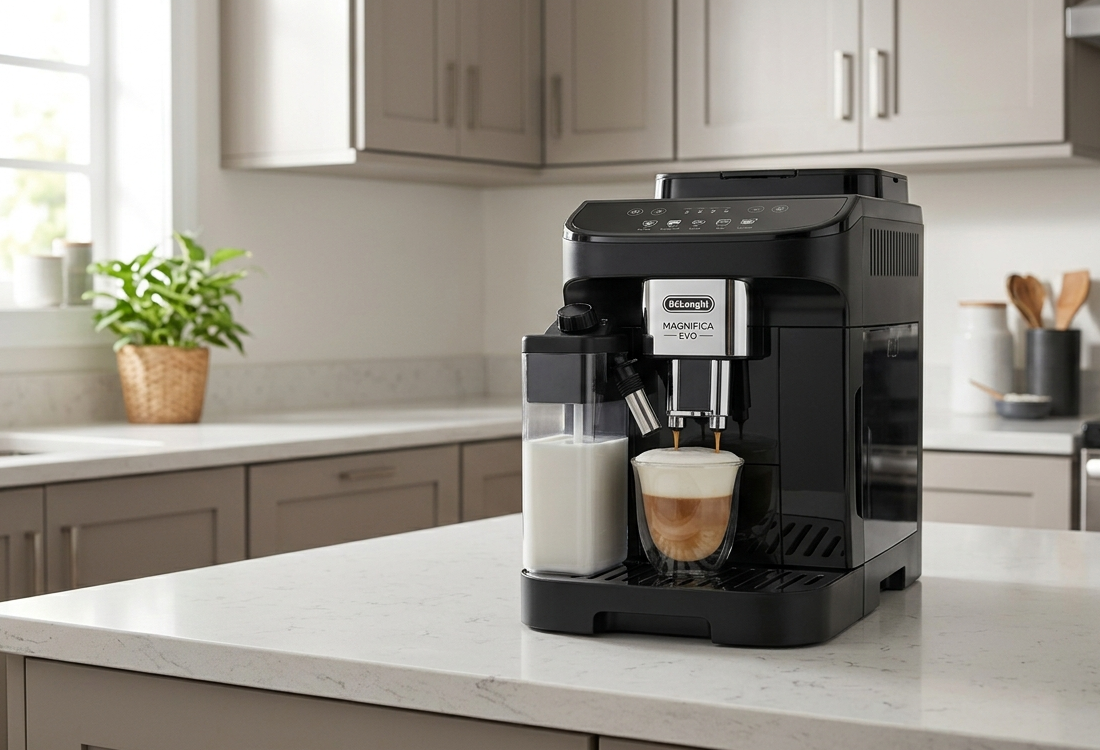
Last updated: May 2026 | Model tested: ECAM29084SB (Silver, with LatteCrema automatic milk system)
TL;DR: The Magnifica Evo ECAM29084SB is the easiest way to get consistent cappuccino and latte at home without learning anything. Strong on convenience, weak on espresso precision. Worth it if you drink mostly milk-based coffee and don’t want a hobby. Skip it if you care about single-origin light roasts or latte art.
Price range: $649–749 (check current price) | Verdict: 7.8/10
Where I’m coming from with this one. My own daily machine is the Magnifica Start, the Evo’s cheaper sibling — same brew group, same grinder, same espresso in the cup. So the extraction and grinder parts of this review are stuff I deal with every single morning. The Evo-specific stuff is different. A close friend has the 84, and I’ve made enough lattes standing in her kitchen to have opinions about the LatteCrema carafe, but I haven’t lived with it. Haven’t cleaned it for the hundredth time on a Tuesday night, haven’t watched it age. For the long-term picture I leaned on owner threads (r/espresso, r/superautomatic, Coffee Forums) and a few hundred Amazon reviews, and I’ll quote the specific ones where it matters.
One thing I’m not going to do is pretend this machine is more than it is. It’s a mid-range super-automatic. It makes good coffee very easily. It does not pull barista-level espresso, and anyone telling you otherwise is selling you something.
(If you don’t know the category at all, I have a separate explainer on super automatic espresso machines — the Evo sits in the middle of it.)
Quick Specifications
| Specification | ECAM29084SB |
|---|---|
| Pump pressure | 15 bar (vibration pump) |
| Brew pressure (actual) | ~9 bar at group head |
| Heating system | Thermoblock (single) |
| Grinder | Steel conical burr, 13 settings |
| Bean hopper | 250 g |
| Water tank | 1.8 L (removable) |
| Milk system | LatteCrema automatic carafe (detachable) |
| Drinks menu | 7 pre-programmed (espresso, coffee, Americano, long, cappuccino, latte macchiato, hot water) |
| Iced coffee function | Yes |
| Auto-rinse | Yes (startup + shutdown) |
| Auto-clean milk system | Yes (Clean button) |
| Dimensions | 9.3″ W × 14.1″ D × 14.2″ H |
| Weight | 20.1 lbs |
| Warranty | 2 years (US), 1 year (international) |
| Power | 1450 W, 120V |
Who this machine is for
Short version: people who drink two or more milk drinks a day and want them to just appear. Push a button, get a cappuccino, no learning curve, no portafilter to clean, no shot to time. If you’re coming from pods or drip, it’s going to feel like magic for the first month.
Who should not buy it: anyone who reads about light roasts and single origins with actual interest. Anyone who wants latte art. And honestly, anyone who’s even a little curious about espresso as a craft — for the same $700 you can get a Gaggia Classic Pro and a real grinder, and that setup will make better espresso and keep getting better as you do. The Evo will make the same cup on day one and day one thousand. That’s its whole promise. For some people that’s the dream and for some people it’s a dead end, and you probably already know which one you are.
Also, the milk system needs weekly cleaning. Not negotiable. If you know yourself well enough to know you won’t do it, skip ahead to the failure patterns section and then buy something with a manual wand.
Still not sure you want a super-automatic at all versus a semi-auto with a separate grinder? That’s a different decision and I wrote it up separately: super-auto vs semi-auto.
Decoding the model number
De’Longhi’s naming drives me a little crazy. ECAM means Espresso Coffee Automatic Machine, 290 is the Evo chassis, 84 is the feature tier, SB is just silver/black. The tier is the part that matters:
| Model | Milk system | Iced coffee | Typical price |
|---|---|---|---|
| ECAM29021B | Manual steam wand | No | $499–599 |
| ECAM29043SB | Manual panarello | No | $549–649 |
| ECAM29064B | LatteCrema carafe | No | $599–699 |
| ECAM29084SB | LatteCrema + auto-clean | Yes | $649–749 |
Don’t need automatic milk? Save the $150, get the 29021. Want milk drinks? Get the 84 and not the 64 — auto-clean on the milk system is worth the difference by itself. I genuinely don’t know who the 64 is for.grade over the 64. I wouldn’t bother with the 64 unless it’s significantly discounted.
The espresso, honestly
This is where new owners get disappointed, so let me set it straight.
The machine pre-infuses for a second or two and extracts at about 9 bar at the group head. The “15 bar” on the box is maximum pump pressure, a number that means nothing for your cup — even retailers repeat it wrong. Shot volume is programmable from 20 to 180 ml.
What lands in the cup: medium-thick crema that fades faster than from a real espresso machine. Chocolate, nut and caramel notes from medium and medium-dark roasts come through fine. Fruit and acidity from lighter roasts mostly don’t survive the trip. The first shot of the day runs cooler than the rest, which is thermoblock life, and you stop noticing after a while.
The thing it does better than you: consistency. Shot-to-shot variance is tiny. I’ve pulled the same shot from the same brew group for two years on my Start and it tastes the same every morning, which sounds boring until you’ve fought a manual machine at 6:45am.
About light roasts — they don’t work here, and it’s not one fixable thing, it’s three stacked: the 13 grind steps are too coarse-grained for the adjustments light roasts need (you want a setting between 3 and 4, it doesn’t exist), the thermoblock runs cooler at the puck than light roasts want, and there’s no pressure profiling at all. If you’ve been buying single-origin Ethiopian, save it for a different machine. Lavazza Super Crema, Illy Classico, any Italian-style blend will be happy here.
One setting change you should make on day one, before anything else: shorten the drink volumes. Factory defaults are too long, every single one. Espresso down from 40 ml to 30, “coffee” from 180 to 90, long coffee at 120 max. Hold the drink button three seconds to reprogram. This one change does more for taste than any bean upgrade. I don’t know why De’Longhi ships them so diluted. Probably tested on people who wanted bigger cups.
The LatteCrema milk system
The whole reason to buy the 84. Mechanically it’s simple: the carafe pulls milk through a tube, steam-mixes it in a chamber, dispenses foam straight into the cup. A dial on the lid sets density — Cappuccino, Latte, Flat, or just hot milk.
From the lattes I’ve made at my friend’s place: the foam is the same every time, it’s fast (under two minutes from cold start), and the carafe living in the fridge between uses is more convenient than it sounds, because there’s no pitcher to fill and rinse. The foam itself is bubbly rather than silky. If you’re picturing café microfoam with a rosetta on top, no. Not this machine, not at any setting.
On alternative milks I’ll be honest about my limits: I’ve seen barista oat go through it exactly once (worked, foam died fast) and that’s my entire firsthand experience. Owner consensus says soy froths best of the plant milks and regular oat makes thin, collapsing foam. Take that part as relayed, not tested.
One real limitation: minimum milk volume for proper frothing is around 80 ml, so a small macchiato means wasted milk.
The cleaning part nobody wants to hear
Auto-clean rinses the circuit after each use. It is not enough. You still have to take the carafe apart and wash it properly every week, minimum, and this is the hill half the angry forum posts die on. Skip a few days, sour smell. Skip a week, biofilm in the mixing chamber. Keep going and you’re in mold territory — not a scare story, it shows up in owner reports over and over.
Real cost: three or four minutes of disassembly and rinsing, once or twice a week. My friend does it Sunday nights while the kettle’s on. If even that sounds like too much, get a manual wand machine — you’ll keep it cleaner precisely because the dirt is visible.
Grinder and dialing in
The built-in grinder catches the most criticism of any component, most of it unfair. People compare it to standalone grinders. It isn’t one and was never going to be.
| Roast type | Recommended setting | Notes |
|---|---|---|
| Dark Italian blend | 4–5 | Prevents bitterness |
| Medium-dark (most blends) | 3–4 | Sweet spot for this machine |
| Medium (standard espresso) | 3 | Default, works fine |
| Light/medium-light | 2 (borderline) | Risk of choking the group |
| Light roast (Scandinavian style) | Don’t bother | See above |
I’ve sat on 3 with a medium roast for two years and touched it maybe twice.
The manual says “grind to taste,” which is useless if you’ve never dialed in before, so here’s the actual mechanic. Pull 30 ml, time it. Under 20 seconds: too coarse, one step finer. Over 35: too fine, one step coarser. You want 25–30 seconds at the “2 cup” strength.
The one warning that matters: never turn the grind dial while the burrs are still. They can jam. Change settings only while the grinder is actually running beans. It’s buried in the manual and it is the number one cause of “my grinder broke after a month” posts. Burr wear, on the other hand, is not your problem — steel burrs in home use outlast the rest of the machine.
What it costs to live with
Roughly $100–150 a year in consumables: EcoDecalk descaler every 2–3 months, milk cleaning tablets monthly, carafe seals once a year, water filter every two months if you bother with one. Don’t stockpile a year’s worth up front — wait a few months and see your real burn rate first.
The water filter question comes up a lot and the answer is boring: if your tap water is genuinely hard (300+ ppm TDS — much of the US Southwest, the UK), use it. Soft water, skip it, descale on schedule, save the money.
Years 3–5, expect one real repair, usually brew group seals or a milk carafe dying of plastic fatigue. Call it $50–150 unscheduled. The nightmare scenario is thermoblock failure, where fixing it costs almost as much as a new machine. It’s uncommon. There’s nothing you can do to prevent it. I’ve made my peace with that and you’ll have to as well.
Against café coffee the machine wins so fast it’s barely worth computing — a daily $5 cappuccino is over $1,800 a year, so the Evo pays for itself somewhere around month five.
Known issues, from actual owner reports
In rough order of how often they come up:
1. “Insert water tank” with a full tank. Stuck magnetic float. Pull the tank, shake it, put it back. Happens to every owner once, then never gets googled again.
2. Brew group sticking around year two. Coffee oils on the rails. Prevented entirely by a monthly rinse of the brew group under warm water. No soap.
3. Milk foam getting weaker over months. Residue narrowing the steam inlet. One owner on r/superautomatic:
“Now when we turn on the machine, it won’t let us use the milk frother at all. The light for the frother keeps flashing even after we’ve washed hot water through it over and over…” — [Source: r/superautomatic thread]
Monthly deep clean with Puly Milk or Urnex Rinza fixes and prevents this. The Clean button alone won’t.
4. “General alarm” error. Usually power fluctuation or a misaligned brew group, occasionally straight out of the box:
“I have a brand new Delonghi Magnifica EVO and haven’t been able to brew coffee because the general alarm button is on (steady, not flashing) and I can’t reset it to factory settings.” — [Source: forum thread]
Unplug 30 seconds, reseat the brew group, restart. Still on? Warranty case. Stop playing technician.
5. Thermoblock failure. The expensive one from the cost section. Rare, random, unpreventable.
For what it’s worth, none of this makes the Evo a lemon. The same lists exist for the Philips 3200 and Jura E-series. Machines in this bracket fail in these ways; the difference is whether you panic-return yours over a stuck float.
Against the competition
Tables flatten everything, so read this one as a rough map, not gospel.
| Feature | DeLonghi ECAM29084SB | Philips 3200 LatteGo | Breville Barista Touch | Gaggia Classic Pro |
|---|---|---|---|---|
| Type | Super-automatic | Super-automatic | Semi-automatic | Semi-automatic |
| Price | $649–749 | $699–799 | $999–1,199 | $449 + $300 grinder |
| Espresso quality | Good | Good | Very good | Very good (with skill) |
| Milk system | LatteCrema auto | LatteGo auto | Automatic steam wand | Manual steam wand |
| Latte art capable | No | No | Yes | Yes |
| Learning curve | Zero | Zero | Moderate | Steep |
| Light roast capable | No | No | Yes | Yes |
| Cleaning effort | Medium | Low (easiest) | Medium | Low |
| Best for | Cappuccino/latte daily drivers | Same, easier cleanup | Prosumer home baristas | Espresso hobbyists |
The Philips 3200 LatteGo deserves a straight sentence: its milk system cleans in 15 seconds, full stop, and that’s the one reason I’d ever send someone away from the DeLonghi. The DeLonghi extracts slightly better. Pick your priority.
The Breville Barista Touch costs more and gives more, but only if you put in the time. And the Gaggia route is for people who want a hobby, which I’ve already said enough about.
But the alternative most Evo shoppers actually need to consider isn’t in the table at all. It’s the Magnifica Start — the machine on my own counter, $150 cheaper, with the identical brew group and grinder. The Evo’s entire premium goes to the LatteCrema carafe, the nicer screen and three extra presets. I broke down exactly where that $150 goes in a separate comparison, and if you’re not sure you need automatic milk, read that before this.
Beans that work here
Quick version, since roast matters more than usual on this machine. For straight espresso: Lavazza Super Crema as the safe baseline, Kicking Horse Cliff Hanger if you want more going on, Peet’s Major Dickason’s for big dark body. For drinks that have to cut through milk: Illy Classico, Lavazza Qualità Rossa on a budget, Stumptown Hair Bender at the top end.
Avoid anything labeled Nordic or filter roast, any single-origin Ethiopian or Kenyan, and oily dark roasts like Starbucks French — those last ones gum up the grinder and the savings will not feel worth it.
Accessories actually worth having
EcoDecalk descaler (third-party descalers void the warranty during descaling cycles, so this one’s not optional), Puly Milk Plus for the weekly milk deep clean, the DLSC002 water filter only if your water is hard, and a knock box, because the internal grounds bin fills faster than you’d think. If you want to get ahead of year two, the plastic brew group bellows is the part that wears first.
And buy a second carafe lid. The seal takes two weeks to ship when it dies. Ask me how I know this is worth pre-ordering.
First-week setup
- Reprogram the drink volumes (see the espresso section — do this first).
- Set grind to 3 and leave it alone for a week. Let the machine settle before you start chasing adjustments.
- Run two full water tanks through before your first real coffee.
- Run a descaling cycle even though no light is on, to flush factory water.
- Take the LatteCrema carafe apart once just to see how it goes together. Better now than mid-crisis.
Frequently Asked Questions
Does the ECAM29084SB work with oat milk?
Yes, with worse foam than dairy. Barista oat milks (Oatly Barista, Minor Figures) hold up best; regular oat goes thin and collapses fast. See my caveat above — this is mostly owner consensus, not my testing.
What’s the difference between ECAM29084SB and ECAM29084SB+?
Nothing. Some retailers add the “+” informally. Same machine.
Can I use pre-ground coffee?
Through the bypass chute, yes, but the doser isn’t really built for it and the cup shows it. Evening decaf duty only.
How loud is the grinder?
Loud. Not “run it at 6am next to a bedroom” loud, but close.
How often does it need descaling?
The machine decides for you, based on usage and your hardness setting — roughly every 2–3 months at four shots a day on medium-hard water. (If you want the full ritual, I wrote a whole descaling guide for the Magnifica.)
Is the iced coffee function worth it?
Stronger, cooler shot that survives ice without going watery. Nice in summer, not a reason to buy.
Will it last 10 years?
Honestly? Probably, for some of you. Plan on one significant service somewhere in years 4–6 — brew group, milk system, or the dreaded thermoblock — and 8–10 years is realistic after that. But realistic for the owners who descale on schedule and clean the milk system weekly. The ones who don’t are the year-three one-star reviews.
Is there a Wi-Fi/app-connected version?
Not in the Evo line. You’d have to jump to the Eletta Explore or Rivelia, and no, the app isn’t worth $400. You’d open it twice and forget it exists.
Final Verdict
The ECAM29084SB is the right machine for a specific person: someone who wants reliable milk drinks every day, values their time over extraction theory, and accepts ten minutes a week of cleaning as the price of automation. For that person it’s an easy recommendation and the 7.8 below probably underrates how happy they’ll be.
For everyone else, the grinder is too coarse-stepped, the thermoblock too limited, and the milk system too rigid to grow with you. At $700 the honest competitor is a Gaggia Classic Pro with a Baratza Encore ESP — same money, meaningfully better espresso, if you’re willing to learn.
It’s a convenience appliance that makes consistently decent milk drinks. Buy it for exactly that, or don’t buy it.
Score: 7.8/10
- Build quality: 8/10
- Espresso quality: 7/10
- Milk system: 8/10
- Ease of use: 10/10
- Value: 7/10
- Maintenance burden: 6/10
Buy if: milk drinks, convenience, daily driver. Skip if: espresso precision, light roasts, hobby interest.hobby interest
This review is based on manufacturer specifications, owner feedback patterns from Amazon reviews, and community reports from coffee enthusiast forums. No manufacturer provided compensation or machines for this review. As an Amazon Associate, this site earns from qualifying purchases — this does not affect the assessment.
Last reviewed: April 2026. Next scheduled update: October 2026, or sooner if a successor model launches.